India Chairs the Kimberley Process: Plenary in New Delhi
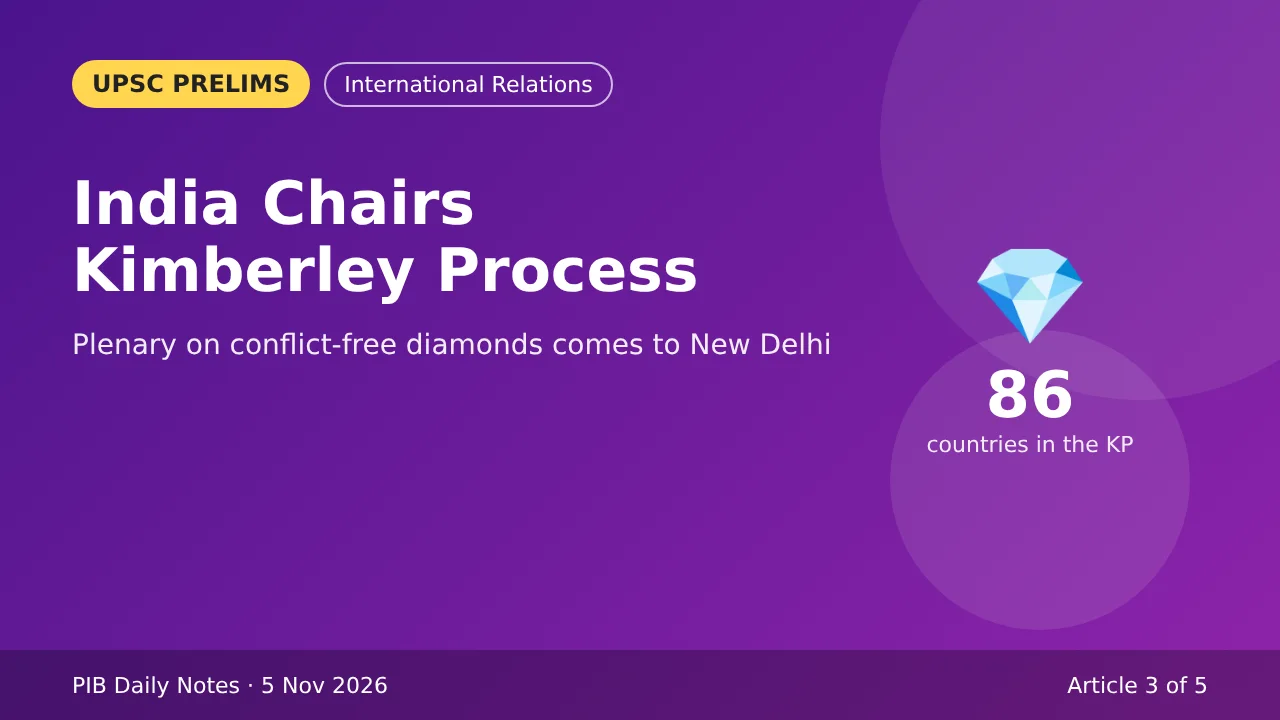
As Chair of the Kimberley Process (KP) for 2026, India held a stakeholder consultation in Luanda, Angola, on 3 November 2026
DDecode Civils
· 3 min read
India Chairs the Kimberley Process: Plenary in New Delhi
Why in News
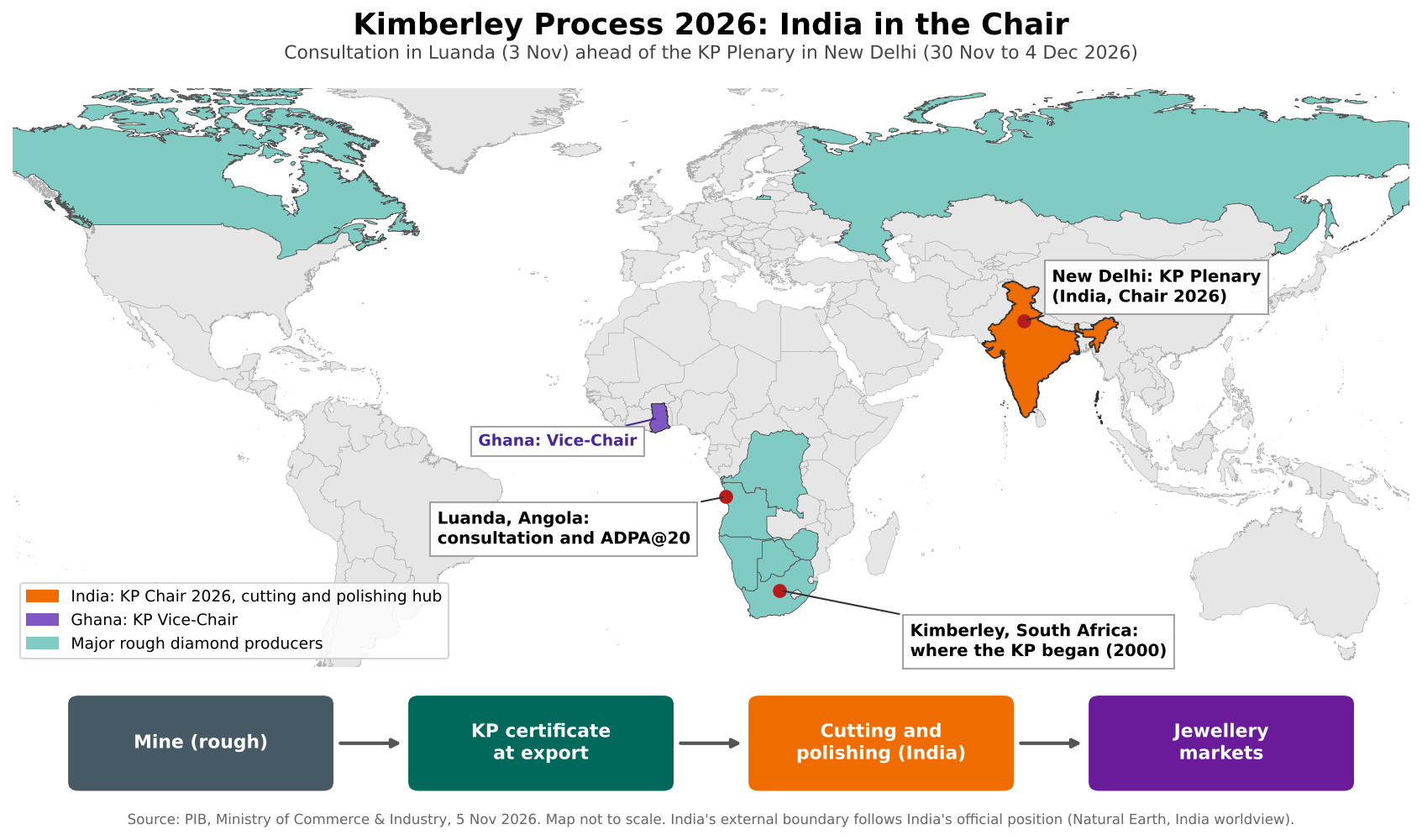
As Chair of the Kimberley Process (KP) for 2026, India held a stakeholder consultation in Luanda, Angola, on 3 November 2026. It was part of India's outreach before the KP Plenary in New Delhi (30 November to 4 December 2026). India also took part in the 20th anniversary of the African Diamond Producers' Association (ADPA@20).
News Summary
The consultation, led by KP Chair and Additional Secretary, Department of Commerce, Yashvir Singh, covered responsible rough diamond sourcing, compliance, institutional governance and consumer confidence.
India's Chairship theme is the 3Cs: Confidence, Compliance and Credibility.
Talks also covered reform of the "conflict diamond" definition, artisanal and alluvial mining, and digital certification.
The ADPA Council of Ministers approved an MoU between India's Gem & Jewellery Export Promotion Council (GJEPC) and ADPA on skills in sorting, valuation and manufacturing.
Botswana was admitted as an ADPA Observer on 4 November 2026.
The Plenary at Bharat Mandapam will be preceded by the New Delhi Diamond Dialogue (KP Forum) on 29 November. India chaired the KP earlier in 2008 and 2019.
Prelims Facts & Static Linkages
The Kimberley Process Certification Scheme
Origin: a meeting of diamond-producing states in Kimberley, South Africa, in 2000. It was backed by UN General Assembly Resolution 55/56 (2000), and the certification scheme began in 2003.
Aim: keep conflict diamonds (rough diamonds used by rebel groups to fund wars against legitimate governments) out of legal trade.
Tripartite: governments, the diamond industry (World Diamond Council) and civil society.
Members:60 Participants representing 86 countries; the EU and its member states count as one.
Rule: every shipment of rough diamonds must carry a KP certificate, and members trade rough diamonds only with other members.
Chair: rotates every year. India took over on 1 January 2026, with Ghana as Vice-Chair.
African Diamond Producers' Association (ADPA)
Feature
Detail
Founded
4 November 2006, Luanda, Angola
Members
15 member countries and 8 Observers
Non-African Observers
Russia and India
Share
Over 60% of world diamond output
Current chair
Sierra Leone
India and diamonds
India is the world's largest centre for cutting and polishing diamonds, centred on Surat and Mumbai.
India's only working diamond mine is at Majhgawan, Panna (Madhya Pradesh), run by NMDC.
The famous Golconda diamonds, such as the Koh-i-Noor, came from the Krishna valley mines.
Lab-grown diamonds are made by CVD (chemical vapour deposition) or HPHT (high pressure, high temperature) and are chemically identical to natural ones.
Diamond is an allotrope of carbon and the hardest natural substance.
Likely Prelims angles
The Kimberley Process covers only rough diamonds, not polished stones or jewellery.
It is a certification scheme, not a treaty body or UN agency.
Matching countries with their key minerals, such as Botswana (diamonds), DR Congo (cobalt) and Chile (lithium and copper).
Quick Revision
India chairs the Kimberley Process in 2026, its third time after 2008 and 2019.
The KP Plenary is at Bharat Mandapam, New Delhi, from 30 November to 4 December 2026.
The KP stems from UNGA Resolution 55/56 (2000).
It has 60 Participants representing 86 countries.
India's theme is Confidence, Compliance and Credibility.
ADPA was set up in Luanda in 2006; India is an Observer.
Practice MCQ
Q. With reference to the Kimberley Process, consider the following statements:
1. It certifies both rough and polished diamonds.
2. It has a tripartite structure of governments, industry and civil society.
3. The European Union participates as a single entity.
Which of the statements given above is/are correct?
(a) 1 and 2 only
(b) 2 and 3 only
(c) 1 and 3 only
(d) 1, 2 and 3
Answer: (b). The KP certifies only rough diamonds.
Related PYQs
PYQ 1 (UPSC CSE Prelims 2025)
Consider the following pairs:
Country
Resource-rich in
I. Botswana
Diamond
II. Chile
Lithium
III. Indonesia
Nickel
In how many of the above rows is the given information correctly matched?



 28
Nov 2026
 28
Nov 2026
 28
Nov 2026














0 comments
Discussion
No comments yet. Be the first.