India Concludes Negotiations to Join Horizon Europe
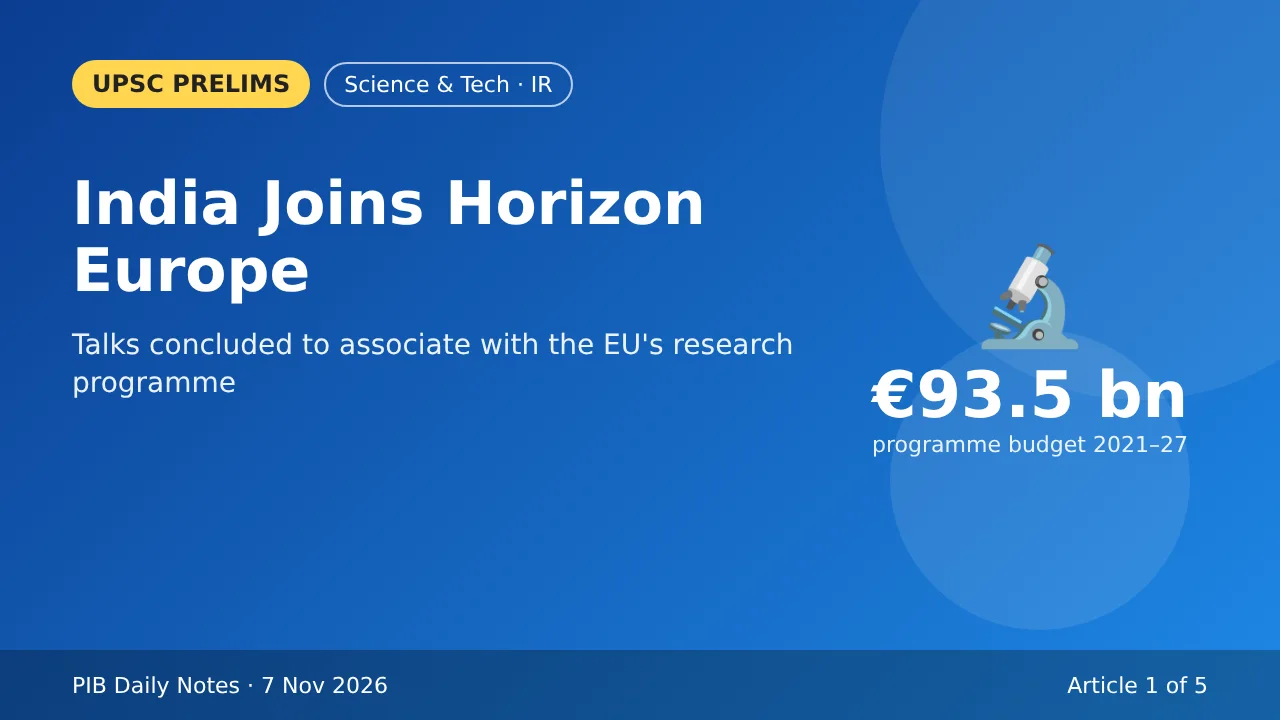
India and the European Union (EU) have concluded negotiations for India's association with Horizon Europe, the EU's flagship research and innovation programme
DDecode Civils
· 3 min read
India Concludes Negotiations to Join Horizon Europe
Why in News
India and the European Union (EU) have concluded negotiations for India's association with Horizon Europe, the EU's flagship research and innovation programme, the Ministry of Science and Technology announced on 7 November 2026. Association will let Indian researchers, institutions and industry bid for Horizon Europe funding on terms close to those of EU members.
News Summary
Association moves India–EU research cooperation to a long-term institutional framework.
Indian participants will be able to join collaborative research projects, enter European consortia and use cutting-edge research infrastructure.
It is expected to boost talent mobility and the co-development of critical technologies and standards.
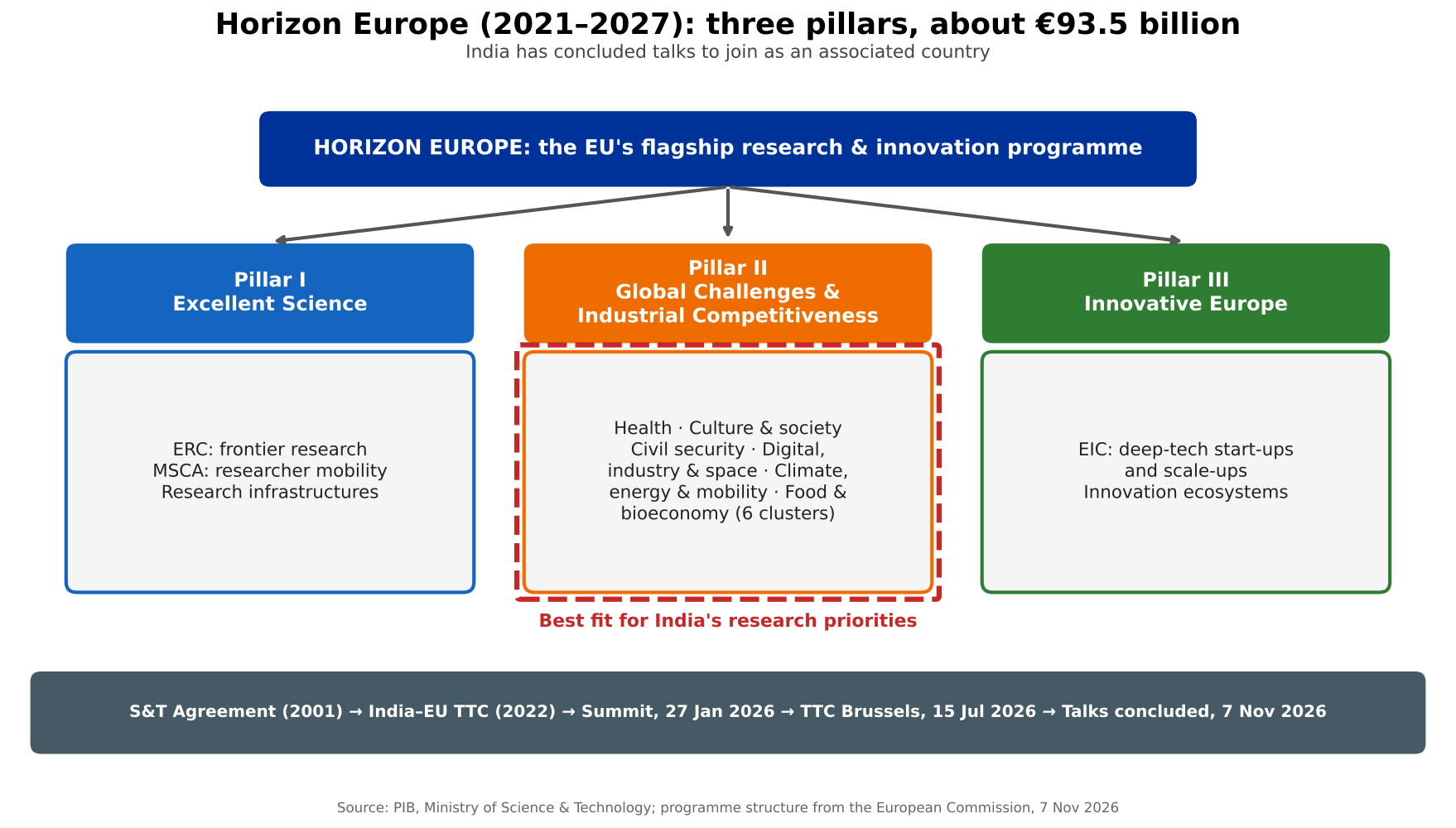
The thematic clusters of Pillar II (health, digital, industry and space, climate, energy and mobility, food and bioeconomy) match India's research priorities.
Timeline: exploration began after the India–EU Summit of 27 January 2026. Formal talks started after the Trade and Technology Council (TTC) ministerial meeting in Brussels on 15 July 2026.
Prelims Facts & Static Linkages
Horizon Europe at a glance
Period: 2021–2027, the ninth EU framework programme for research and innovation. It succeeded Horizon 2020 (2014–2020).
Budget: about €93.5 billion.
Pillar I, Excellent Science: the European Research Council (ERC) for frontier research and Marie Skłodowska-Curie Actions (MSCA) for researcher mobility.
Pillar II, Global Challenges and European Industrial Competitiveness: six thematic clusters for collaborative, mission-oriented research. This is where Indian teams gain most.
Pillar III, Innovative Europe: the European Innovation Council (EIC) for deep-tech start-ups and scale-ups.
Associated countries pay into the budget and take part almost like members. Non-European associates include Canada, New Zealand and the Republic of Korea.
India–EU technology architecture
Framework
Year
Purpose
India–EU S&T Cooperation Agreement
Signed 2001
Base treaty for joint research; renewed periodically
India–EU Strategic Partnership
2004
Political umbrella for cooperation
Trade and Technology Council (TTC)
Launched 2022
Digital, clean-tech and supply-chain coordination; the EU's second TTC after the one with the USA
Horizon Europe association
Talks concluded 2026
Access to EU research funding as an associate
The European Union: static facts
The EU has 27 member States. Croatia (2013) was the last to join, and the United Kingdom left in 2020.
Belarus and Switzerland are not EU members. Switzerland is linked through bilateral treaties.
The euro is used by 21 members after Bulgaria adopted it on 1 January 2026.
The EU enacted the Nature Restoration Law (2024), a binding target to restore degraded ecosystems.
Why association matters for India
Funding access: Indian teams can lead or join large, multi-country projects instead of small bilateral calls.
Standards: co-developing standards in areas such as AI, semiconductors and clean energy gives India a voice in rule-making.
Viksit Bharat 2047: complements the Anusandhan National Research Foundation (ANRF) and the ₹1 lakh crore RDI Scheme.
Quick Revision
India has concluded negotiations to associate with Horizon Europe.
Horizon Europe runs from 2021 to 2027 with about €93.5 billion.
It has three pillars: Excellent Science, Global Challenges and Industrial Competitiveness, and Innovative Europe.
The ERC and MSCA sit in Pillar I; the EIC in Pillar III.
Talks began after the India–EU TTC meeting in Brussels in July 2026.
The EU has 27 members; Switzerland and Belarus are not among them.
Practice MCQ
Q. With reference to Horizon Europe, consider the following statements:
1. It is the European Union's research and innovation programme for the period 2021–2027.
2. Only member States of the European Union can participate in it.
3. The European Research Council is part of its "Excellent Science" pillar.
Which of the statements given above is/are correct?
(a) 1 only
(b) 1 and 3 only
(c) 2 and 3 only
(d) 1, 2 and 3
Answer: (b). Non-EU countries can join as associated countries, as India is now set to do.
Related PYQs
PYQ 1 (UPSC CSE Prelims 2026)
Which of the following countries are members of the European Union?
1. Belarus
2. Poland
3. Germany
4. Switzerland
Select the answer using the code given below:
(a) 1, 2 and 4
(b) 1 and 4 only
(c) 2 and 3
(d) 2 and 4 only
Answer: (c).
PYQ 2 (UPSC CSE Prelims 2025)
Which organization has enacted the Nature Restoration Law (NRL) to tackle climate change and biodiversity loss?
(a) The European Union
(b) The World Bank
(c) The Organization for Economic Cooperation and Development



 28
Nov 2026
 28
Nov 2026
 28
Nov 2026














0 comments
Discussion
No comments yet. Be the first.