IndiaAI Mission Releases EKA-1 and Dhīr Foundation Models
The IndiaAI Mission of the Ministry of Electronics and Information Technology (MeitY) released two sets of indigenous foundation models
DDecode Civils
· 4 min read
IndiaAI Mission Releases EKA-1 and Dhīr Foundation Models
Why in News
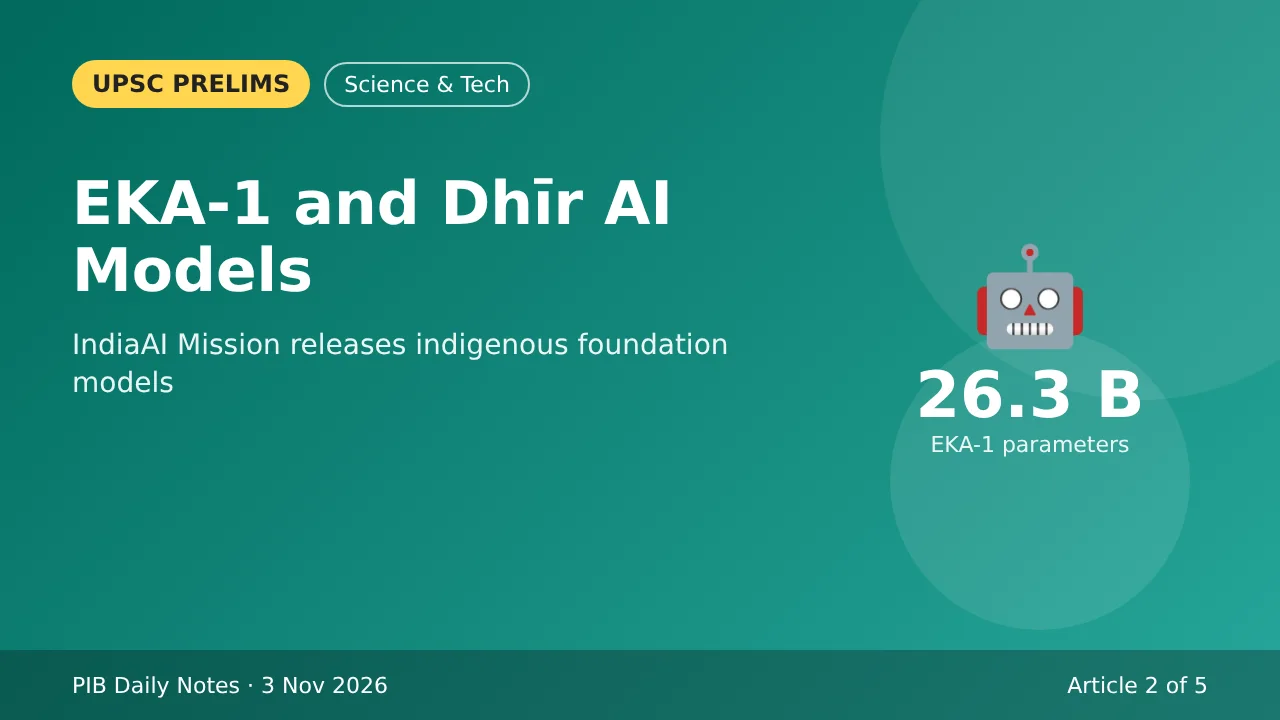
The IndiaAI Mission of the Ministry of Electronics and Information Technology (MeitY) released two sets of indigenous foundation models on 3 November 2026 in New Delhi: EKA-1 by Soket Labs and Dhīr 2B and Dhīr 5B by ZenteiQ AiTech Innovations. Both teams were selected under the mission's IndiaAI Innovation Centre (Foundation Models) pillar.
News Summary
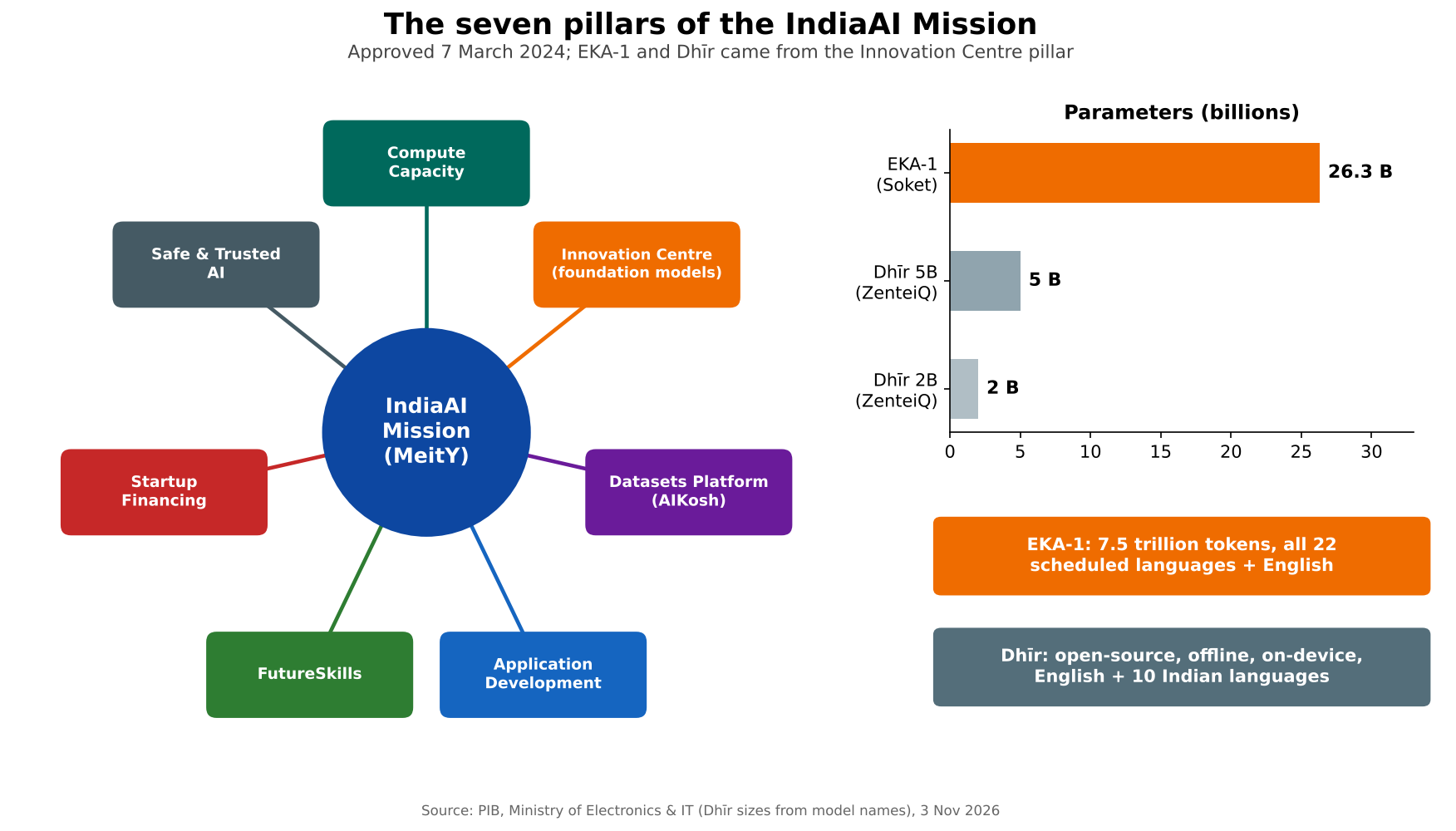
EKA-1 has 26.3 billion parameters and was trained on about 7.5 trillion tokens.
It covers all 22 scheduled Indian languages and English. It is an open, sparse hybrid model built for maths, code, reasoning and agentic use, with a focus on banking, financial services and cybersecurity.
Dhīr 2B and Dhīr 5B are open-source models that support English and 10 Indian languages.
They can run on-premise and offline, even on mobile phones, so data stays on the device. They suit defence, government, industry and education, especially in low-connectivity or sensitive settings.
Both teams used subsidised national AI compute and mission support for research costs.
The models can be shared through AIKosh, the mission's datasets platform.
Prelims Facts & Static Linkages
The seven pillars of the IndiaAI Mission
IndiaAI Compute Capacity: shared GPU infrastructure at subsidised rates.
IndiaAI Innovation Centre: home-grown foundation models and LLMs.
IndiaAI Datasets Platform (AIKosh): access to quality non-personal datasets.
IndiaAI Application Development Initiative: AI solutions for public problems.
IndiaAI FutureSkills: AI courses and data labs, including in smaller cities.
IndiaAI Startup Financing: funding for deep-tech AI startups.
Safe & Trusted AI: tools and frameworks for responsible AI.
Mission basics
Feature
Detail
Approved
7 March 2024, Union Cabinet
Outlay
About ₹10,372 crore over five years
Ministry
MeitY
Implementer
IndiaAI Independent Business Division, under the Digital India Corporation
Vision
"Making AI in India and Making AI Work for India"
Key terms
Foundation model: a large model trained on broad data that can be adapted to many tasks.
Parameters: the internal weights a model learns. More parameters usually mean more capacity.
Tokens: small units of text, such as words or parts of words, used in training.
Sparse model: only part of the network is active for each input, which saves computing power.
Open-source or open-weight: the model can be downloaded, studied and adapted by others.
On-premise: the model runs on the user's own hardware, not on a remote cloud.
Linked initiatives
Bhashini: the National Language Translation Mission for Indian-language AI tools.
Eighth Schedule: lists the 22 scheduled languages. The 92nd Amendment (2003) raised the count from 18 to 22.
Digital Personal Data Protection Act, 2023: shapes how training data with personal details is handled.
Likely Prelims angles
The pillars of the IndiaAI Mission and the role of AIKosh.
The meaning of parameters, tokens and sparse models.
Why offline, on-device AI matters for privacy and security.
Quick Revision
EKA-1 (Soket Labs): 26.3 billion parameters, 7.5 trillion tokens, 22 scheduled languages and English.
Dhīr 2B and 5B (ZenteiQ): open-source, offline-capable, English and 10 Indian languages.
Both came from the IndiaAI Innovation Centre pillar.
The IndiaAI Mission was approved on 7 March 2024 and has seven pillars.
AIKosh is the mission's datasets platform.
Practice MCQ
Q. With reference to the IndiaAI Mission, consider the following statements:
1. It is implemented under the Ministry of Electronics and Information Technology.
2. AIKosh is its platform for datasets.
3. Models built under it must run only on cloud servers owned by the Government.
Which of the statements given above is/are correct?
(a) 1 only
(b) 1 and 2 only
(c) 2 and 3 only
(d) 1, 2 and 3
Answer: (b). Dhīr models, for example, can run on-premise and on mobile phones.
Related PYQs
PYQ 1 (UPSC CSE Prelims 2026)
Which of the following statements with regard to Large Language Models (LLMs) used in machine learning is/are correct?
1. LLMs assign probabilities to the next possible words and then pick the one with the highest probability.
2. LLMs process data through mathematical optimization to minimise prediction errors.
3. LLMs produce unbiased outputs.
Select the answer using the code given below:
(a) 1 only
(b) 1 and 2 only
(c) 2 and 3 only
(d) 1, 2 and 3
Answer: (b).
PYQ 2 (UPSC CSE Prelims 2020)
With the present state of development, Artificial Intelligence can effectively do which of the following?
1. Bring down electricity consumption in industrial units
2. Create meaningful short stories and songs
3. Disease diagnosis
4. Text-to-Speech Conversion
5. Wireless transmission of electrical energy
Select the correct answer using the code given below:



 28
Nov 2026
 28
Nov 2026
 28
Nov 2026














0 comments
Discussion
No comments yet. Be the first.