India's 18 Biosphere Reserves: Where People and Nature Coexist
Ahead of the International Day for Biosphere Reserves (3 November), PIB released a backgrounder on India's network of 18 notified Biosphere Reserves (BRs)
DDecode Civils
· 4 min read
India's 18 Biosphere Reserves: Where People and Nature Coexist
Why in News
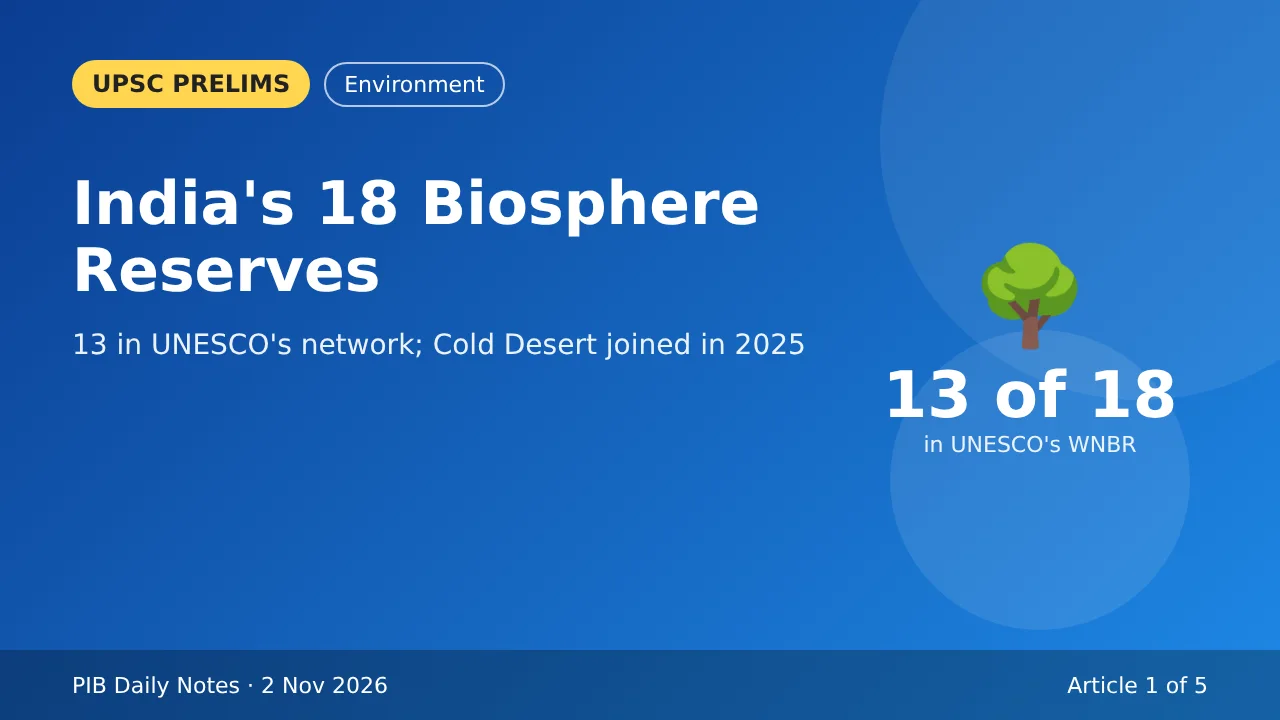
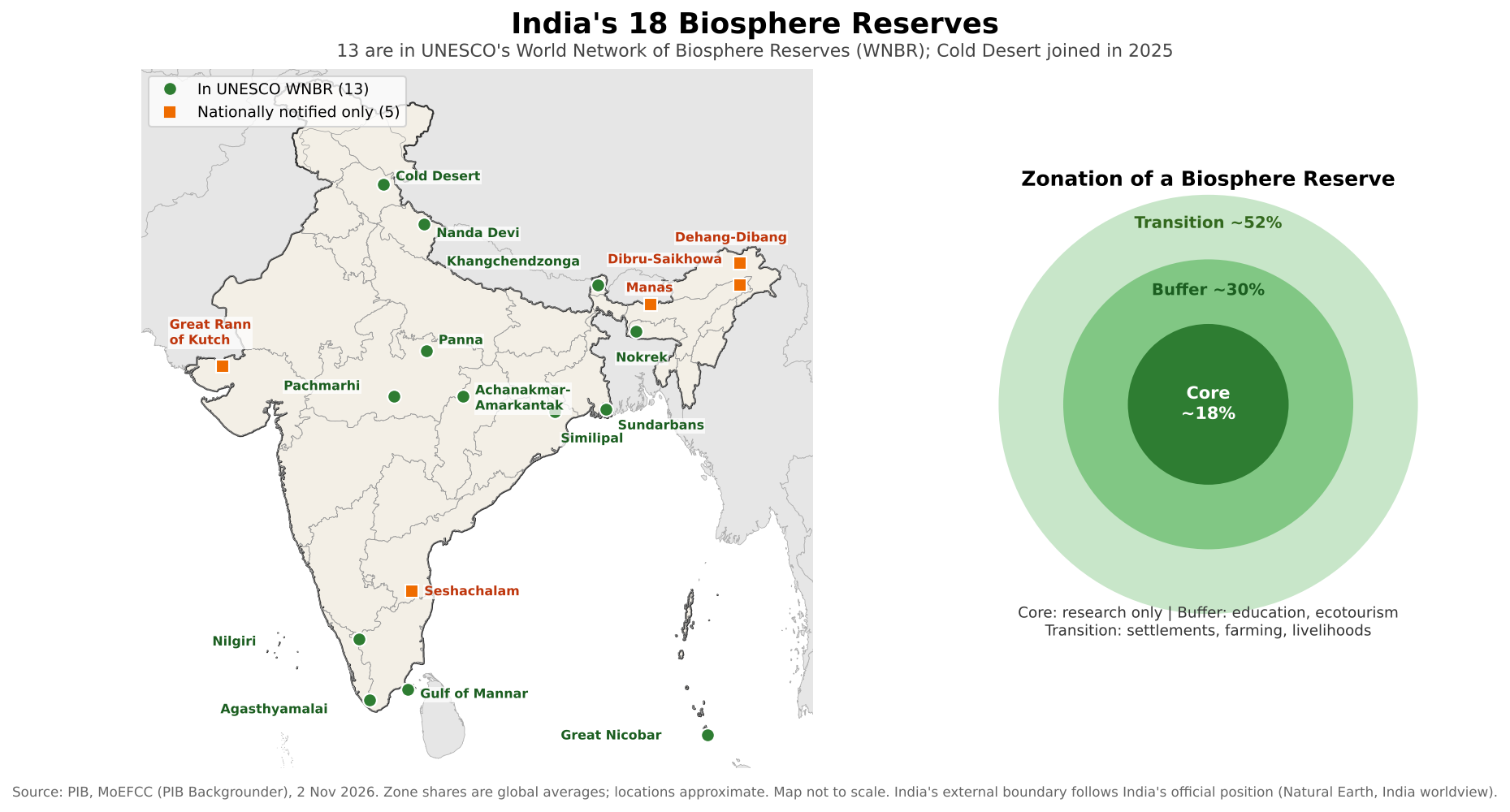
Ahead of the International Day for Biosphere Reserves (3 November), PIB released a backgrounder on India's network of 18 notified Biosphere Reserves (BRs). Of these, 13 are in UNESCO's World Network of Biosphere Reserves (WNBR), the highest number of internationally recognised BRs in South Asia.
News Summary
The day is proclaimed by UNESCO and highlights how BRs reconcile conservation with human well-being.
India is one of the world's 17 mega-diverse countries. It holds about 7–8% of recorded species on only 2.4% of the Earth's land area.
Globally, the WNBR has 797 BRs in 145 countries. They cover about 5% of the Earth's land surface but hold over 60% of terrestrial vertebrate species richness, and about 300 million people live in them.
Cold Desert (Himachal Pradesh) became India's 13th UNESCO BR in 2025.
The MoEFCC funds BRs through the 'Biodiversity Conservation' sub-scheme of the umbrella scheme 'Conservation of Natural Resources and Ecosystems', a Centrally Sponsored Scheme. Funding is 60:40 (Centre:State), and 90:10 for North-Eastern and Himalayan States.
Since 2022–23, five-year Integrated Management Plans have been piloted in Nanda Devi, Pachmarhi, Dehang-Dibang and Agasthyamalai.
In the Nilgiri BR, indigenous artisans turn the invasive Lantana camara into life-sized elephant sculptures.
Prelims Facts & Static Linkages
The three zones of a Biosphere Reserve
Core area (about 18% globally): strictly protected. Only research and monitoring are allowed. It is usually a National Park or Wildlife Sanctuary.
Buffer zone (about 30%): surrounds the core. Education, research and regulated ecotourism are allowed.
Transition area (about 52%): the outermost zone with settlements, farming, sustainable forestry and local enterprise.
Three functions: conservation, sustainable economic development and logistic (scientific) support.
India's Biosphere Reserves at a glance
Fact
Detail
First BR
Nilgiri (1986), also the first in the WNBR (2000)
Largest
Great Rann of Kutch, Gujarat (12,454 sq km)
Smallest
Dibru-Saikhowa, Assam (765 sq km)
Latest notified
Panna, Madhya Pradesh (2011)
Latest in WNBR
Cold Desert, Himachal Pradesh (2025)
Marine BR
Gulf of Mannar, Tamil Nadu
Not in WNBR
Manas, Dibru-Saikhowa, Dehang-Dibang, Great Rann of Kutch, Seshachalam
Key concepts to revise
Man and the Biosphere (MAB) Programme: launched by UNESCO in 1971. BRs act as "living laboratories" for sustainable development.
Legal status: BRs are notified by the Central Government but are not a legal category under the Wildlife (Protection) Act, 1972. National Parks and Sanctuaries are.
Three levels of biodiversity under the CBD: genetic, species and ecosystem diversity.
Multi-State BRs: Nilgiri (Tamil Nadu, Kerala, Karnataka), Agasthyamalai (Kerala, Tamil Nadu) and Achanakmar-Amarkantak (Madhya Pradesh, Chhattisgarh).
Flagship species: lion-tailed macaque and Nilgiri tahr (Nilgiri), snow leopard and Himalayan ibex (Cold Desert), dugong and corals (Gulf of Mannar).
Likely Prelims angles
Matching BRs with their States and their WNBR status.
The activities allowed in each zone.
How BRs differ from National Parks and Sanctuaries.
Invasive species such as Lantana camara, which has spread over about 3 lakh sq km of Indian forests.
Quick Revision
India has 18 BRs, 13 of them in UNESCO's WNBR.
The International Day for Biosphere Reserves is 3 November.
MAB was launched in 1971; Nilgiri was India's first BR in 1986.
Cold Desert became the 13th UNESCO BR in 2025.
Zones: core, buffer and transition, in roughly an 18:30:52 split worldwide.
Funding ratio: 60:40, and 90:10 for North-Eastern and Himalayan States.
Practice MCQ
Q. Consider the following Biosphere Reserves:
1. Manas
2. Cold Desert
3. Seshachalam
4. Panna
How many of the above are included in UNESCO's World Network of Biosphere Reserves?
(a) Only one
(b) Only two
(c) Only three
(d) All four
Answer: (b). Cold Desert (2025) and Panna (2020) are in the WNBR; Manas and Seshachalam are not.
Related PYQs
PYQ 1 (UPSC CSE Prelims 2020)
Which of the following are the most likely places to find the musk deer in its natural habitat?
1. Askot Wildlife Sanctuary
2. Gangotri National Park
3. Kishanpur Wildlife Sanctuary
4. Manas National Park
Select the correct answer using the code given below:
(a) 1 and 2 only
(b) 2 and 3 only
(c) 3 and 4 only
(d) 1 and 4 only
Answer: (a).
PYQ 2 (UPSC CSE Prelims 2020)
Which of the following Protected Areas are located in Cauvery basin?
1. Nagarhole National Park
2. Papikonda National Park
3. Sathyamangalam Tiger Reserve
4. Wayanad Wildlife Sanctuary
Select the correct answer using the code given below:



 28
Nov 2026
 28
Nov 2026
 28
Nov 2026














0 comments
Discussion
No comments yet. Be the first.