India's Chemicals and Petrochemicals Sector: PCPIRs, BHAVYA Rasayan and Plastic Parks
A PIB Backgrounder released on 7 November 2026 reviewed India's chemicals and petrochemicals sector, its industrial parks and schemes
DDecode Civils
· 4 min read
India's Chemicals and Petrochemicals Sector: PCPIRs, BHAVYA Rasayan and Plastic Parks
Why in News
A PIB Backgrounder released on 7 November 2026 reviewed India's chemicals and petrochemicals sector, its industrial parks and schemes, after India Chem 2026 (14th edition) was held in Mumbai from 22 to 24 October 2026.
News Summary
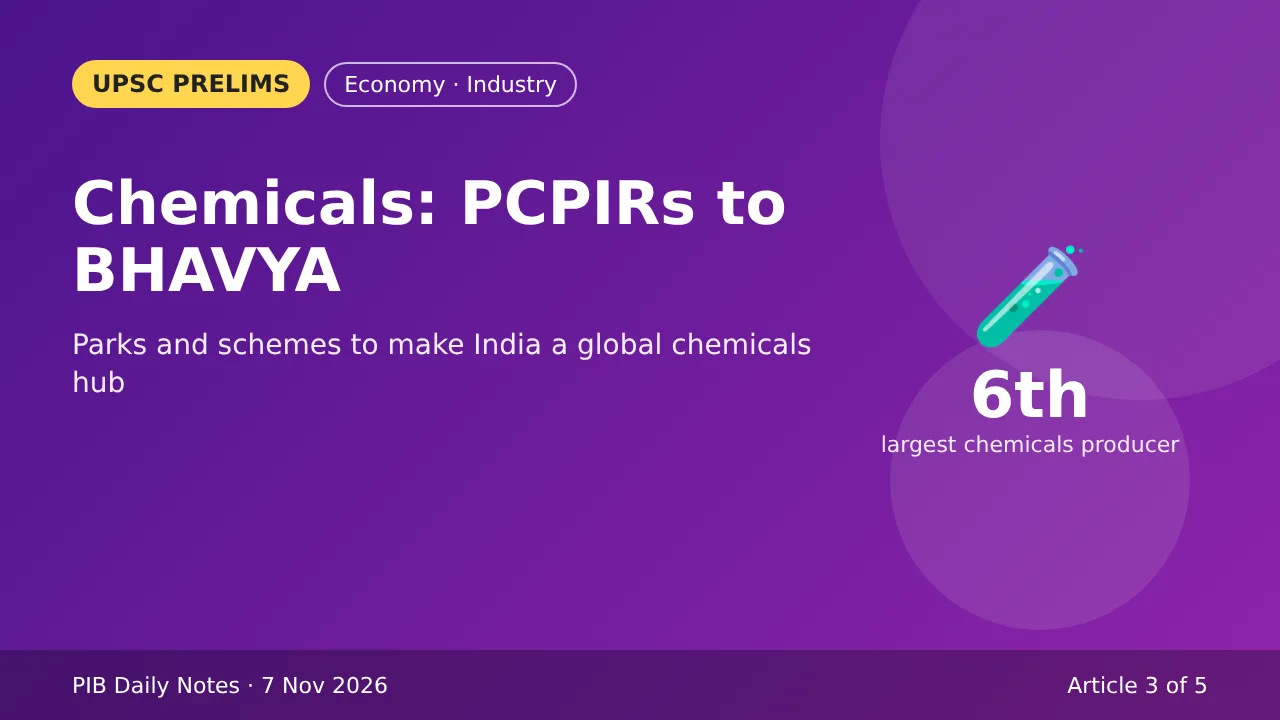
India is the sixth-largest producer of chemicals in the world and fourth-largest in Asia. The sector is worth about USD 220 billion and is projected to reach USD 300 billion by 2030 and USD 1 trillion by 2040.
India is the second-largest manufacturer and exporter of dyes and the third-largest exporter of agrochemicals.
The sector has about 13,000 large units and 4.45 lakh MSMEs.
100% FDI is allowed through the automatic route in most chemical sectors. FDI during 2014–2026 was ₹1,04,895 crore, more than double the 2004–14 figure.
Output of major chemicals and petrochemicals rose from 45,638 thousand tonnes (2015-16) to 58,617 thousand tonnes (2024-25).
India Chem 2026's theme was "Advantage Bharat: An Emerging Global Chemicals Hub".
Prelims Facts & Static Linkages
Industrial parks for the sector
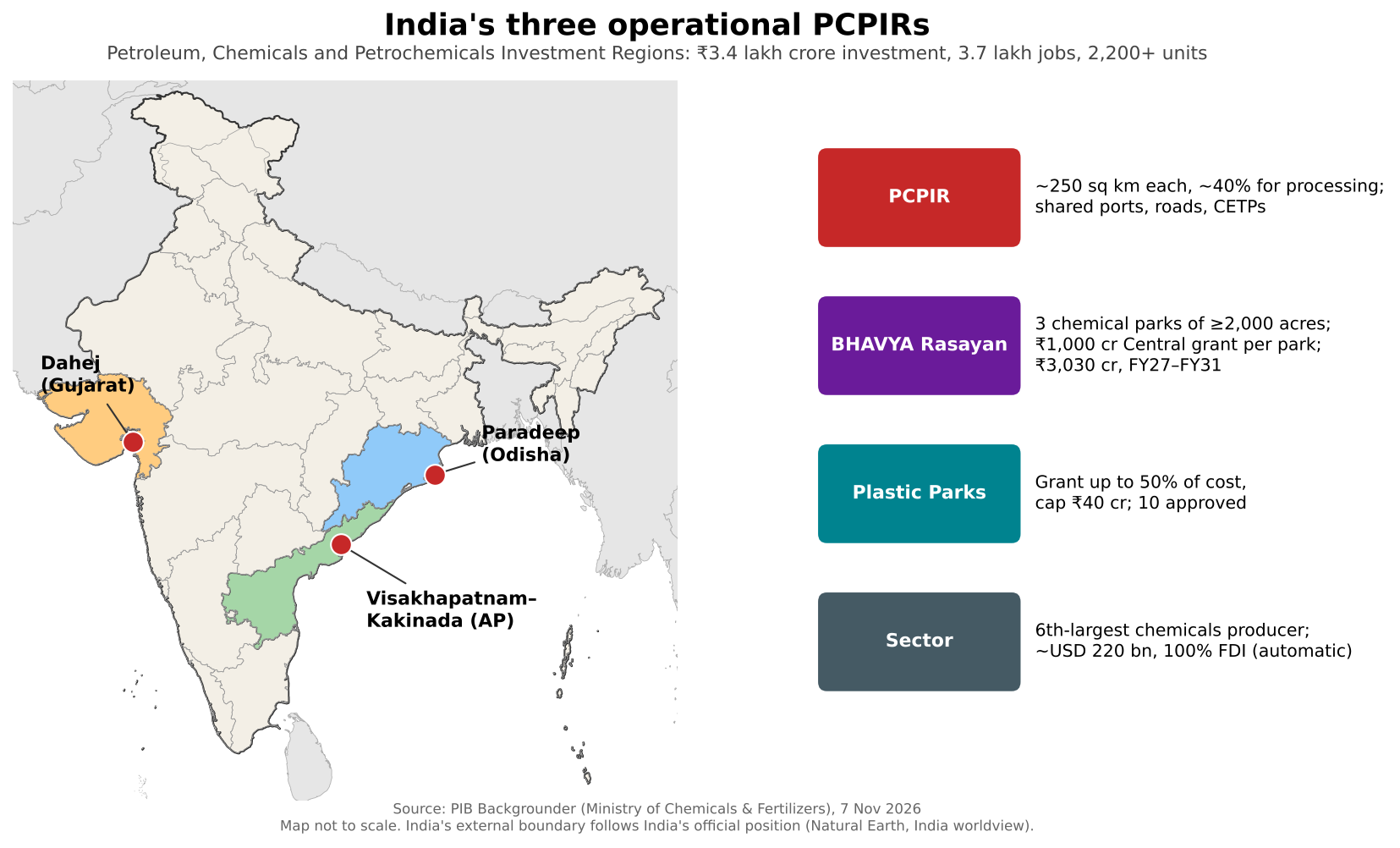
PCPIRs (Petroleum, Chemicals and Petrochemicals Investment Regions): delineated regions of about 250 sq km, with about 40% for processing activities and shared infrastructure such as ports, roads and Common Effluent Treatment Plants.
Three operational PCPIRs:Dahej (Gujarat), Visakhapatnam–Kakinada (Andhra Pradesh) and Paradeep (Odisha). Together they drew ₹3.4 lakh crore of investment, 3.7 lakh jobs and over 2,200 units.
BHAVYA Rasayan (Bharat Audyogik Vikas Yojana Rasayan): approved in July 2026 for three chemical parks of at least 8 sq km (2,000 acres) each. Central grant up to ₹1,000 crore per park, with at least ₹500 crore from the State. Outlay ₹3,030 crore, FY 2026-27 to 2030-31.
Plastic Parks: grant of up to 50% of project cost, capped at ₹40 crore. Ten parks approved; four fully complete.
Institutions and schemes
Name
Key fact
CIPET
Central Institute of Petrochemicals Engineering & Technology; 51 centres; skilling, testing and research
CPDS
Chemical Promotion and Development Scheme; studies, databases and farmer training on safe pesticide use
IPFT
Institute of Pesticide Formulation Technology; runs Integrated Pest Management training
RDI Scheme
₹1 lakh crore corpus (Nov 2025); advanced chemicals added as a funding area from 8 Oct 2026
QCOs
37 Quality Control Orders make BIS standards mandatory for chemicals
Safety and regulation
Major Accident Hazard (MAH) units: a five-year training programme will cover all 2,393 MAH units on safe handling of hazardous chemicals.
Static link: the Manufacture, Storage and Import of Hazardous Chemical Rules, 1989 were framed under the Environment (Protection) Act, 1986, passed after the Bhopal gas tragedy (1984), which involved methyl isocyanate.
The Department of Chemicals and Petrochemicals is under the Ministry of Chemicals and Fertilizers.
Plastics: concepts to revise
Polymers such as polyethylene, polypropylene and PVC are petrochemicals made from naphtha or natural gas.
Hidden plastics occur in cigarette filters (cellulose acetate), lenses (polycarbonate), tyres and chewing-gum bases.
Plastic Waste Management Rules, 2016 bring in Extended Producer Responsibility (EPR). Identified single-use plastic items were banned from 1 July 2022.
Quick Revision
India is the sixth-largest chemicals producer in the world.
Three PCPIRs operate at Dahej, Visakhapatnam–Kakinada and Paradeep.
BHAVYA Rasayan will set up three chemical parks with ₹3,030 crore.
Plastic Park grants cover up to 50% of cost, capped at ₹40 crore.
100% FDI is allowed through the automatic route in most chemical sectors.
CIPET runs 51 centres for skilling and research.
Practice MCQ
Q. Which of the following is/are operational Petroleum, Chemicals and Petrochemicals Investment Regions (PCPIRs) in India?
1. Dahej
2. Paradeep
3. Visakhapatnam–Kakinada
4. Haldia
Select the correct answer using the code given below:
(a) 1 and 2 only
(b) 1, 2 and 3 only
(c) 3 and 4 only
(d) 1, 2, 3 and 4
Answer: (b). Haldia is a port and petrochemical hub in West Bengal but not an operational PCPIR.
Related PYQs
PYQ 1 (UPSC CSE Prelims 2025)
Consider the following:
I. Cigarette butts
II. Eyeglass lenses
III. Car tyres
How many of them contain plastic?
(a) Only one
(b) Only two
(c) All the three
(d) None
Answer: (c).
PYQ 2 (UPSC CSE Prelims 2024)
Consider the following statements:
Statement-I: Many chewing gums found in the market are considered a source of environmental pollution.
Statement-II: Many chewing gums contain plastic as gum base.
Which one of the following is correct in respect of the above statements?
(a) Both Statement-I and Statement-II are correct and Statement-II explains Statement-I
(b) Both Statement-I and Statement-II are correct, but Statement-II does not explain Statement-I
(c) Statement-I is correct, but Statement-II is incorrect
(d) Statement-I is incorrect, but Statement-II is correct



 28
Nov 2026
 28
Nov 2026
 28
Nov 2026














0 comments
Discussion
No comments yet. Be the first.