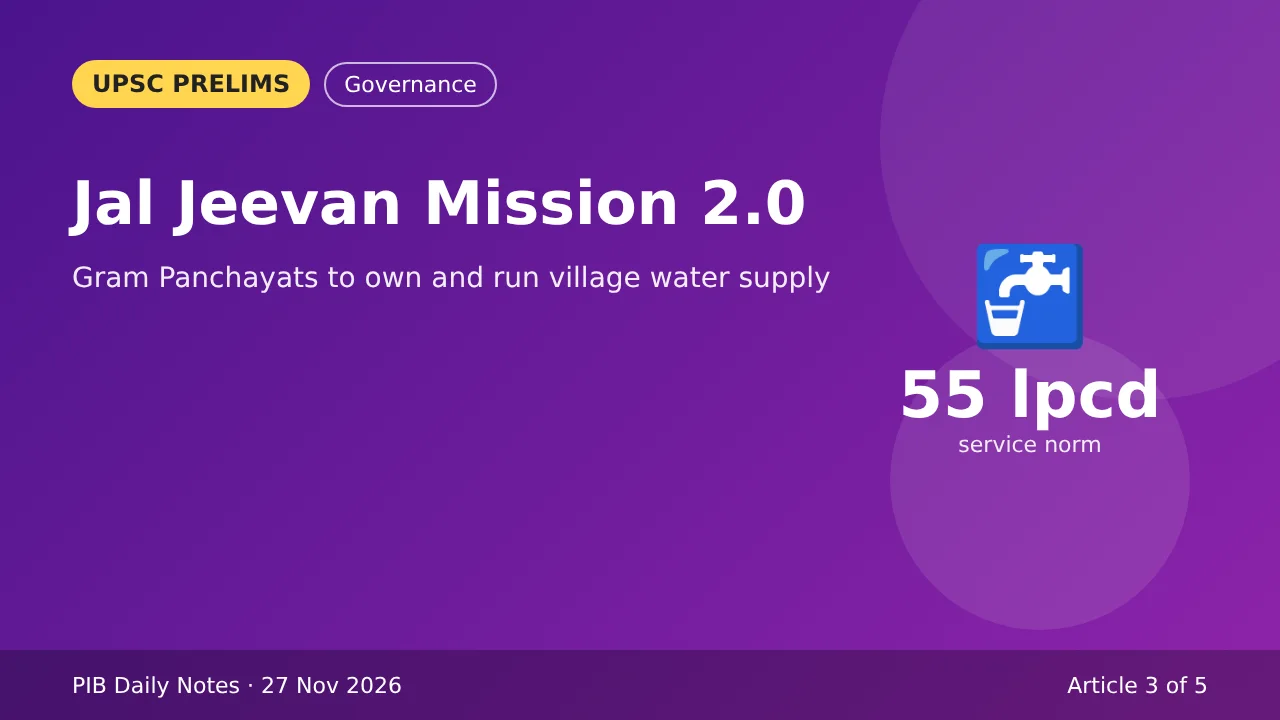
Jal Jeevan Mission 2.0: Gram Panchayats to Own Water Supply
The second regional conference on Jal Jeevan Mission (JJM) 2.0 ended at Agra
DDecode Civils
· 4 min read
Jal Jeevan Mission 2.0: Gram Panchayats to Own Water Supply
Why in News
The second regional conference on Jal Jeevan Mission (JJM) 2.0 ended at Agra on 27 November 2026. It was organised by the Department of Drinking Water and Sanitation (DDWS) for seven northern States and UTs. Officials joined Jal Arpan Diwas events in five villages of Uttar Pradesh.
News Summary
The focus has moved from building pipelines to sustained service: operation and maintenance, water quality, source sustainability and community ownership.
Jal Arpan hands water supply assets and responsibility to Gram Panchayats and communities. It is meant as shared responsibility, not just a handover.
Good practices from UP include solar-powered water schemes and command-and-control monitoring.
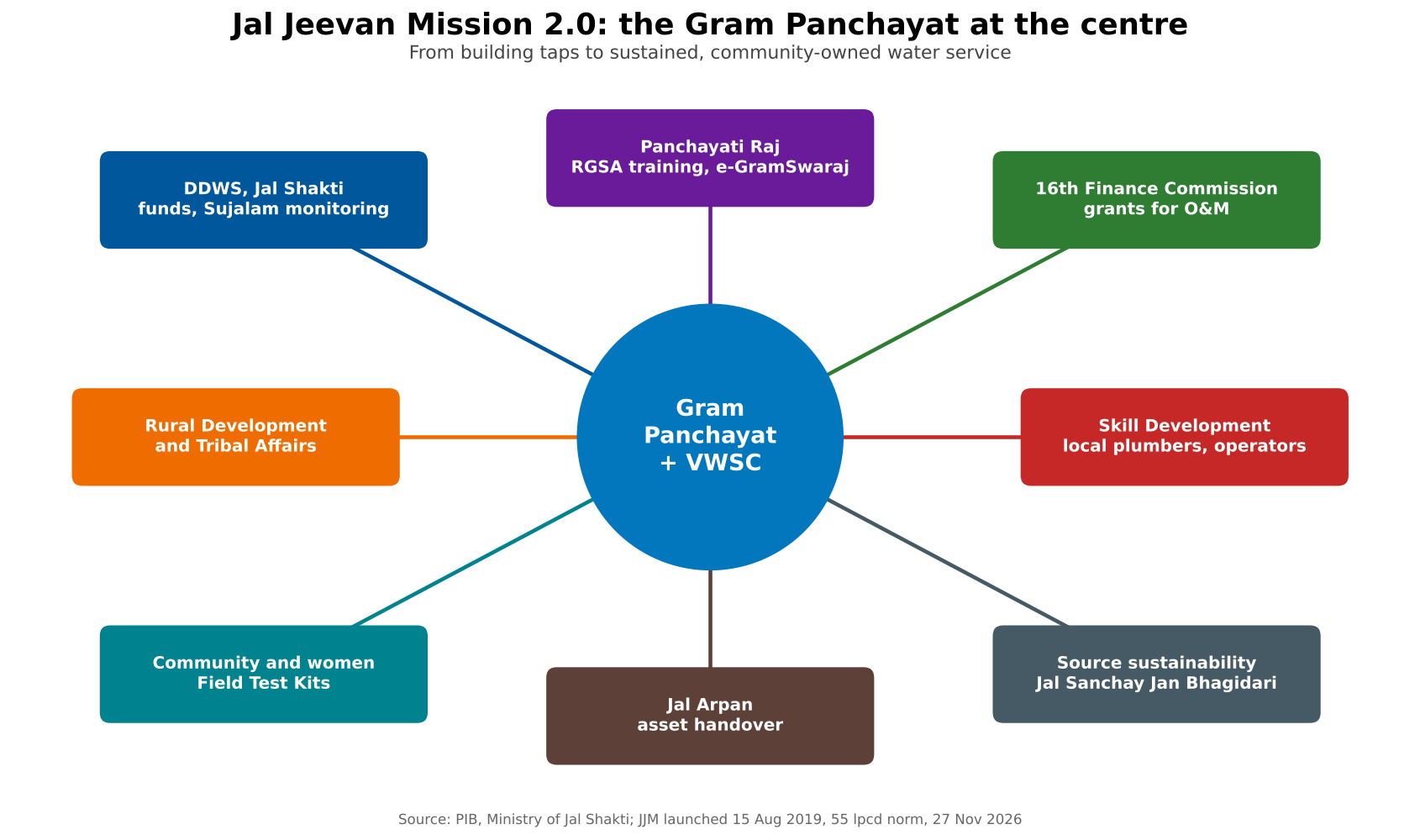
Convergence is needed among Panchayati Raj, Rural Development, Tribal Affairs, Skill Development and Drinking Water departments.
DDWS and the Ministry of Panchayati Raj will align SBM-G training with Rashtriya Gram Swaraj Abhiyan (RGSA).
States were asked to map water assets on e-GramSwaraj, include drinking water in Gram Panchayat Development Plans (GPDPs) and use 16th Finance Commission grants for O&M.
Women trained to use Field Test Kits (FTKs) check water quality in villages.
Prelims Facts & Static Linkages
Who does what under JJM 2.0
Gram Panchayat: owns and runs the village scheme after Jal Arpan.
VWSC / Pani Samiti: a GP sub-committee that plans, operates and collects user charges.
State department: technical support, especially for major repairs.
DDWS (Ministry of Jal Shakti): policy, funds and digital monitoring through the Sujalam framework.
Community: water conservation through Jal Sanchay Jan Bhagidari.
Jal Jeevan Mission at a glance
Feature
Detail
Launched
15 August 2019
Aim
Functional Household Tap Connection (FHTC) for every rural home
Service norm
55 litres per capita per day, of BIS:10500 quality
Ministry
Jal Shakti (DDWS)
Fund sharing
50:50; 90:10 for NE and Himalayan States; 100% for UTs without legislature
Approach
Bottom-up, community-led, with a Village Action Plan
Constitutional linkages
Water is in the State List (Entry 17).
Drinking water is item 11 of the Eleventh Schedule (29 subjects), added by the 73rd Amendment, 1992.
Article 243G lets States devolve such powers to Panchayats.
Article 280 provides for the Finance Commission, whose grants to local bodies are partly tied to water and sanitation.
Key terms
Jal Arpan: formal handover of a completed village water scheme to the Gram Panchayat and community.
Field Test Kit (FTK): a simple kit with which trained village women test water for contamination.
Source sustainability: recharging and protecting the source (well, spring or river) so that taps do not run dry.
Jal Sanchay Jan Bhagidari: a community water-conservation drive launched in Surat, Gujarat, in September 2024.
e-GramSwaraj: the Panchayati Raj Ministry's portal for panchayat planning, accounts and asset records.
RGSA: the scheme that trains and builds the capacity of Panchayati Raj institutions.
Likely Prelims angles
JJM norms (55 lpcd, BIS:10500) and funding ratios.
Eleventh Schedule subjects.
Roles of VWSCs and Gram Panchayats.
Quick Revision
The second regional conference on JJM 2.0 was held at Agra.
Jal Arpan transfers water assets to Gram Panchayats.
VWSCs and women with Field Test Kits are at the core.
Drinking water is in the Eleventh Schedule.
Finance Commission grants can fund operation and maintenance.
JJM began on 15 August 2019 with a 55 lpcd norm.
Practice MCQ
Q. With reference to the Jal Jeevan Mission, consider the following statements:
1. It aims to give a functional tap connection to every rural household.
2. It is implemented by the Ministry of Housing and Urban Affairs.
3. Drinking water is one of the subjects listed in the Eleventh Schedule of the Constitution.
Which of the statements given above is/are correct?
(a) 1 only
(b) 1 and 3 only
(c) 2 and 3 only
(d) 1, 2 and 3
Answer: (b). JJM is run by the Department of Drinking Water and Sanitation, Ministry of Jal Shakti.
Related PYQs
PYQ 1 (UPSC CSE Prelims 2025)
Consider the following statements:
1. Panchayats at the intermediate level exist in all States.
2. To be eligible to be a Member of a Panchayat at the intermediate level, a person should attain the age of thirty years.
3. The Chief Minister of a State constitutes a commission to review the financial position of Panchayats at the intermediate levels and to make recommendations regarding the distribution of net proceeds of taxes and duties, leviable by the State, between the State and Panchayats at the intermediate level.
Which of the statements given above are not correct?



 27
Nov 2026
 27
Nov 2026
 27
Nov 2026














0 comments
Discussion
No comments yet. Be the first.