Biosafety Level-3 (BSL-3) / Animal Biosafety Level-3 (ABSL-3) facility at CSIR-Central Drug Research Institute
DDecode Civils
· 3 min read
New BSL-3 Lab at CSIR-CDRI for TB Research
Why in News
Union Minister Dr. Jitendra Singh inaugurated a Biosafety Level-3 (BSL-3) / Animal Biosafety Level-3 (ABSL-3) facility at CSIR-Central Drug Research Institute (CDRI), Lucknow. He said India must move from generic drugs to discovering new medicines.
News Summary
The facility allows high-containment work on Mycobacterium tuberculosis and non-tuberculous mycobacteria (NTM).
CDRI has taken 13 drugs to market, licensed 80+ process technologies and six diagnostics, and holds 456 international and 586 Indian patents.
It has a library of about 90,000 compounds and 50+ animal models.
Centchroman (Ormeloxifene), CDRI's non-steroidal, once-a-week oral contraceptive, joined the National Family Planning Programme in 2016. Over 350 lakh strips were given free through ASHA workers in five years.
A Picrorhiza kurroa (kutki) extract for MASLD (fatty liver disease) has completed Phase III trials.
India ranks 3rd in pharma output by volume and 11th by value. It meets over 50% of Africa's generic needs and about 40% of US generic demand.
New pacts were signed with ICMR–NIRTH Jabalpur, UP University of Medical Sciences and Medanta Hospital.
Prelims Facts & Static Linkages
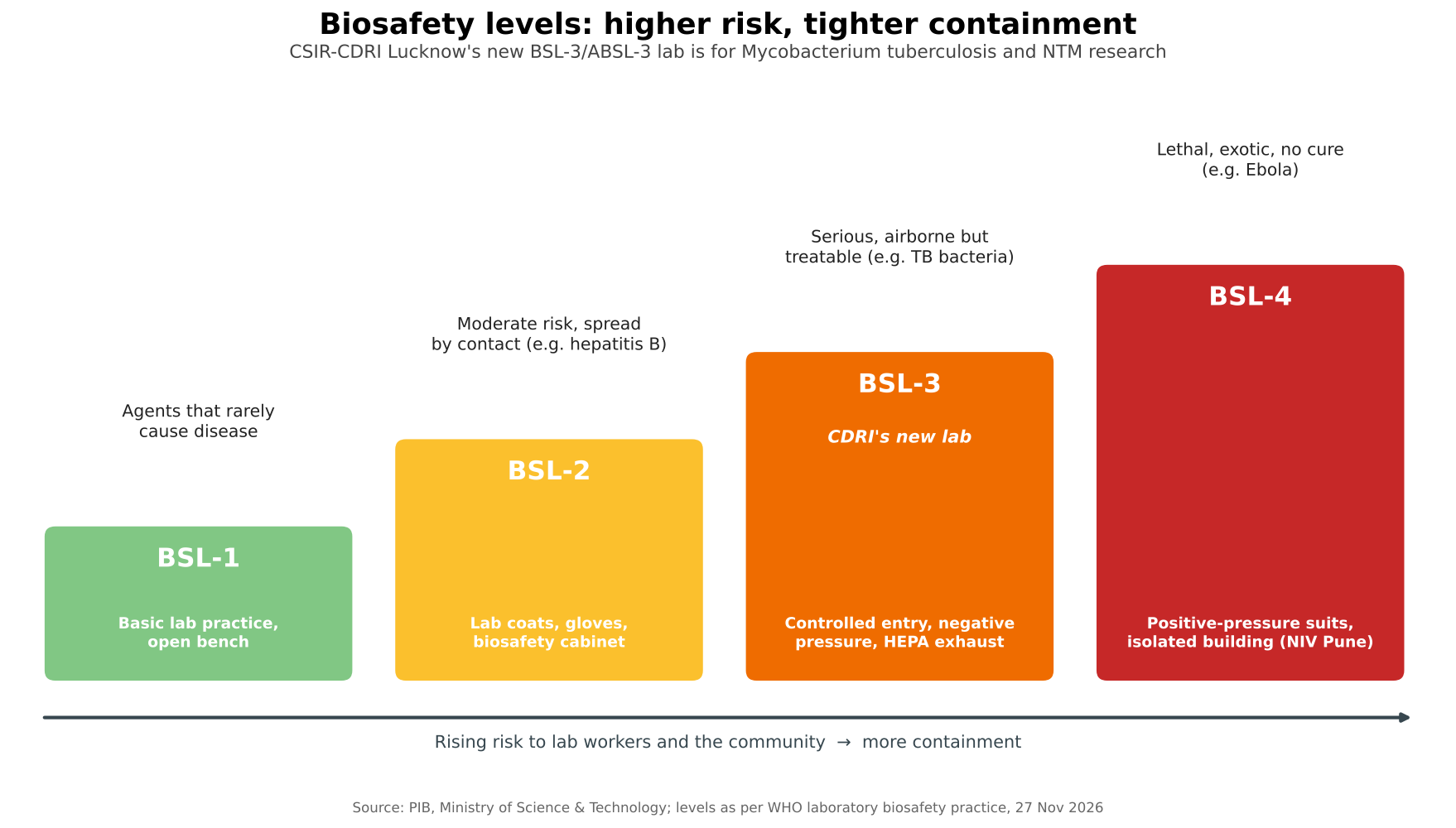
Biosafety levels explained
BSL-1: agents that do not usually cause disease in healthy adults. Basic lab practices.
BSL-2: moderate-risk agents spread by contact, such as hepatitis B. Lab coats and biosafety cabinets.
BSL-3: serious or lethal agents that spread through the air but have treatments, such as TB bacteria. Controlled entry, negative air pressure and HEPA-filtered exhaust.
BSL-4: dangerous exotic agents with no cure, such as Ebola. Full-body positive-pressure suits. India has one at NIV, Pune.
ABSL levels apply the same logic to labs that infect animals.
Tuberculosis basics
Feature
Detail
Cause
Mycobacterium tuberculosis, a bacterium
Spread
Airborne droplets
Vaccine
BCG (protects children mainly)
Drug-resistant forms
MDR-TB and XDR-TB
India's goal
End TB ahead of the SDG 2030 target
Portal
Ni-kshay, for case notification and support
Related institutions
CSIR: an autonomous society under the Department of Scientific and Industrial Research. The Prime Minister is its President.
CDRI, Lucknow: set up in 1951.
CSIR-CIMAP, Lucknow: medicinal and aromatic plants.
ICMR–NIRTH, Jabalpur: the ICMR institute for research on tribal health, now a CDRI partner.
ICMR–NIV, Pune isolated the SARS-CoV-2 strain used to develop COVAXIN with Bharat Biotech, work that needs high-containment labs.
The Hazardous Microorganisms Rules, 1989, under the Environment (Protection) Act, 1986, regulate work with dangerous microbes and GMOs.
Key terms
Non-tuberculous mycobacteria (NTM): relatives of the TB germ, found in soil and water, that cause lung and skin infections, mostly in people with weak immunity.
MASLD: metabolic dysfunction-associated steatotic liver disease, the new name for non-alcoholic fatty liver disease.
Phytopharmaceutical: a drug made from a purified, standardised plant extract.
Phase I, II and III trials: tests for safety, then efficacy and dose, then large-scale confirmation before approval.
Likely Prelims angles
Matching biosafety levels with example pathogens.
CSIR labs and their cities.
India's position in global pharmaceutical production.
Quick Revision
CDRI Lucknow now has a BSL-3/ABSL-3 lab for TB and NTM research.
BSL-3 handles airborne, serious but treatable pathogens.
BSL-4 is for agents like Ebola; NIV Pune has one.
Centchroman is a once-a-week, non-steroidal oral contraceptive.
India is 3rd in pharma by volume and 11th by value.
The PM is President of CSIR.
Practice MCQ
Q. Consider the following statements:
1. A Biosafety Level-3 laboratory is used for agents that can cause serious disease through inhalation.
2. Centchroman is a steroidal oral contraceptive taken daily.
3. Tuberculosis is caused by a virus.
Which of the statements given above is/are correct?
(a) 1 only
(b) 1 and 2 only
(c) 2 and 3 only
(d) 1, 2 and 3
Answer: (a). Centchroman is non-steroidal and taken once a week, and TB is caused by a bacterium.
Related PYQs
PYQ 1 (UPSC CSE Prelims 2022)
In the context of vaccines manufactured to prevent COVID-19 pandemic, consider the following statements:
1. The Serum Institute of India produced COVID-19 vaccine named Covishield using mRNA platform.
2. Sputnik V vaccine is manufactured using vector based platform.
3. COVAXIN is an inactivated pathogen based vaccine.



 27
Nov 2026
 27
Nov 2026
 27
Nov 2026














0 comments
Discussion
No comments yet. Be the first.