NBA Shares ₹13.76 Crore in Access and Benefit Sharing Funds
National Biodiversity Authority (NBA) has disbursed ₹13.76 crore of Access and Benefit Sharing
DDecode Civils
· 4 min read
NBA Shares ₹13.76 Crore in Access and Benefit Sharing Funds
Why in News
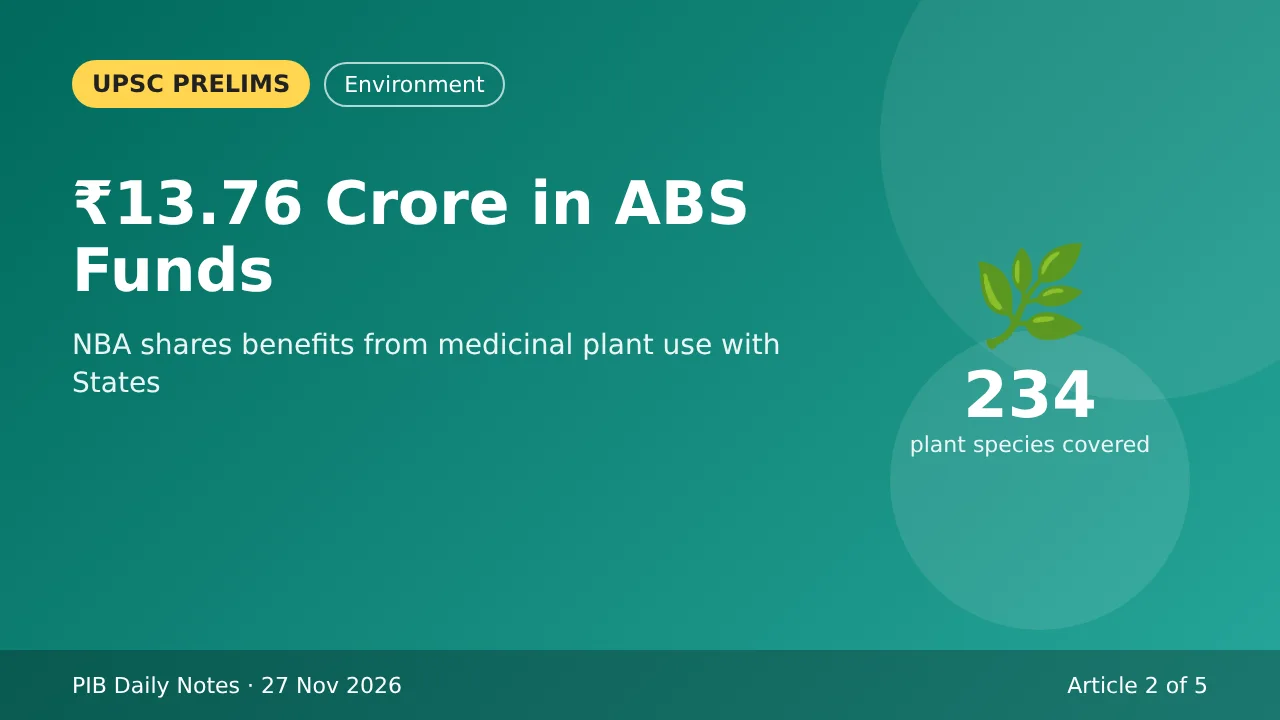
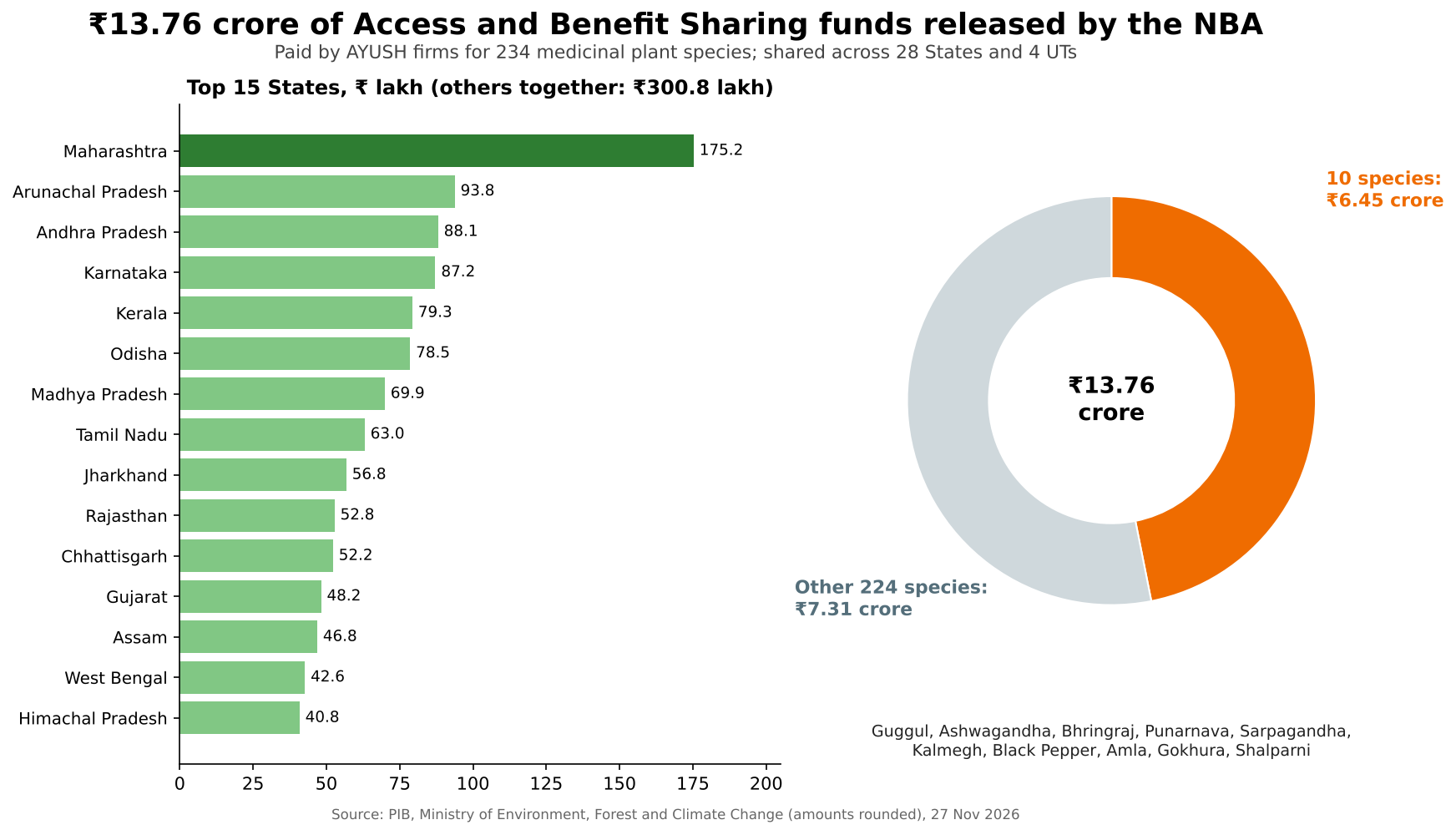
The National Biodiversity Authority (NBA) has disbursed ₹13.76 crore of Access and Benefit Sharing (ABS) money across 28 States and 4 Union Territories. The money came from AYUSH product makers that commercially use medicinal plants.
News Summary
The amount relates to three applications covering 234 plant species.
The plants were bought through market and trader networks, so individual benefit claimers could not be traced. The money was therefore shared on the basis of each State's forest cover and the occurrence of medicinal plants there.
Ten species account for ₹6.45 crore: Guggul, Ashwagandha, Bhringraj, Punarnava, Sarpagandha, Kalmegh, Black Pepper, Indian Gooseberry (Amla), Gokhura and Shalparni.
Maharashtra received the most (about ₹1.75 crore), followed by Arunachal Pradesh, Andhra Pradesh, Karnataka and Kerala.
The funds can support Biodiversity Management Committees (BMCs), People's Biodiversity Registers (PBRs), documentation of traditional knowledge, restoration and sustainable harvesting.
The NBA has so far collected ₹278 crore through ABS and disbursed about ₹218.86 crore.
ABS supports Target 13 of the Kunming–Montreal Global Biodiversity Framework (KMGBF). The Yerevan Pathway was adopted at CBD COP 17 (19–30 October 2026).
Prelims Facts & Static Linkages
How access and benefit sharing works
A company seeks approval to use a biological resource or associated traditional knowledge.
The authority fixes benefit-sharing terms on mutually agreed terms.
The company pays its share to the National Biodiversity Fund.
The money goes to the SBB or BMC of the area from which the resource came.
Local bodies spend it on conservation and livelihoods of the communities that hold the resource.
Three-tier structure under the Biological Diversity Act, 2002
Level
Body
Role
National
National Biodiversity Authority (Chennai, 2003)
Approvals for foreign entities, IPR on Indian bio-resources, ABS
State
State Biodiversity Boards (SBBs)
Regulate commercial use by Indian entities
Local
Biodiversity Management Committees (BMCs)
Prepare People's Biodiversity Registers; may levy collection fees
Global framework
Convention on Biological Diversity (CBD), 1992 (Rio): conservation, sustainable use, and fair and equitable benefit sharing.
Cartagena Protocol (2000): biosafety of living modified organisms.
Nagoya Protocol (2010, in force 2014): access to genetic resources and ABS. India is a party.
KMGBF (COP 15, 2022): 23 targets for 2030, including "30 by 30" (Target 3) and benefit sharing (Target 13).
Biological Diversity (Amendment) Act, 2023
It eases rules for registered AYUSH practitioners and for codified traditional knowledge.
It encourages the cultivation of medicinal plants to cut pressure on wild stocks.
It decriminalises most offences, replacing jail terms with penalties.
It keeps benefit sharing with local communities at the heart of the law.
Plants in the news
Guggul (Commiphora wightii): a resin-yielding shrub of arid Rajasthan and Gujarat, heavily over-tapped.
Sarpagandha (Rauvolfia serpentina): source of reserpine, used for high blood pressure.
Ashwagandha (Withania somnifera): a root used as a tonic.
Kalmegh (Andrographis paniculata): a bitter herb used for fevers.
Likely Prelims angles
The three-tier structure of the 2002 Act.
Differences among the CBD's protocols.
KMGBF targets.
Quick Revision
NBA released ₹13.76 crore of ABS funds to 28 States and 4 UTs.
The money came from AYUSH firms using 234 plant species.
Forest cover and occurrence of medicinal plants decided each State's share.
Total ABS collected so far is ₹278 crore.
BMCs maintain People's Biodiversity Registers.
ABS serves KMGBF Target 13 and the Nagoya Protocol.
Practice MCQ
Q. Consider the following statements:
1. The National Biodiversity Authority is a statutory body headquartered in Chennai.
2. The Nagoya Protocol deals with the safe handling of living modified organisms.
3. Target 13 of the Kunming–Montreal Global Biodiversity Framework relates to benefit sharing from genetic resources.
Which of the statements given above is/are correct?
(a) 1 only
(b) 1 and 3 only
(c) 2 and 3 only
(d) 1, 2 and 3
Answer: (b). Living modified organisms are covered by the Cartagena Protocol.
Related PYQs
PYQ 1 (UPSC CSE Prelims 2023)
Consider the following statements:
1. In India, the Biodiversity Management Committees are key to the realization of the objectives of Nagoya Protocol.
2. The Biodiversity Management Committees have important functions in determining access and benefit sharing, including the power to levy collection fees on the access of biological resources within its jurisdiction.
Which of the statements given above is/are correct?
(a) 1 only
(b) 2 only
(c) Both 1 and 2
(d) Neither 1 nor 2
Answer: (c).
PYQ 2 (UPSC CSE Prelims 2025)
Which organization has enacted the Nature Restoration Law (NRL) to tackle climate change and biodiversity loss?
(a) The European Union
(b) The World Bank
(c) The Organization for Economic Cooperation and Development



 27
Nov 2026
 27
Nov 2026
 27
Nov 2026














0 comments
Discussion
No comments yet. Be the first.