Lachit Diwas: Lachit Borphukan and the Battle of Saraighat
Prime Minister Narendra Modi paid tribute to Lachit Borphukan on Lachit Diwas, 24 November 2026.
DDecode Civils
· 3 min read
Lachit Diwas: Lachit Borphukan and the Battle of Saraighat
Why in News
Prime Minister Narendra Modi paid tribute to Lachit Borphukan on Lachit Diwas, 24 November 2026. He remembered Lachit's courage and determination in protecting Assam.
News Summary
The Prime Minister said Lachit's leadership and devotion to the people continue to inspire generations.
He said Lachit's life is a reminder of the strength and spirit of Assam.
The message was posted in English and Assamese.
Lachit Diwas is observed every year on 24 November, Lachit's birth anniversary.
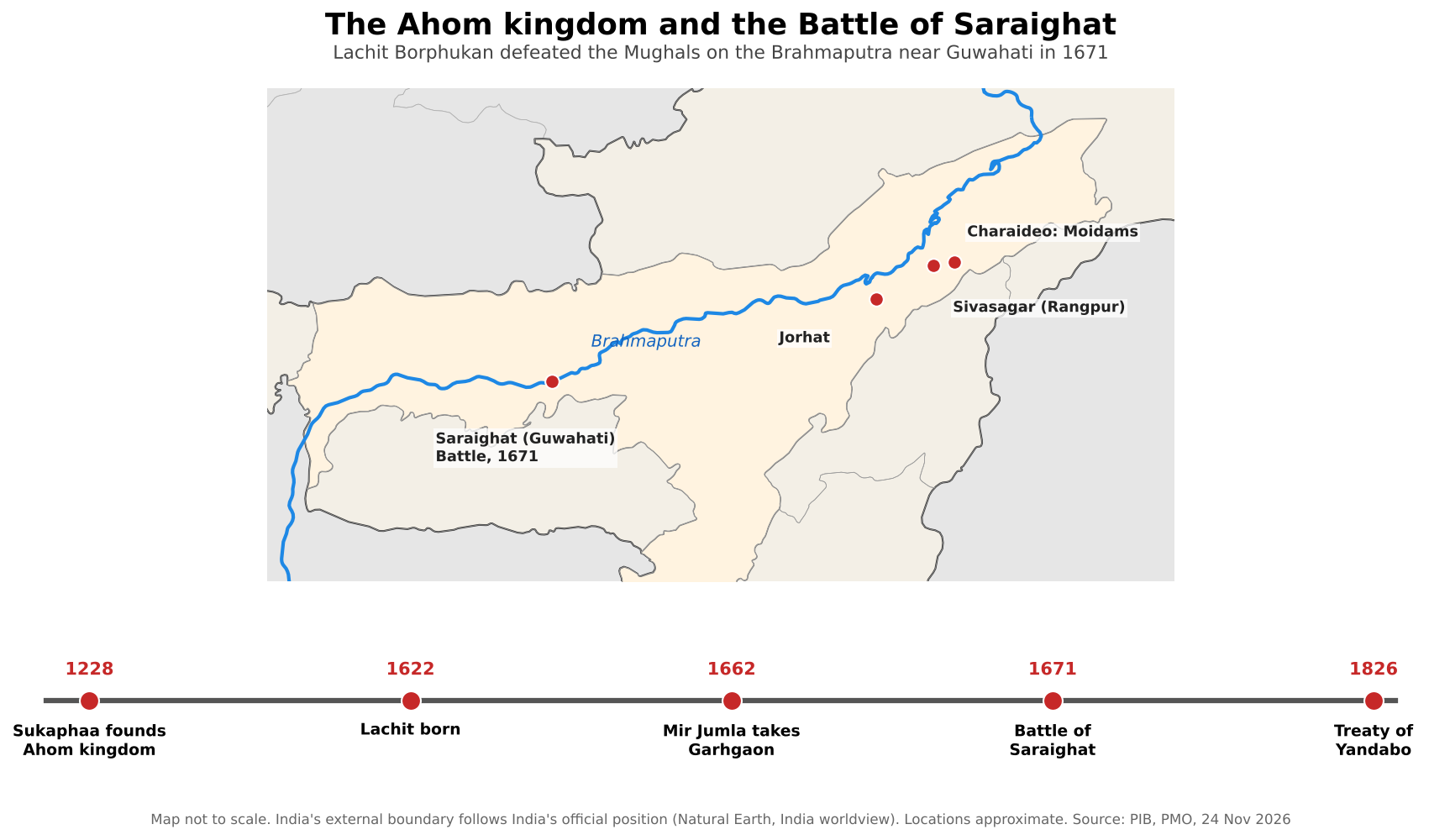
Lachit was the commander of the Ahom army who defeated the Mughals at the Battle of Saraighat (1671).
Assam observes the day with programmes on his life and legacy.
Prelims Facts & Static Linkages
Who was Lachit Borphukan
Born on 24 November 1622.
He was appointed Borphukan (the Ahom governor of lower Assam and military commander) by King Chakradhwaj Singha.
He recaptured Guwahati from the Mughals in 1667.
He died in 1672, about a year after Saraighat.
The Lachit Borphukan Gold Medal has been given to the best cadet at the National Defence Academy since 1999.
A tall statue of Lachit was unveiled near Jorhat in 2024.
Battle of Saraighat (1671)
Fought on the Brahmaputra near Guwahati.
The Mughal army was led by Raja Ram Singh I of Amber, sent by Aurangzeb.
The Ahoms used naval warfare and the narrow river channel to defeat the larger Mughal fleet.
It stopped Mughal expansion into Assam.
An earlier battle, at Alaboi (1669), had gone in the Mughals' favour.
The Ahom kingdom
Feature
Fact
Founder
Sukaphaa, in 1228
Origin
Tai people who came from present-day Myanmar/Yunnan
Duration
About 600 years, until the Treaty of Yandabo (1826) brought Assam under British control
Capitals
Charaideo, later Garhgaon and Rangpur (Sivasagar)
Labour system
Paik system: men gave labour or military service to the state
Chronicles
Buranjis, written in Ahom and later in Assamese
Mughal campaigns in Assam
Mir Jumla, Aurangzeb's governor of Bengal, invaded Assam in 1662 and captured the Ahom capital Garhgaon.
The Treaty of Ghilajharighat (1663) forced the Ahoms to cede territory and pay tribute.
The Ahoms under Chakradhwaj Singha fought back and recovered Guwahati in 1667.
After Saraighat, the Mughals never regained lasting control of Assam.
Later, the Burmese invasions (from 1817) weakened the kingdom and led to British rule after the First Anglo-Burmese War.
Moidams
The Moidams of Charaideo are the mound burial grounds of Ahom royals and nobles.
They became a UNESCO World Heritage Site in 2024, India's first cultural site from the North-East.
They are sometimes called the "Pyramids of Assam".
Kings and nobles were buried with goods for the afterlife, in vaulted chambers covered by earthen mounds.
Assam's natural World Heritage Sites are Kaziranga and Manas national parks.
Quick Revision
Lachit Diwas is on 24 November.
The Battle of Saraighat was fought in 1671 on the Brahmaputra near Guwahati.
Ram Singh I of Amber led the Mughal army.
The Ahom kingdom was founded by Sukaphaa in 1228.
The Treaty of Yandabo was signed in 1826.
The Charaideo Moidams became a World Heritage Site in 2024.
The NDA's best cadet receives the Lachit Borphukan Gold Medal.
Practice MCQ
Q. Consider the following statements about the Battle of Saraighat:
1. It was fought between the Ahoms and the Mughals.
2. The Ahom forces were led by Lachit Borphukan.
3. It was fought on the banks of the Barak river.
Which of the statements given above are correct?
(a) 1 and 2 only
(b) 2 and 3 only
(c) 1 and 3 only
(d) 1, 2 and 3
Answer: (a). It was fought on the Brahmaputra.
Related PYQs
PYQ 1 (UPSC CSE Prelims 2026)
Which one of the following statements with regard to the Moidams, built by the Tai-Ahom kingdom and inscribed as a World Heritage Site by UNESCO, is/are correct?
1. They acted as army fortresses.
2. They were recreation centres of the Royals and Nobles.
3. They were burial grounds of the Royals and Nobles.
4. They were battle drill centres of the Royals and Nobles.



 25
Nov 2026
 25
Nov 2026
 25
Nov 2026














0 comments
Discussion
No comments yet. Be the first.