India's Space Economy: Set to Grow to USD 40–45 Billion
India's space economy, now about USD 9 billion, will grow to USD 40–45 billion
DDecode Civils
· 3 min read
India's Space Economy: Set to Grow to USD 40–45 Billion
Why in News
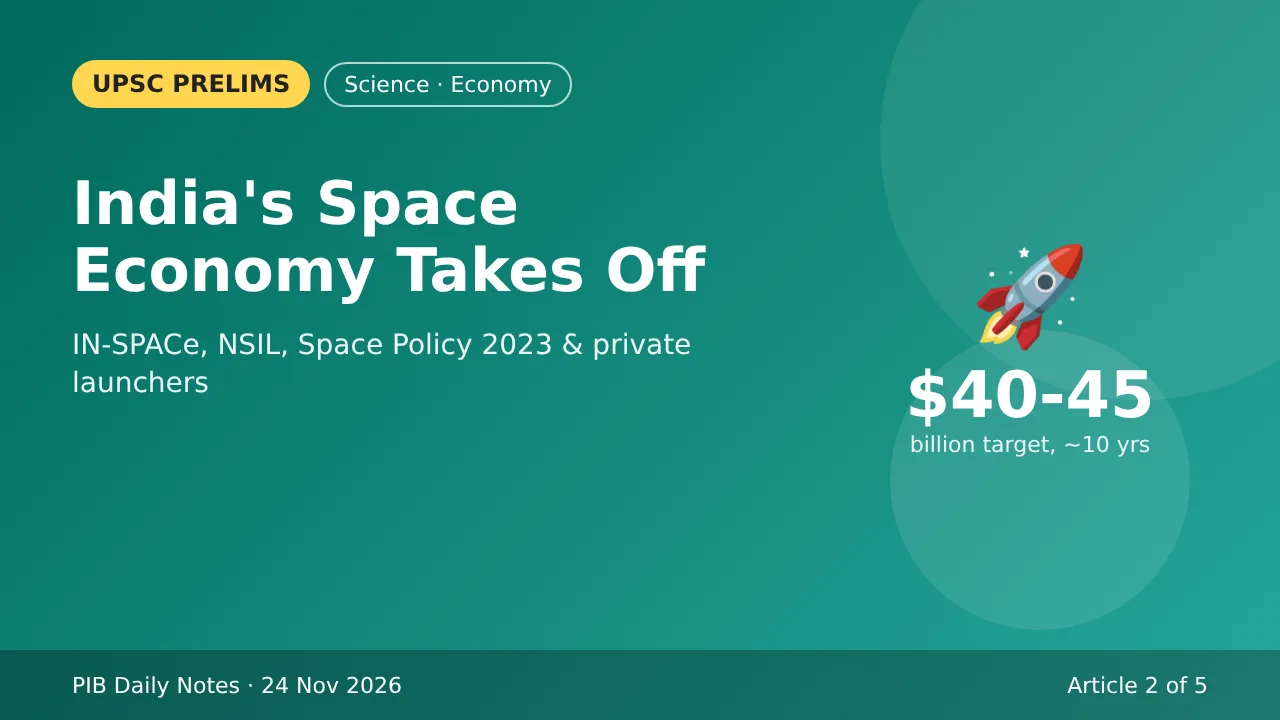
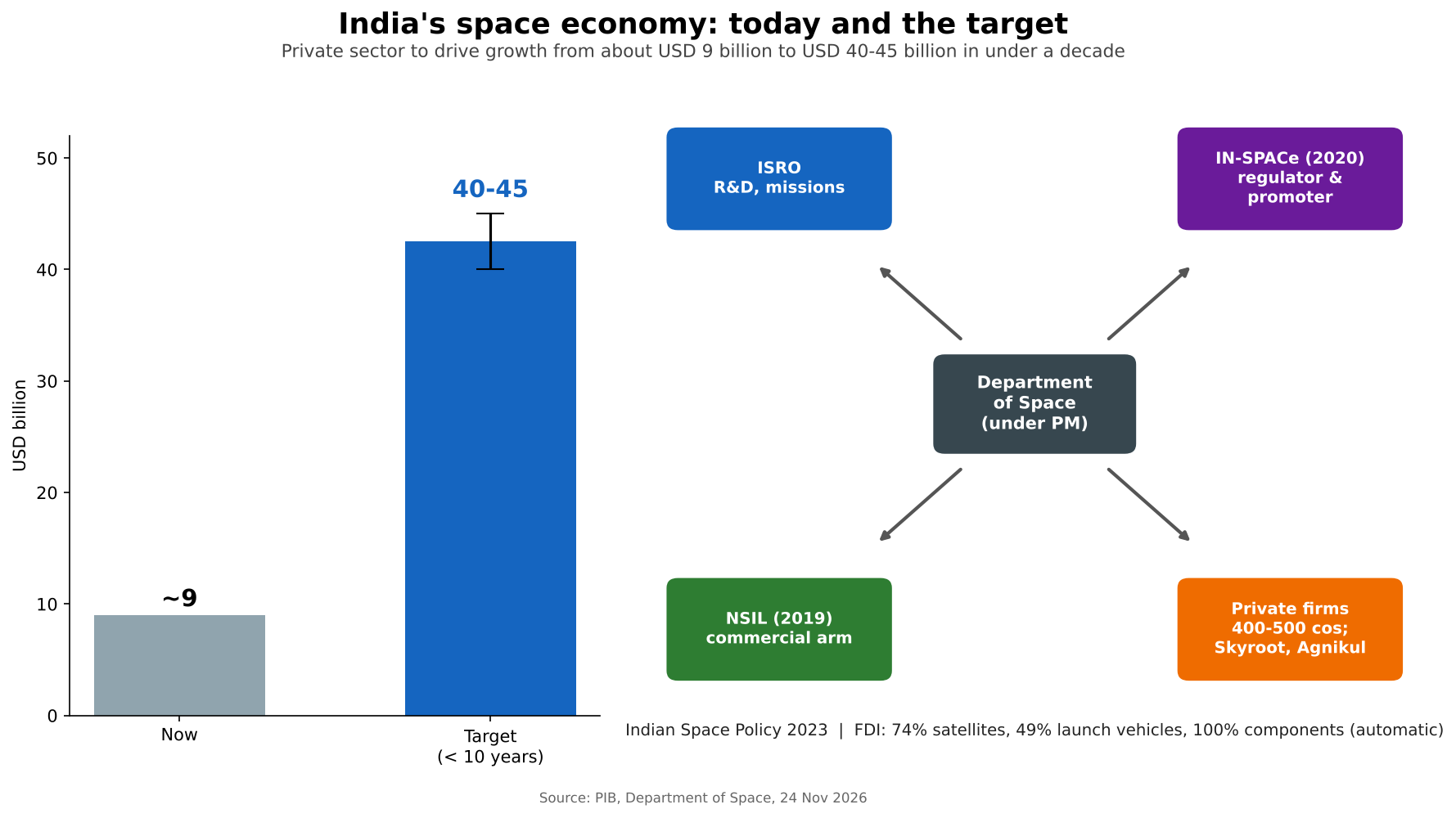
Addressing the fifth India International Space Conclave 2026 in New Delhi on 24 November 2026, Union Minister Dr Jitendra Singh said India's space economy, now about USD 9 billion, will grow to USD 40–45 billion in less than a decade, driven by the private sector.
News Summary
The conclave was organised by the Indian Space Association (ISpA) on 23–24 November 2026.
The report "Space Economy 2036: The India Blueprint" was launched.
India's space ecosystem has grown from single-digit startups to about 400–500 companies.
The Minister credited three reforms:
Setting up New Space India Limited (NSIL)
Creating IN-SPACe
Opening the space sector to private participation
Startup milestones:
Skyroot Aerospace's maiden launch vehicle flight on 18 July 2026, and its unicorn status
Agnikul Cosmos and others building propulsion systems and privately made rocket engines
Space applications support the PM Gati Shakti National Master Plan, railways, defence, health and education.
The National Quantum Mission has achieved 1,000 km of secure quantum communication in three years.
He urged industry to fund research through CSR, and pointed to the Anusandhan National Research Foundation and the RDI Fund.
Prelims Facts & Static Linkages
Space institutions
Body
Role
ISRO
Research and development; under the Department of Space
Department of Space
Created in 1972; reports directly to the Prime Minister
NSIL
Public sector commercial arm of ISRO, set up in 2019
IN-SPACe
Single-window regulator and promoter for private space activity, set up in 2020; HQ Ahmedabad
Antrix Corporation
ISRO's older commercial arm, set up in 1992
ISpA
Industry body of private space firms, launched in 2021
Policy reforms
The Indian Space Policy, 2023 lets private firms take part in every space activity. ISRO focuses on research and advanced missions.
FDI rules (2024):
Up to 74% automatic route for satellite manufacturing and operation
Up to 49% automatic route for launch vehicles and spaceports
Up to 100% automatic route for components and systems
Private milestones
Vikram-S (Skyroot, 2022) was India's first privately built rocket to fly, on a suborbital mission called Prarambh.
Agnibaan SOrTeD (Agnikul, 2024) flew the world's first single-piece 3D-printed semi-cryogenic engine.
Agnikul launched from India's first private launchpad, at Sriharikota.
India's launch vehicles
Vehicle
Main use
PSLV
Workhorse for polar and sun-synchronous orbits
GSLV
Heavier satellites to geosynchronous transfer orbit, with a cryogenic upper stage
LVM3
Heaviest launcher; used for Chandrayaan-3 and the Gaganyaan programme
SSLV
Small satellites on demand, at low cost
Related missions
National Quantum Mission (2023): runs to 2030–31, with an outlay of about ₹6,003 crore.
ANRF: set up under the Anusandhan National Research Foundation Act, 2023.
RDI Fund: a ₹1 lakh crore fund to support private-sector research, development and innovation.
PM Gati Shakti: a GIS-based master plan that uses satellite data to plan infrastructure across ministries.
Quick Revision
India's space economy is about USD 9 billion now, with a target of USD 40–45 billion.
IN-SPACe (2020) authorises and promotes private space activity.
NSIL (2019) is ISRO's commercial arm.
The Indian Space Policy was released in 2023.
FDI in satellites is allowed up to 74% through the automatic route.
Skyroot's Vikram-S flew in 2022.
Practice MCQ
Q. With reference to India's space sector, consider the following statements:
1. IN-SPACe is the single-window agency that authorises private space activities.
2. NSIL is the commercial arm of ISRO.
3. FDI in launch vehicles is allowed up to 100% under the automatic route.
Which of the statements given above are correct?
(a) 1 and 2 only
(b) 2 and 3 only
(c) 1 and 3 only
(d) 1, 2 and 3
Answer: (a). The automatic route for launch vehicles is capped at 49%.
Related PYQs
PYQ 1 (UPSC CSE Prelims 2026)
Consider the following statements with regard to involvement of private entities in India's space programme:
1. The Indian National Space Promotion and Authorisation Centre (IN-SPACe) is an autonomous agency formed to facilitate participation of private entities.
2. Agnikul Cosmos launched the world's first flight using 3D-printed rocket engine.
3. Skyroot Aerospace has developed liquid fuel for GSLV.
Which of the statements given above is/are correct?



 25
Nov 2026
 24
Nov 2026














0 comments
Discussion
No comments yet. Be the first.