Department of Animal Husbandry and Dairying will celebrate National Milk Day 2026 on 26 November 2026
DDecode Civils
· 3 min read
National Milk Day 2026 and India's Dairy Sector
Why in News
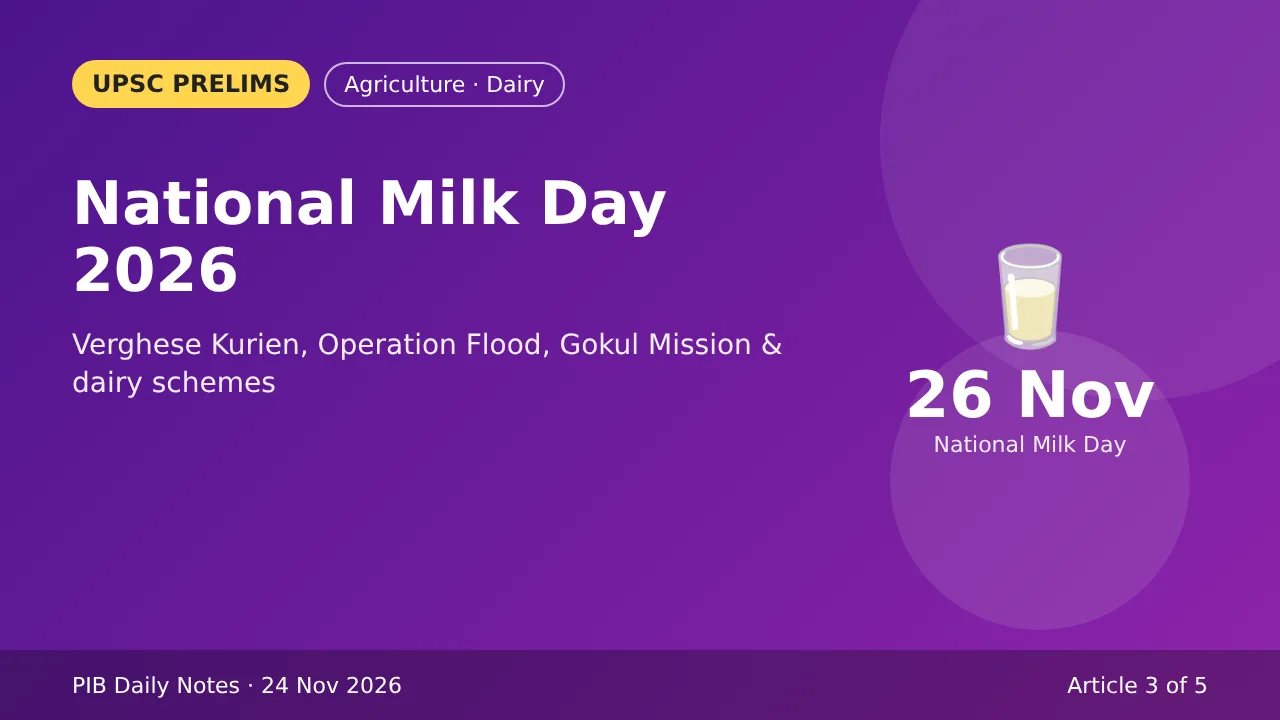
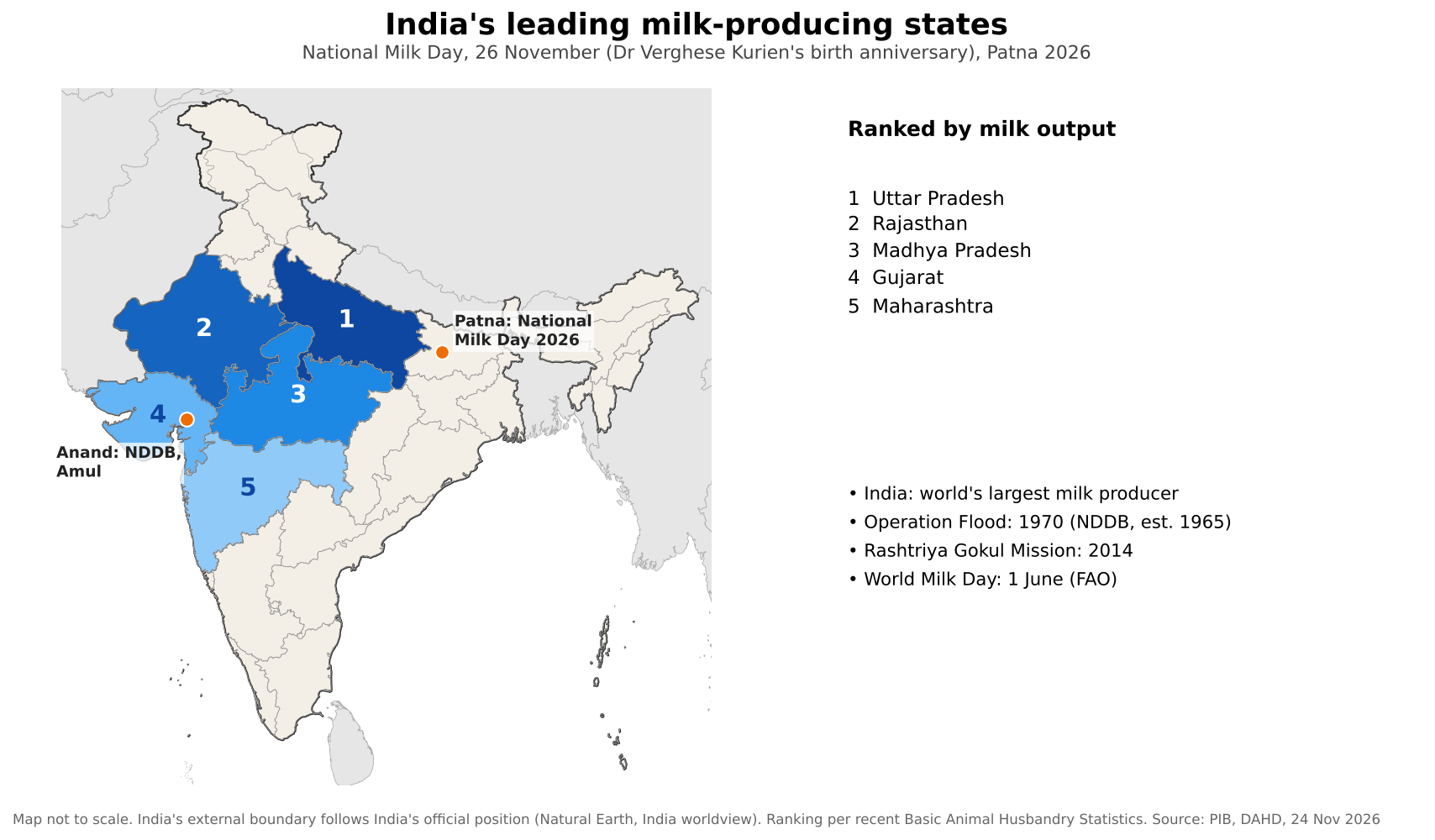
The Department of Animal Husbandry and Dairying will celebrate National Milk Day 2026 on 26 November 2026 at Patna, Bihar. Several dairy projects will be dedicated and new initiatives launched.
News Summary
The National Gopal Ratna Awards 2026 will be presented in three categories:
Best Dairy Farmer Rearing Indigenous Cattle/Buffalo Breeds
Best Artificial Insemination Technician
Best Dairy Cooperative Society / Milk Producer Company / Dairy FPO
Special awards go to winners from the North-Eastern Region and Himalayan States.
Projects under the National Programme for Dairy Development (NPDD):
Data Processing and Milk Collection Units for cooperatives
Mineral Mixture Plants at Patna and Muzaffarpur
An Effluent Treatment Plant at Samastipur
A 2 lakh litres per day milk processing plant near Patna, built with help from the Animal Husbandry Infrastructure Development Fund (AHIDF), will be dedicated.
Launches include:
SOPs and a portal for rating and grading dairy cooperatives and Milk Producer Organisations
A Climate-Resilient Roadmap for India's Livestock and Dairy Sector towards Viksit Bharat @2047
Basic Animal Husbandry Statistics (BAHS) 2026, based on the Integrated Sample Survey (March 2025 to February 2026)
Bihar's Sudha brand will launch makhana kheer and rabri.
Prelims Facts & Static Linkages
Why 26 November
National Milk Day marks the birth anniversary of Dr Verghese Kurien (born 1921), the "Father of the White Revolution".
It was first observed in 2014.
World Milk Day, set by the FAO, is on 1 June.
India's dairy story
India is the world's largest milk producer, with about a quarter of global output.
Operation Flood was launched in 1970 by the National Dairy Development Board (NDDB), set up in 1965 at Anand, Gujarat.
The Anand pattern is a three-tier cooperative model: village society, district union and state federation.
The largest milk-producing states are Uttar Pradesh, Rajasthan, Madhya Pradesh, Gujarat and Maharashtra.
Key schemes
Scheme
Fact
Rashtriya Gokul Mission
Launched in 2014; conserves and develops indigenous cattle and buffalo breeds
NPDD
Builds infrastructure for milk procurement, testing and chilling
AHIDF
Supports private and cooperative investment in dairy and meat processing
LHDCP
Livestock Health and Disease Control Programme; vaccination and veterinary services
National Gopal Ratna Awards
Given since 2021
Cooperatives and recent push
White Revolution 2.0 (2024), led by the Ministry of Cooperation, aims to raise milk procurement by dairy cooperatives.
Major cooperative brands include Amul (Gujarat), Nandini (Karnataka), Aavin (Tamil Nadu), Verka (Punjab) and Sudha (Bihar).
Dairy is the largest agricultural commodity by value in India.
Most milk comes from small and marginal farmers, many of them women.
Milk is outside the Minimum Support Price system; cooperatives pay farmers based on fat and SNF (solids-not-fat) content.
Indigenous breeds
Gir and Kankrej (Gujarat), Sahiwal (Punjab), Red Sindhi, Tharparkar and Rathi (Rajasthan) are well-known dairy cattle breeds.
Murrah (Haryana) is the best-known dairy buffalo breed.
Sex-sorted semen is used to get more female calves.
Quick Revision
National Milk Day is on 26 November, Verghese Kurien's birthday.
World Milk Day is on 1 June.
Operation Flood began in 1970.
NDDB was set up in 1965 at Anand.
Uttar Pradesh is the largest milk-producing state.
The Rashtriya Gokul Mission began in 2014.
Practice MCQ
Q. Consider the following statements:
1. National Milk Day is celebrated on the birth anniversary of Dr Verghese Kurien.
2. Operation Flood was launched by the National Dairy Development Board.
3. World Milk Day is observed on 26 November.
Which of the statements given above are correct?
(a) 1 and 2 only
(b) 2 and 3 only
(c) 1 and 3 only
(d) 1, 2 and 3
Answer: (a). World Milk Day is on 1 June.
Related PYQs
PYQ 1 (UPSC CSE Prelims 2025)
Consider the following statements about the Rashtriya Gokul Mission:
I. It is important for the upliftment of rural poor as majority of low producing indigenous animals are with small and marginal farmers and landless labourers.
II. It was initiated to promote indigenous cattle and buffalo rearing and conservation in a scientific and holistic manner.
Which of the statements given above is/are correct?



 25
Nov 2026
 25
Nov 2026
 25
Nov 2026














0 comments
Discussion
No comments yet. Be the first.