Naxal-Free India: How Left-Wing Extremism Was Defeated
A PIB Backgrounder released on 24 November 2026 set out how India became effectively free from Left-Wing Extremism
DDecode Civils
· 3 min read
Naxal-Free India: How Left-Wing Extremism Was Defeated
Why in News
A PIB Backgrounder released on 24 November 2026 set out how India became effectively free from Left-Wing Extremism (LWE) on 31 March 2026, with no district still classed as LWE-affected. The target had been set on 24 August 2024.
News Summary
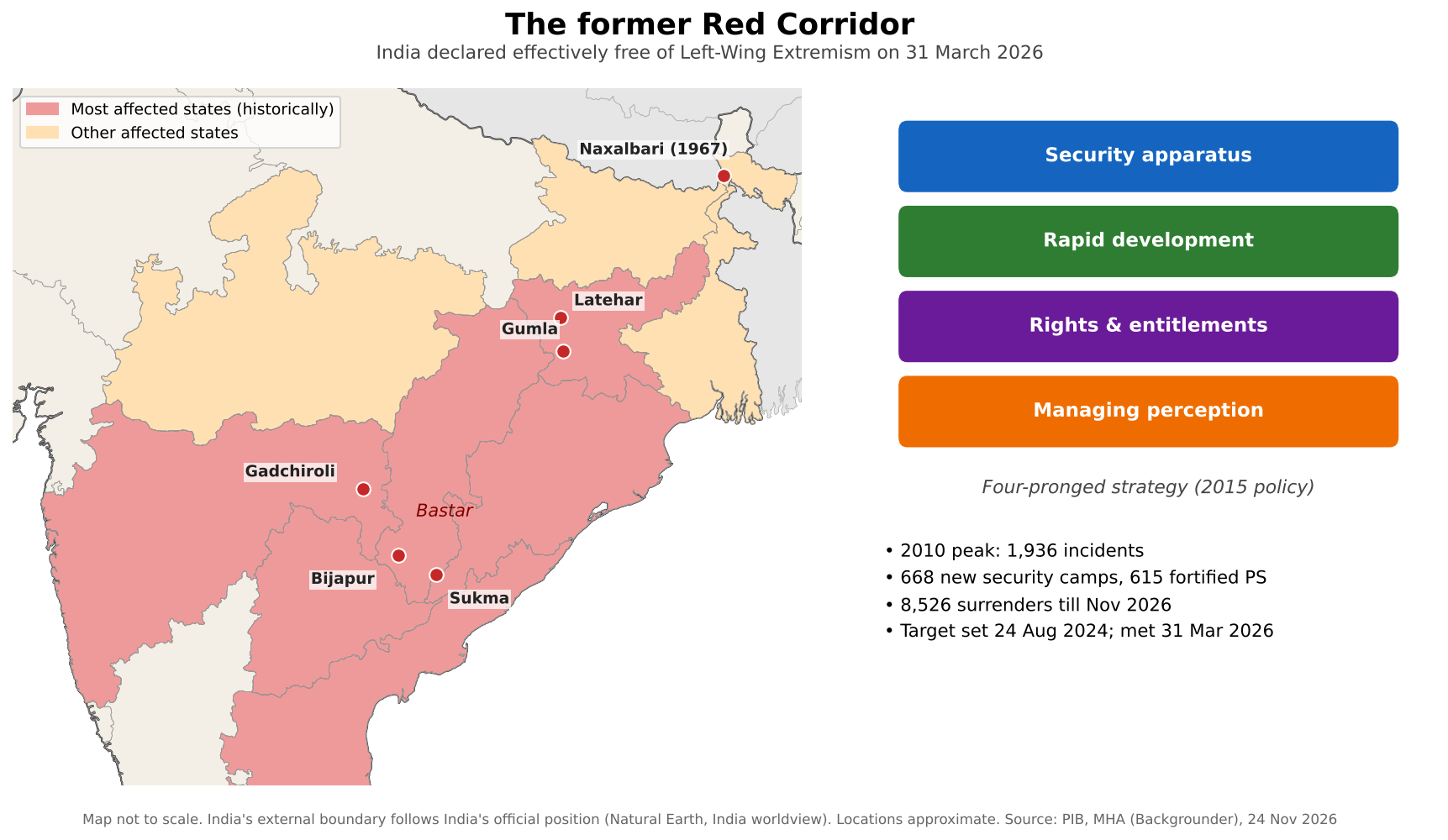
LWE began with the Naxalbari uprising (West Bengal) in 1967, inspired by Maoist ideology.
Several groups merged into the CPI (Maoist) in 2004, which became India's biggest internal security challenge.
2004–2014 was the most violent decade:
17,542 violent incidents
1,913 security personnel and 5,019 civilians killed
Peak year 2010: 1,936 incidents and 720 civilian deaths
The National Policy and Action Plan (2015) replaced fragmented responses with a whole-of-government approach.
The four-pronged strategy covered:
Strengthening the security apparatus
Rapid development
Ensuring rights and entitlements
Managing perception
Security grid:
668 new security camps, against 169 before 2014
615 Fortified Police Stations
68 night-landing helipads
Forces involved: CoBRA, CRPF, District Reserve Guard (DRG), Jharkhand Jaguar and Andhra Pradesh's Greyhounds.
The doctrine of "Trace, Target, Neutralise" used drones, satellite imagery and AI-based data analysis. Operations included Black Forest and Double Bull.
All Politburo and Central Committee members of CPI (Maoist) have been neutralised, 41 since 2014.
The NIA set up a vertical to choke Naxal financing.
About 8,526 Naxalites surrendered up to November 2026. The rehabilitation package includes a grant of ₹5 lakh or ₹2.5 lakh and ₹10,000 a month for 36 months.
Prelims Facts & Static Linkages
The Red Corridor
LWE was concentrated in the forested, mineral-rich, tribal belt of central and eastern India.
The worst-hit states were Chhattisgarh (especially Bastar: Bijapur, Sukma, Dantewada), Jharkhand, Odisha, Maharashtra (Gadchiroli), Telangana and Andhra Pradesh.
Bihar, West Bengal, Madhya Pradesh (Balaghat) and Kerala were also affected.
Funding schemes
Scheme
Purpose
Security Related Expenditure (SRE)
Operational costs, training, rehabilitation and ex gratia; ₹3,877.98 crore since 2014–15
Special Infrastructure Scheme (SIS)
Special forces, intelligence branches and Fortified Police Stations; ₹1,761 crore sanctioned
Special Central Assistance (SCA)
Fills critical development gaps; about ₹4,318.52 crore released since 2017
Forces and terms
CoBRA: Commando Battalion for Resolute Action, a specialised CRPF unit for jungle warfare.
Greyhounds: Andhra Pradesh's elite anti-Naxal force, raised in 1989.
DRG: District Reserve Guard of Chhattisgarh, which recruits local youth and surrendered cadres.
SAMADHAN (2017): the MHA's operational doctrine for LWE areas.
UAPA, 1967: the law under which CPI (Maoist) is banned.
Development push in former LWE areas
Road Connectivity Project for LWE Affected Areas built roads into remote forest areas.
Mobile towers were set up to connect villages that had no network.
Eklavya Model Residential Schools, ITIs and skill centres opened in tribal areas.
Many former LWE districts were part of the Aspirational Districts Programme (2018).
Bank branches, ATMs and post offices improved access to services.
Constitutional linkages
Police and public order are State List subjects (Entries 1 and 2), so the Centre supports states with forces and funds.
Many affected areas are Fifth Schedule areas, where the PESA Act, 1996 and the Forest Rights Act, 2006 protect tribal rights.
Quick Revision
LWE began at Naxalbari, West Bengal, in 1967.
CPI (Maoist) was formed in 2004.
India was declared effectively Naxal-free on 31 March 2026.
The National Policy and Action Plan dates from 2015.
CoBRA is part of the CRPF.
Police and public order are State subjects.
Practice MCQ
Q. Consider the following pairs:
1. CoBRA : Central Reserve Police Force
2. Greyhounds : Andhra Pradesh
3. Naxalbari : Chhattisgarh
How many of the pairs given above are correctly matched?
(a) Only one
(b) Only two
(c) All three
(d) None
Answer: (b). Naxalbari is in West Bengal.
Related PYQs
PYQ 1 (UPSC CSE Prelims 2022)
If a particular area is brought under the Fifth Schedule of the Constitution of India, which one of the following statements best reflects the consequence of it?
(a) This would prevent the transfer of land of tribal people to non-tribal people.
(b) This would create a local self-governing body in that area.
(c) This would convert that area into a Union Territory.
(d) The State having such areas would be declared a Special Category State.



 25
Nov 2026
 24
Nov 2026
 24
Nov 2026














0 comments
Discussion
No comments yet. Be the first.