Year-on-year inflation of 12.29%, up from 11.39% in September 2026. The WPI now uses 2022–23 as its base year.
DDecode Civils
· 3 min read
WPI Inflation Rises to 12.29% in October 2026
Why in News
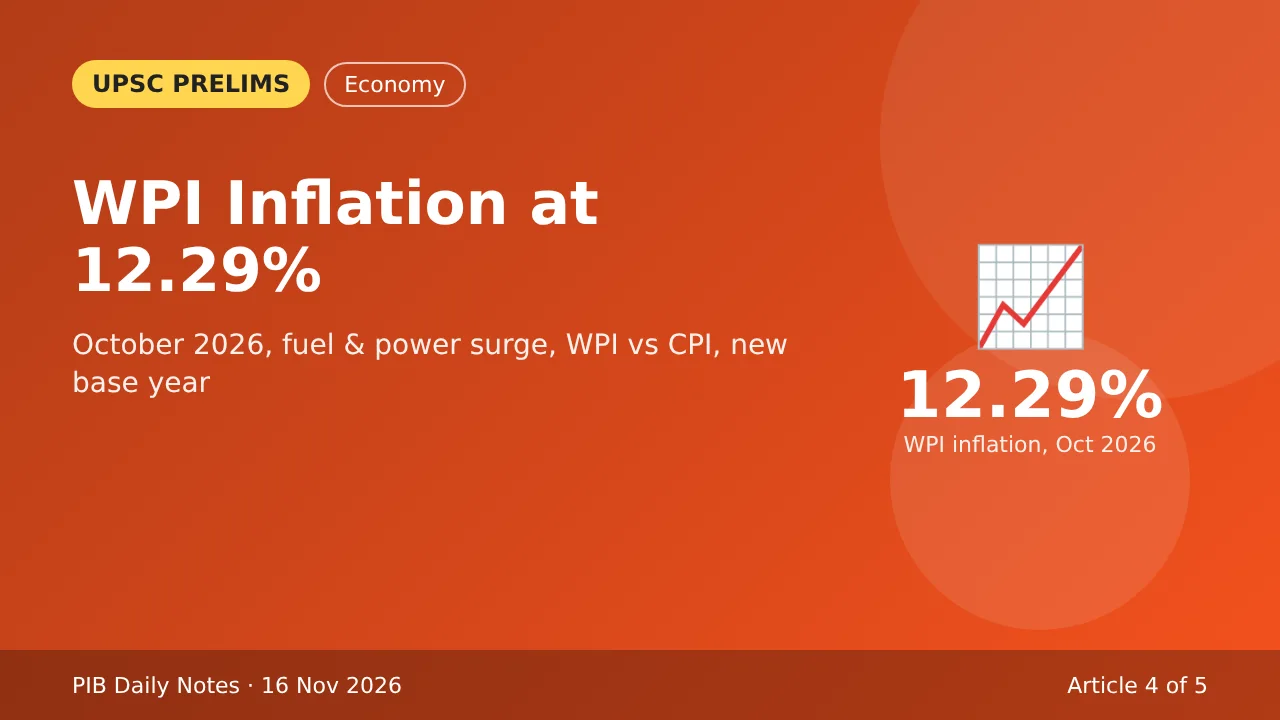
The provisional Wholesale Price Index (WPI) for October 2026, released on 16 November 2026, showed year-on-year inflation of 12.29%, up from 11.39% in September 2026. The WPI now uses 2022–23 as its base year.
News Summary
The all-commodities index rose to 113.3 in October from 112.5 in September.
Inflation by major group in October 2026:
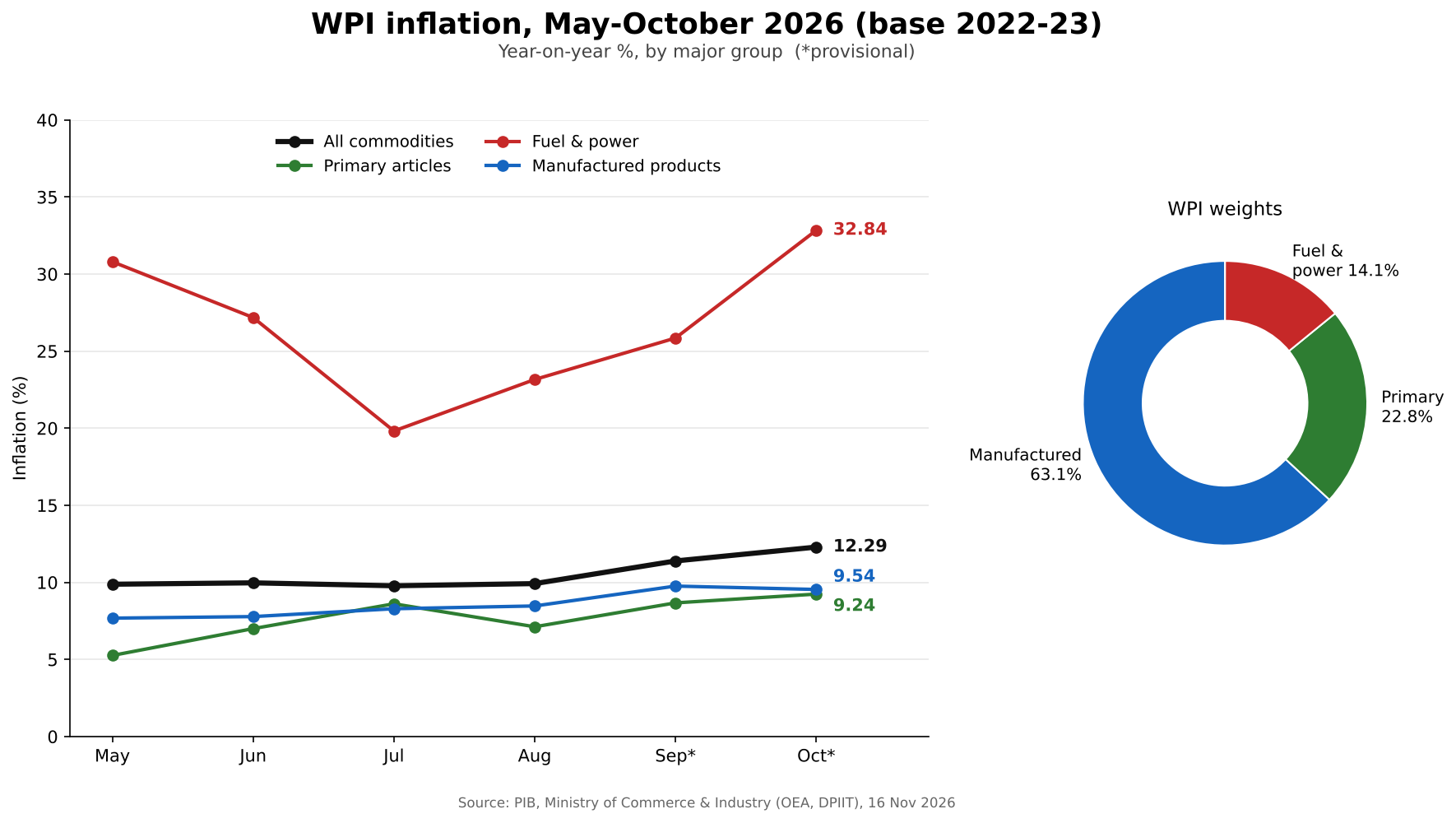
Primary Articles: 9.24% (8.67% in September)
Fuel and Power:32.84% (25.85% in September)
Manufactured Products: 9.54% (9.76% in September)
Fuel and power drove the rise, especially mineral oils, crude petroleum and natural gas, and electricity.
Other drivers included food articles, basic metals, chemicals, food products, non-food articles, textiles, and rubber and plastic products.
The WPI Food Index (weight 24.99%) showed inflation of 8.58%, slightly down from 8.66%.
The final WPI for August 2026 stayed at 110.8, with inflation of 9.92%.
The release also carries the Output Producer Price Index (OPPI) and a trial Input Producer Price Index (IPPI).
WPI, OPPI and IPPI are released on the 14th of the following month.
Prelims Facts & Static Linkages
Weights in the new WPI (base 2022–23)
Manufactured Products: about 63.1%
Primary Articles: about 22.8%
Fuel and Power: about 14.1%
WPI versus CPI
Feature
WPI
CPI
Compiled by
Office of the Economic Adviser, DPIIT (Ministry of Commerce & Industry)
National Statistics Office (NSO), MoSPI
Prices measured
Wholesale, first-stage transactions
Retail prices paid by consumers
Services
Not covered
Covered
Food weight
Lower
Higher
Policy use
Tracks producer-level prices
RBI's inflation target
Inflation targeting
Under flexible inflation targeting, the RBI aims for CPI inflation of 4%, within a band of 2% to 6%.
The framework comes from the RBI Act, 1934 (Section 45ZA), as amended in 2016.
The Monetary Policy Committee (MPC) has six members and sets the repo rate.
Recent changes to price statistics
The WPI base year was revised from 2011–12 to 2022–23, with an updated basket of items and weights.
A Producer Price Index is being introduced to align India with international practice.
High wholesale fuel prices usually pass on to retail prices with a lag, through transport and input costs.
Wholesale inflation is high because of fuel, while food inflation in the WPI eased slightly in October.
Key terms
Producer Price Index (PPI): measures the average change in prices received by producers. Unlike WPI, it removes the effect of taxes and trade margins.
Headline inflation: inflation in the full index.
Core inflation: inflation excluding food and fuel, which are volatile.
Base effect: a low index a year earlier makes this year's inflation rate look higher, and vice versa.
Cost-push inflation: inflation caused by rising input costs, such as fuel.
Demand-pull inflation: inflation caused by demand growing faster than supply.
Deflation: a fall in the general price level, shown by negative inflation.
Disinflation: a fall in the rate of inflation, while prices still rise.
Quick Revision
WPI inflation was 12.29% in October 2026.
Fuel and power inflation was 32.84%.
The new WPI base year is 2022–23.
WPI is compiled by the Office of the Economic Adviser, DPIIT.
WPI does not cover services.
The RBI targets CPI inflation of 4% ± 2%.
Practice MCQ
Q. With reference to the Wholesale Price Index (WPI) in India, consider the following statements:
1. It is compiled by the National Statistics Office.
2. Manufactured products have the highest weight in the index.
3. It is used by the RBI as its inflation target.
Which of the statements given above is/are correct?
(a) 1 only
(b) 2 only
(c) 1 and 3 only
(d) 2 and 3 only
Answer: (b). The OEA in DPIIT compiles WPI, and the RBI targets CPI.
Related PYQs
PYQ 1 (UPSC CSE Prelims 2020)
Consider the following statements:
1. The weightage of food in Consumer Price Index (CPI) is higher than that in Wholesale Price Index (WPI).
2. The WPI does not capture changes in the prices of services, which CPI does.
3. Reserve Bank of India has now adopted WPI as its key measure of inflation and to decide on changing the key policy rates.
Which of the statements given above is/are correct?



 24
Nov 2026
 24
Nov 2026
 24
Nov 2026














0 comments
Discussion
No comments yet. Be the first.