Decode Civils

Kutch Earthquake 2001: Lessons in Recovery

A PIB Backgrounder on 16 November 2026 revisited the Kutch (Bhuj) earthquake of 26 January 2001

Kutch Earthquake 2001: Lessons in Recovery

Kutch Earthquake 2001: Lessons in Recovery

Why in News

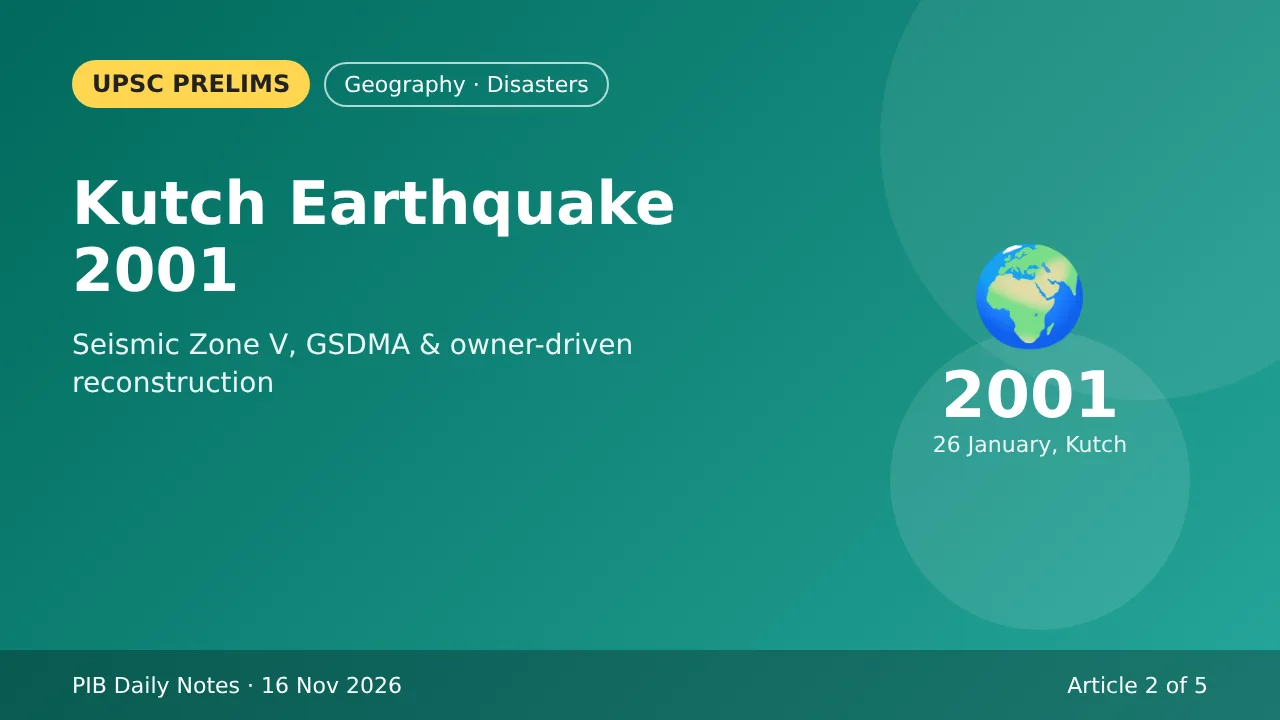
A PIB Backgrounder on 16 November 2026 revisited the Kutch (Bhuj) earthquake of 26 January 2001. It traced how Gujarat moved from emergency relief to an owner-driven, "build back better" reconstruction model.

News Summary

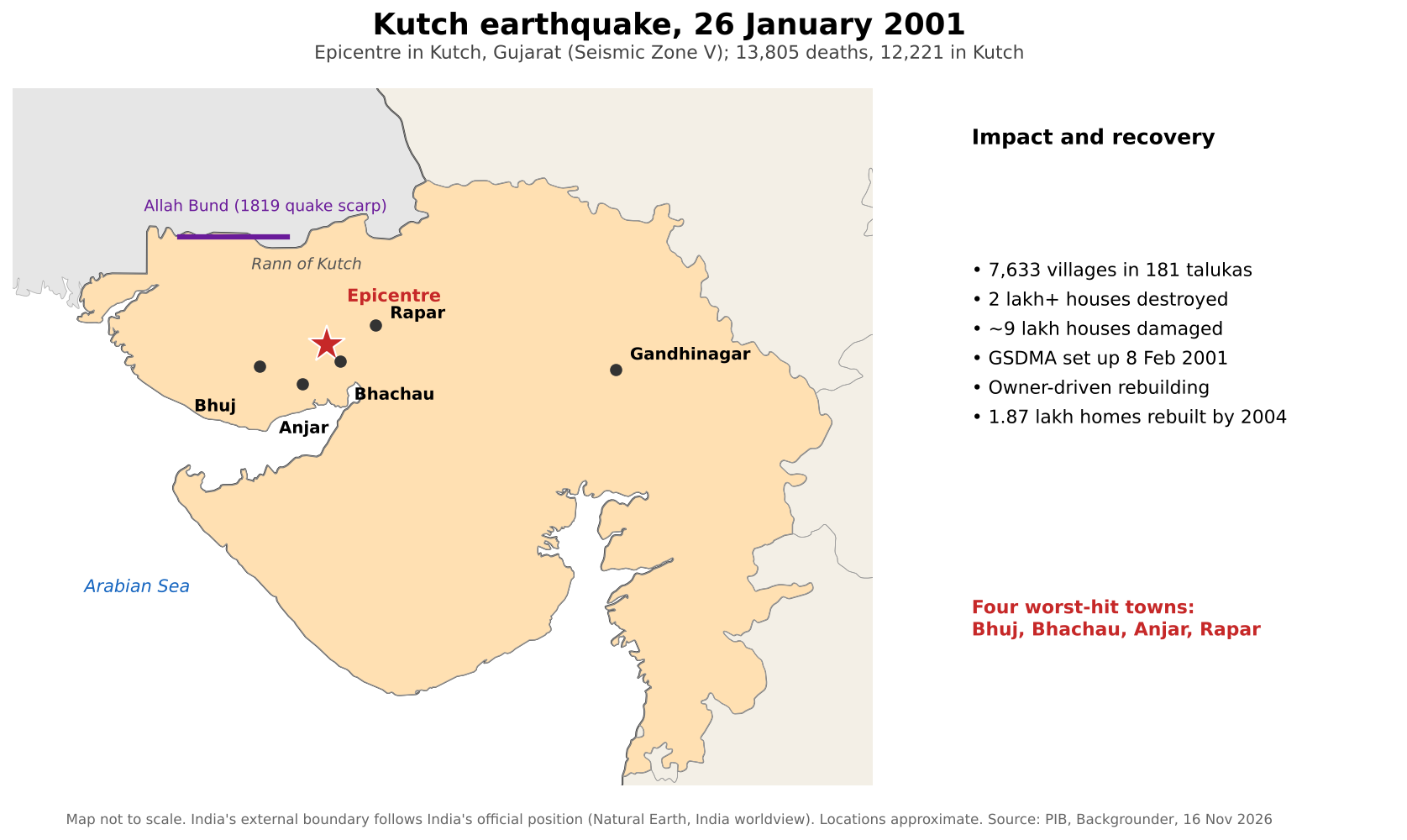
  • The earthquake struck at 8:46 a.m. on 26 January 2001, with its epicentre in Kutch. PIB gives its magnitude as 6.9.

  • Impact:

    • About 7,633 villages in 181 talukas affected, and nearly one crore people

    • 13,805 deaths, including 12,221 in Kutch

    • More than 2 lakh houses destroyed and about 9 lakh damaged

  • Gujarat had plans for cyclones and floods, but no earthquake-specific plan.

  • The Centre released ₹500 crore on the same day.

  • The Gujarat State Disaster Management Authority (GSDMA) was set up on 8 February 2001, modelled on the Orissa SDMA formed after the 1999 super cyclone. It got a legal basis under the Gujarat State Disaster Management Act, 2003.

  • Recovery features:

    • Owner-driven reconstruction, with families rebuilding their own homes

    • Damage graded G1 (minor) to G5 (total)

    • District Judges acted as Ombudsmen for complaints

    • Gram Navrachna Samitis supervised village rebuilding

    • Rebuilt homes were registered jointly in the names of husband and wife

  • By January 2004, about 1.87 lakh houses had been rebuilt.

  • The Bhuj District Civil Hospital was rebuilt with base isolation technology.

Prelims Facts & Static Linkages

Why Kutch shakes

  • Kutch lies in Seismic Zone V, the highest-risk zone on the BIS map.

  • It is an intraplate region: quakes come from old rift faults inside the Indian Plate, not from a plate boundary.

  • The 1819 Rann of Kutch earthquake created a natural fault scarp called the Allah Bund.

Seismic zones of India

ZoneRiskExamples
VVery highNorth-East, J&K, Himachal, Uttarakhand, Kutch, Andaman & Nicobar
IVHighDelhi, parts of the Indo-Gangetic plain
IIIModerateLarge parts of the Peninsula
IILowStable parts of the Deccan plateau

Earthquake basics

  • Focus (hypocentre): the point inside the Earth where rupture starts.

  • Epicentre: the point on the surface directly above the focus.

  • P-waves travel through solids and liquids and arrive first. S-waves travel only through solids, so they cannot cross the liquid outer core. Surface waves cause most damage.

  • Magnitude measures energy released, while intensity measures shaking and damage at a place.

  • Base isolation places flexible bearings between a building and its foundation so less shaking reaches the building.


Other major Indian earthquakes

  • 1934 Bihar–Nepal, 1950 Assam (Medog), 1993 Latur (Maharashtra) and 2005 Kashmir.

  • Latur (1993) showed that even the "stable" Peninsula can have damaging quakes.

Disaster management framework

  • The Disaster Management Act, 2005 came after the 2004 Indian Ocean tsunami.

  • It set up the NDMA, chaired by the Prime Minister, and SDMAs chaired by Chief Ministers.

  • The NDRF was formed under the same Act.

  • The Sendai Framework (2015–2030) is the global framework for disaster risk reduction.

Quick Revision

  • The Kutch earthquake struck on 26 January 2001.

  • GSDMA was set up on 8 February 2001, modelled on the Orissa SDMA.

  • Kutch lies in Seismic Zone V.

  • S-waves cannot pass through liquids.

  • The Disaster Management Act was passed in 2005, and the PM chairs the NDMA.

  • Bhuj's hospital uses base isolation.

Practice MCQ

Q. With reference to earthquakes, consider the following statements:

1. The epicentre is the point inside the Earth where the rupture begins.

2. S-waves cannot travel through the Earth's liquid outer core.

3. The Kutch region lies in Seismic Zone V.

Which of the statements given above are correct?

(a) 1 and 2 only

(b) 2 and 3 only

(c) 1 and 3 only

(d) 1, 2 and 3

Answer: (b). The point inside the Earth is the focus.

Related PYQs

PYQ 1 (UPSC CSE Prelims 2024)

Consider the following:

1. Pyroclastic debris

2. Ash and dust

3. Nitrogen compounds

4. Sulphur compounds

How many of the above are products of volcanic eruptions?

(a) Only one

(b) Only two

(c) Only three

(d) All four

Answer: (d).

Join Decode Civils Telegram Group For Free UPSC CSE Guidance From Mudit Jain, Ex-IPS, Ex-IRS

You can reach me at Instagram, LinkedIn, Twitter, Facebook, Youtube and Telegram.

Click Here to Learn More About

Decode Civils' UPSC Prelims 2027 Courses

Decode Civils' UPSC Mains 2027 Courses

Source: PIB, PIB Backgrounder

Downloads

0 comments

Discussion

Comments are read before they appear.

No comments yet. Be the first.

Preparing for UPSC?

Talk to us about the right programme for your attempt.

+91

By continuing, you agree to our terms & conditions.

Keep reading

Our programmes

View all courses →
Featured PYQ Edge
Prelims PYQ Edge

PYQ Edge

A PYQ mastery program: use PYQs to build an edge in your Prelims score

PYQ Edge Starts 15 Dec 2026

₹2,359 ₹2,949

Learn More: PYQ Edge