Self-enumeration for Phase II (Population Enumeration) of Census 2027 began on 16 November 2026
DDecode Civils
· 3 min read
Census 2027: Self-Enumeration for Phase II Begins
Why in News
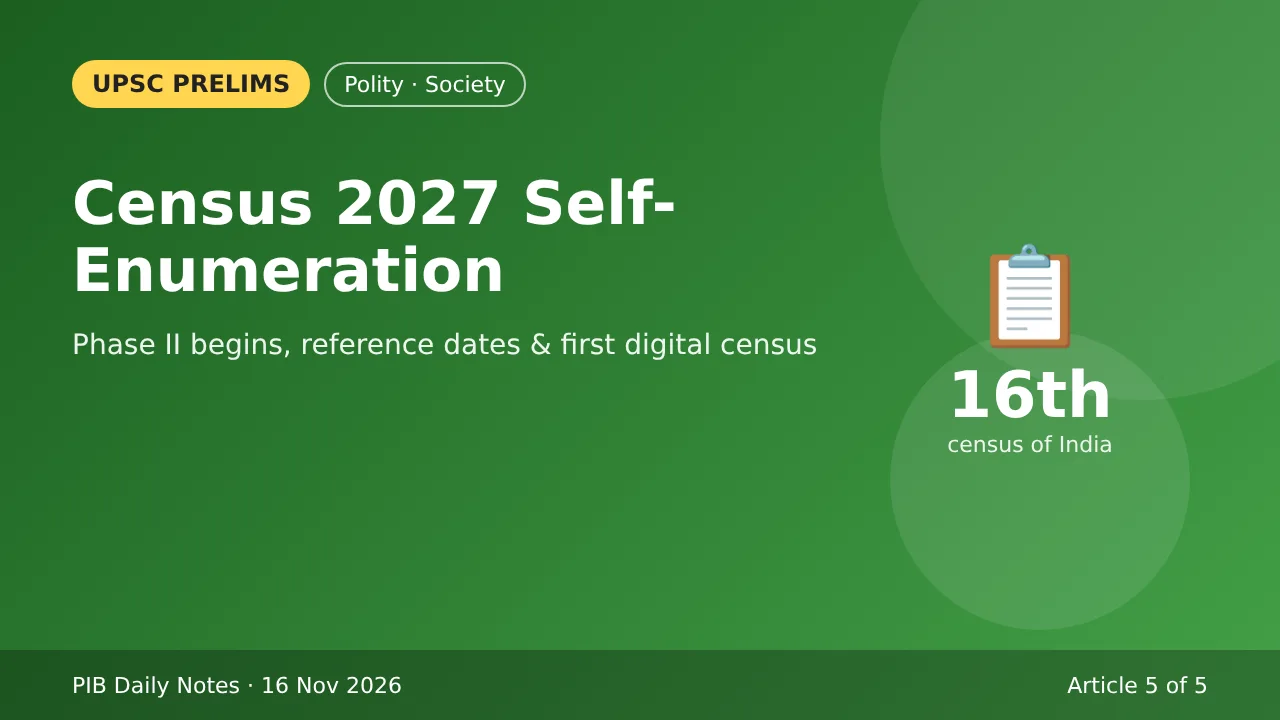
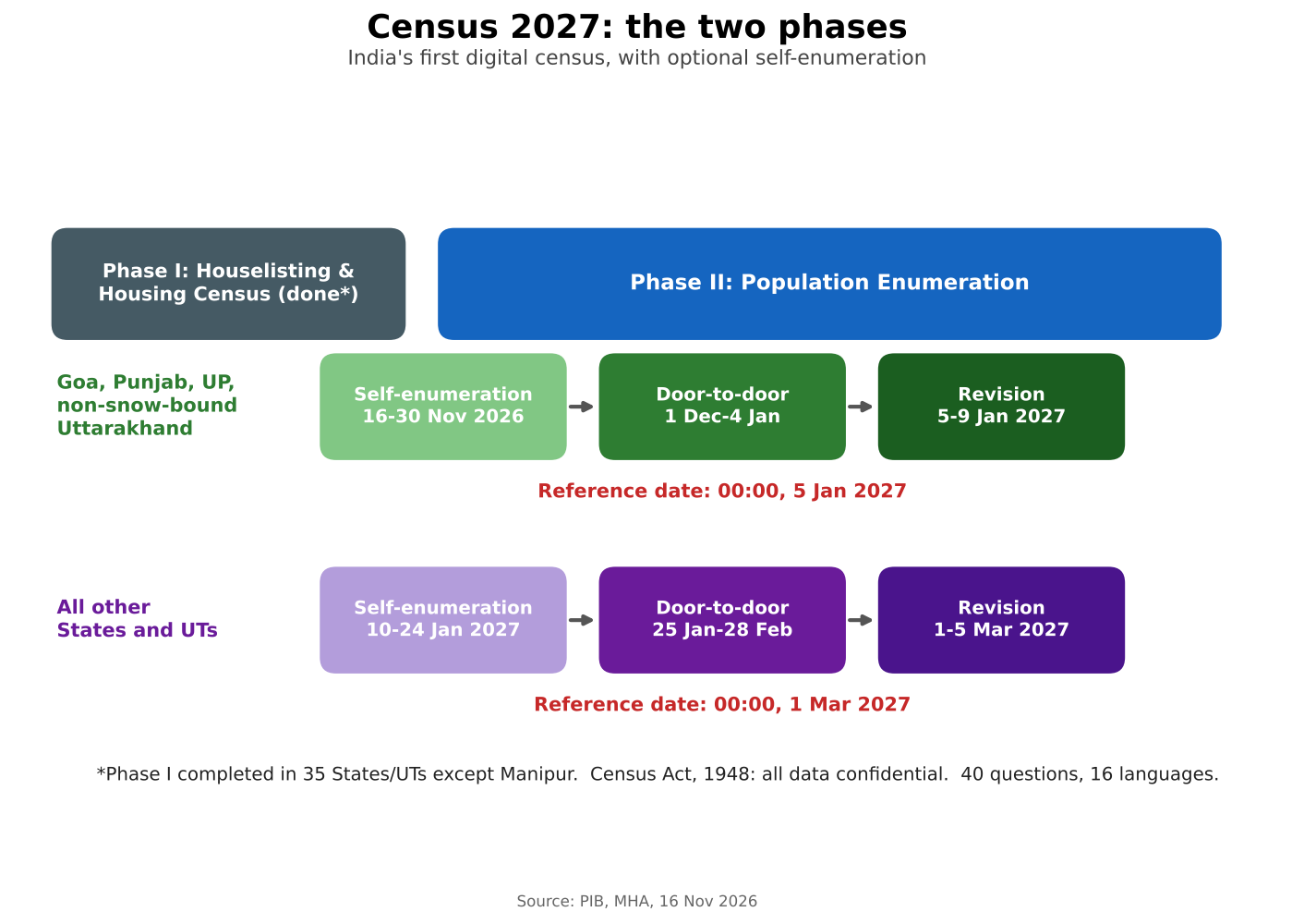
Self-enumeration for Phase II (Population Enumeration) of Census 2027 began on 16 November 2026 in Goa, Punjab, Uttar Pradesh and the non-snow-bound areas of Uttarakhand. Residents can submit details online until 30 November 2026.
News Summary
First group of states (Goa, Punjab, UP and non-snow-bound Uttarakhand):
House-to-house enumeration from 1 December 2026 to 4 January 2027
Revisional round from 5 to 9 January 2027
Reference date: 00:00 hours on 5 January 2027
Remaining states and UTs:
Self-enumeration from 10 to 24 January 2027
House-to-house enumeration from 25 January to 28 February 2027
Revisional round from 1 to 5 March 2027
Reference date: 00:00 hours on 1 March 2027
Phase I (Houselisting and Housing Census) is complete in 35 states and UTs, except Manipur.
Census 2027 is the first census using digital tools. Self-enumeration is a new, optional facility.
How self-enumeration works:
Log in at the official portal with a mobile number.
Answer 40 notified questions on household and individual details.
Share the Self-Enumeration ID with the enumerator during the field visit.
The portal works in 16 Indian languages.
Enumerators will still visit every block.
All information is confidential under the Census Act, 1948.
Prelims Facts & Static Linkages
Two phases of the Census
Phase I, Houselisting and Housing Census: records buildings, housing conditions, amenities and assets.
Phase II, Population Enumeration: records each person's age, sex, education, occupation, migration and other details.
Census basics
Fact
Detail
Legal basis
Census Act, 1948
Constitutional entry
Union List, Entry 69 (Seventh Schedule)
Conducted by
Registrar General and Census Commissioner of India, under the Ministry of Home Affairs
First census (non-synchronous)
1872
First synchronous census
1881
First census after Independence
1951
Census 2027
16th census, and the 8th since Independence
Why the Census matters
It is the base for delimitation of constituencies and for SC/ST seat reservation.
Women's reservation under the 106th Amendment will start after delimitation based on the first census after 2023.
It is also used to divide central taxes among states, since the Finance Commission uses population data.
It is the main source of village- and town-level data.
It is the source of data on population, literacy, sex ratio and migration used for planning.
Census 2027 will also enumerate caste, for the first time since 1931 for all communities.
Census versus other surveys
The Census counts everyone, every ten years.
The Sample Registration System (SRS) gives yearly birth, death and fertility rates from a sample.
The National Family Health Survey (NFHS) covers health and nutrition, run by the Ministry of Health.
The National Population Register (NPR) is a register of usual residents, prepared under the Citizenship Act, 1955.
Census 2011 at a glance
Population: 121.09 crore
Sex ratio: 943 females per 1,000 males
Literacy rate: 74.04%
Decadal growth: 17.7%
Quick Revision
Self-enumeration for Phase II began on 16 November 2026 in Goa, Punjab, UP and non-snow-bound Uttarakhand.
The main reference date is 1 March 2027.
Census 2027 is the first digital census.
The Census is conducted under the Census Act, 1948.
The Census is in Entry 69 of the Union List.
India's first synchronous census was held in 1881.
Practice MCQ
Q. With reference to the Census in India, consider the following statements:
1. Census is a subject in the Concurrent List.
2. The Census is conducted under the Census Act, 1948.
3. The first synchronous census was conducted in 1881.
Which of the statements given above are correct?
(a) 1 and 2 only
(b) 2 and 3 only
(c) 1 and 3 only
(d) 1, 2 and 3
Answer: (b). Census is in the Union List.
Related PYQs
PYQ 1 (UPSC CSE Prelims 2009)
Consider the following statements:
1. Between Census 1951 and Census 2001, the density of the population of India has increased more than three times.
2. Between Census 1951 and Census 2001, the annual growth rate (exponential) of the population of India has doubled.
Which of the statements given above is/are correct?



 24
Nov 2026
 24
Nov 2026
 24
Nov 2026














0 comments
Discussion
No comments yet. Be the first.