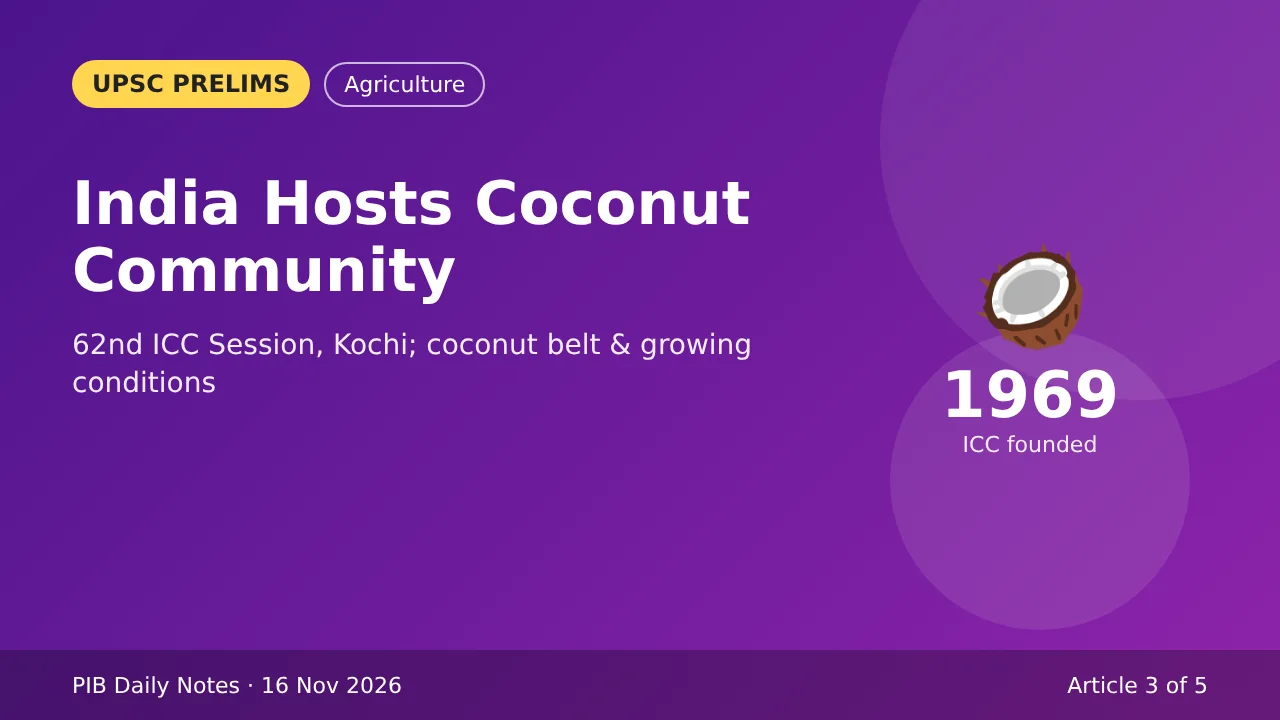
India is hosting the 62nd Session and Ministerial Meeting of the International Coconut Community (ICC) at Kochi, Kerala
DDecode Civils
· 3 min read
India Hosts the International Coconut Community
Why in News
India is hosting the 62nd Session and Ministerial Meeting of the International Coconut Community (ICC) at Kochi, Kerala, from 17 to 20 November 2026. It is jointly organised by the Coconut Development Board (CDB) and the ICC.
News Summary
The ICC was set up in 1969 under the aegis of the UN Economic and Social Commission for Asia and the Pacific (UN-ESCAP).
It is an inter-governmental organisation of coconut-producing countries, headquartered in Jakarta, Indonesia.
It gives members a common platform to discuss the coconut sector, promote cooperation and grow the industry sustainably.
Union Minister of State for Agriculture Ram Nath Thakur inaugurates the session.
Ministers from Pacific island members, including the Marshall Islands, Kiribati and Samoa, are taking part.
ICC Plaques of Appreciation will be given in three categories:
Best National Coconut Farmer
Outstanding Coconut Scientist/Researcher
Best National Coconut Entrepreneur
The meeting aims to share best practices and tackle emerging challenges in the global coconut industry.
Prelims Facts & Static Linkages
Coconut in India
India is one of the world's top three coconut producers, along with Indonesia and the Philippines.
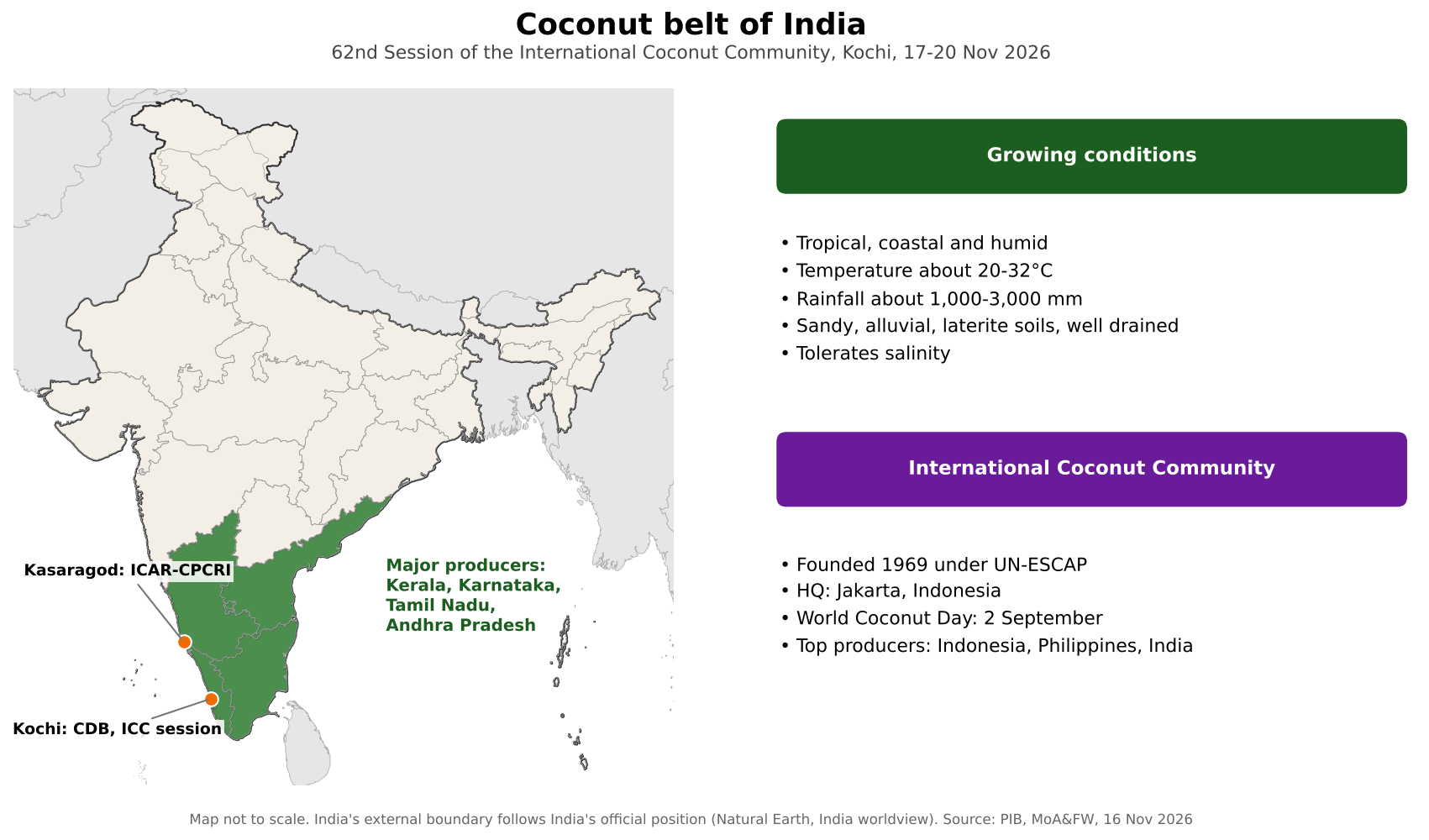
Kerala, Karnataka, Tamil Nadu and Andhra Pradesh grow most of India's coconuts.
Kerala's name is often linked to "kera", meaning coconut palm.
Coconut is called "Kalpavriksha" (the tree of heaven) because every part of it is useful.
Growing conditions
A tropical crop of coastal and humid regions.
Grows best at about 20–32°C, with well-distributed rainfall of about 1,000–3,000 mm.
Suits sandy, alluvial and laterite soils with good drainage.
Tolerates salinity, which is why it thrives along coasts.
Grows mostly below about 600 m altitude, close to the equator.
Institutions
Body
Fact
Coconut Development Board
Statutory body under the Coconut Development Board Act, 1979; set up in 1981; HQ Kochi
ICAR-CPCRI
Central Plantation Crops Research Institute, Kasaragod (Kerala)
International Coconut Community
Founded 1969; HQ Jakarta; formerly the Asian and Pacific Coconut Community
World Coconut Day
2 September, the ICC's founding date
Major producing states
State
Note
Kerala
Traditional coconut heartland; CDB and CPCRI are here
Karnataka
Among the largest producers in recent years
Tamil Nadu
High productivity per palm
Andhra Pradesh
Mainly in the coastal Godavari districts
Threats to the crop
Root (wilt) disease, a serious problem in Kerala.
Rhinoceros beetle and red palm weevil pests.
Price swings in copra and coconut oil, and competition from palm oil.
Coconut products and policy
Copra is dried coconut kernel, used to extract coconut oil.
The Centre announces a Minimum Support Price for milling copra and ball copra, recommended by the CACP.
Neera is the sweet, unfermented sap tapped from coconut flower spikes, promoted as a health drink.
Virgin coconut oil and coconut water are fast-growing value-added products.
Coir comes from coconut husk. The Coir Board (Kochi) works under the Ministry of MSME.
Coconut is a plantation crop under horticulture statistics.
Quick Revision
The ICC was set up in 1969 under UN-ESCAP, with headquarters in Jakarta.
India is hosting its 62nd Session at Kochi.
The Coconut Development Board is in Kochi.
CPCRI is at Kasaragod.
World Coconut Day is 2 September.
Coir Board works under the Ministry of MSME.
Practice MCQ
Q. With reference to the International Coconut Community, consider the following statements:
1. It was established under the aegis of UN-ESCAP.
2. It is headquartered in Manila, Philippines.
3. India is a member of the organisation.
Which of the statements given above are correct?
(a) 1 and 2 only
(b) 1 and 3 only
(c) 2 and 3 only
(d) 1, 2 and 3
Answer: (b). The ICC is headquartered in Jakarta.
Related PYQs
PYQ 1 (UPSC CSE Prelims 2024)
Consider the following:
1. Cashew
2. Papaya
3. Red sanders
How many of the above trees are actually native to India?



 24
Nov 2026
 24
Nov 2026
 24
Nov 2026














0 comments
Discussion
No comments yet. Be the first.