National Entrepreneurship Day: India's Startup Ecosystem
PIB released a backgrounder on India's entrepreneurship ecosystem, which now has over 2.62 lakh DPIIT-recognised startups
DDecode Civils
· 3 min read
National Entrepreneurship Day: India's Startup Ecosystem
Why in News
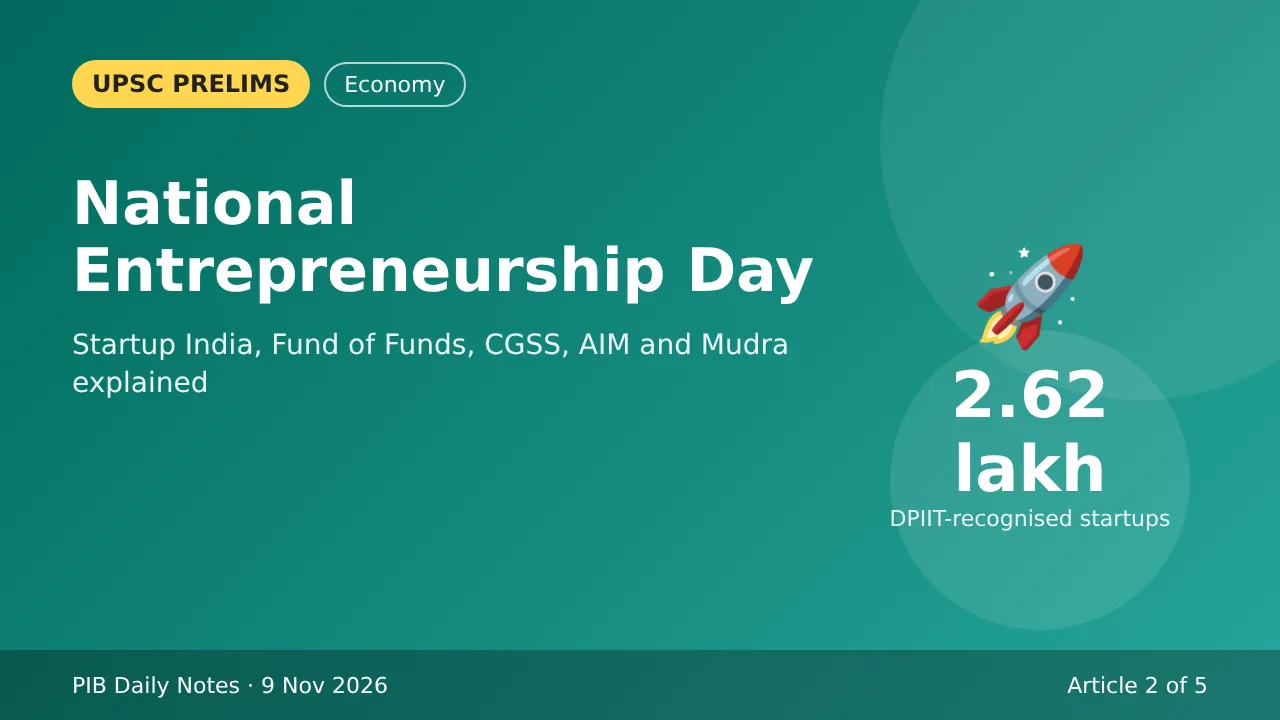
National Entrepreneurship Day was observed on 9 November 2026. PIB released a backgrounder on India's entrepreneurship ecosystem, which now has over 2.62 lakh DPIIT-recognised startups and is the world's third-largest startup ecosystem.
News Summary
The day marks the founding of the Ministry of Skill Development and Entrepreneurship (MSDE) on 9 November 2014.
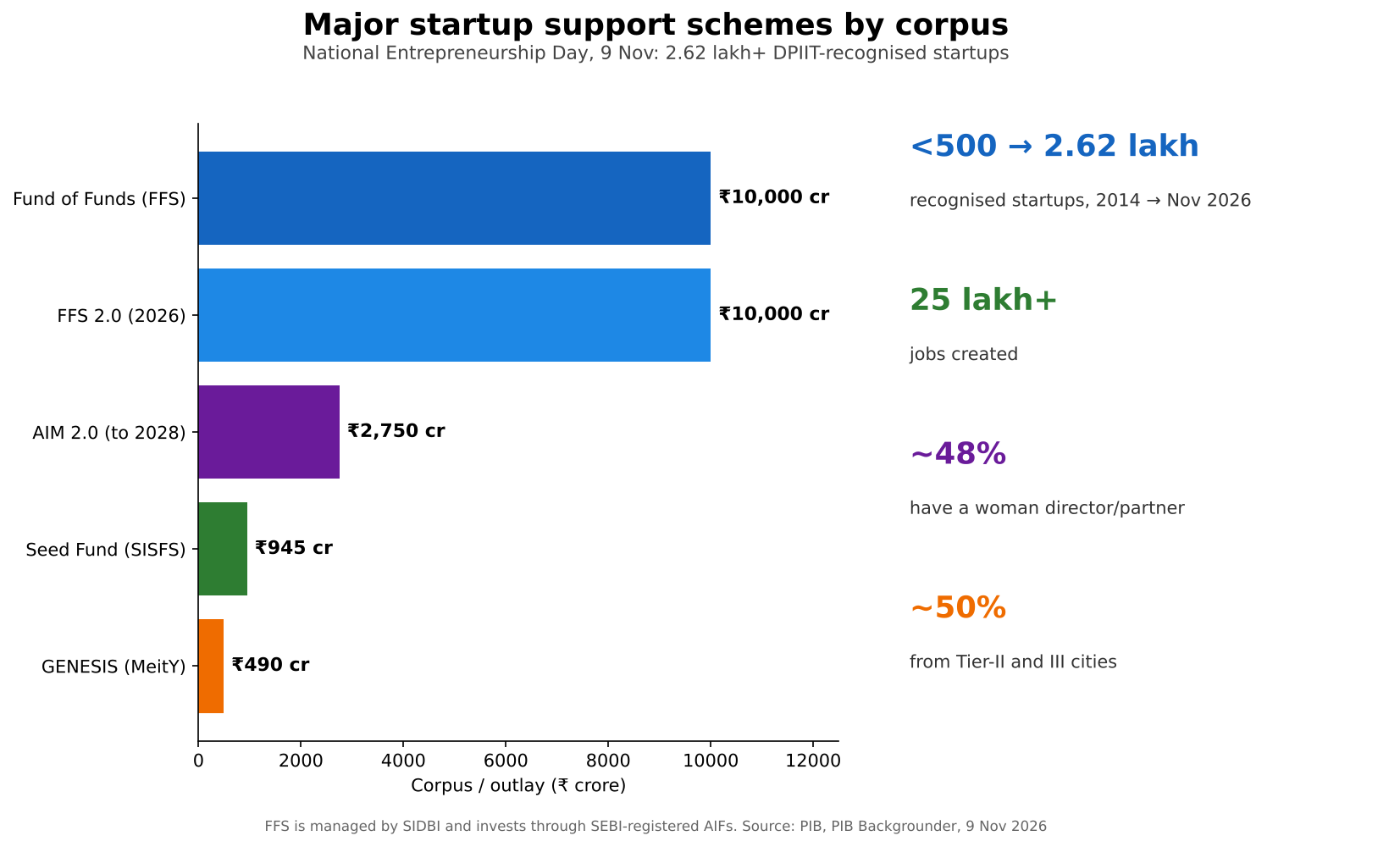
Recognised startups grew from fewer than 500 in 2014 to over 2.62 lakh by November 2026.
55,200+ startups were recognised in FY 2025-26, the most in any year since 2016, a rise of 51.6% over the previous year.
Startups have created over 25 lakh jobs (up to October 2026).
About 48% of recognised startups have at least one woman director or partner.
Nearly half come from Tier-II and Tier-III cities.
Maharashtra, Karnataka, Uttar Pradesh, Delhi and Gujarat lead in numbers and jobs.
Prelims Facts & Static Linkages
Key schemes in the backgrounder
Scheme
Year
Key facts
Startup India
2016
DPIIT's flagship initiative
Fund of Funds for Startups (FFS)
2016
₹10,000 crore, managed by SIDBI, invests through SEBI-registered AIFs; FFS 2.0 (April 2026) adds ₹10,000 crore for deep-tech and manufacturing
Credit Guarantee Scheme for Startups (CGSS)
2023
Collateral-free loans; cover raised from ₹10 crore to ₹20 crore per borrower
Startup India Seed Fund Scheme (SISFS)
2021
₹945 crore for proof of concept, prototypes and market entry, through incubators
Atal Innovation Mission (AIM)
2016
Under NITI Aayog; AIM 2.0 has ₹2,750 crore up to March 2028
PM Mudra Yojana
2015
Collateral-free loans up to ₹20 lakh to non-corporate, non-farm micro enterprises
NIDHI
2016
DST umbrella programme for technology startups and incubators
GENESIS
2022
MeitY, ₹490 crore to scale about 1,600 tech startups in Tier-II and III cities
Mudra loan categories
Shishu: up to ₹50,000.
Kishor: above ₹50,000 and up to ₹5 lakh.
Tarun: above ₹5 lakh and up to ₹10 lakh.
Tarun Plus: above ₹10 lakh and up to ₹20 lakh.
Alternative Investment Funds (AIFs)
AIFs are privately pooled funds regulated by SEBI under the AIF Regulations, 2012.
Category I: venture capital, angel, SME, social venture and infrastructure funds.
Category II: private equity and debt funds.
Category III:hedge funds and funds that trade with leverage.
Bonds and stocks bought directly are not AIFs.
Other facts
SIDBI was set up in 1990 as the apex bank for MSMEs.
The MeitY Startup Hub (2016) links incubators and centres of excellence.
TIDE 2.0 (2019) supports ICT startups through 51 incubators.
The MAARG portal connects startups with mentors.
The Startup India Investor Connect Portal (2023), built with SIDBI, lets a startup reach many investors through one application; 11,582 startups are registered.
Under FFS, SIDBI has committed ₹12,623 crore to 166 AIFs, which have invested ₹28,254 crore in 1,475 startups.
CGSS charges a reduced 1% annual guarantee fee for 27 Champion Sectors such as aerospace, defence and biotechnology.
The 'angel tax' on startup share premiums was abolished in the Union Budget 2024-25.
Quick Revision
National Entrepreneurship Day is 9 November; MSDE was set up in 2014.
India has 2.62 lakh+ recognised startups and the third-largest ecosystem.
FFS is managed by SIDBI and invests through AIFs.
CGSS cover is now ₹20 crore per borrower.
AIM is run by NITI Aayog.
Mudra's Tarun Plus goes up to ₹20 lakh.
Practice MCQ
Q. With reference to the Fund of Funds for Startups (FFS), consider the following statements:
1. It is managed by the Small Industries Development Bank of India.
2. It invests directly in startups without any intermediary.
3. It is an initiative of NITI Aayog.
Which of the statements given above is/are correct?
(a) 1 only
(b) 1 and 2 only
(c) 2 and 3 only
(d) 1, 2 and 3
Answer: (a). FFS is a DPIIT initiative and invests through SEBI-registered AIFs.
Related PYQs
PYQ 1 (UPSC CSE Prelims 2025)
With reference to investments, consider the following:
1. Bonds
2. Hedge Funds
3. Stocks
4. Venture Capital
How many of the above are treated as Alternative Investment Funds?



 28
Nov 2026
 28
Nov 2026
 28
Nov 2026














0 comments
Discussion
No comments yet. Be the first.