On 6 November 2026, the Department of Food and Public Distribution doubled the target for rice sales through e-auctions
DDecode Civils
· 4 min read
OMSS (D) Rice Target Doubled to 50 Lakh Tonnes
Why in News
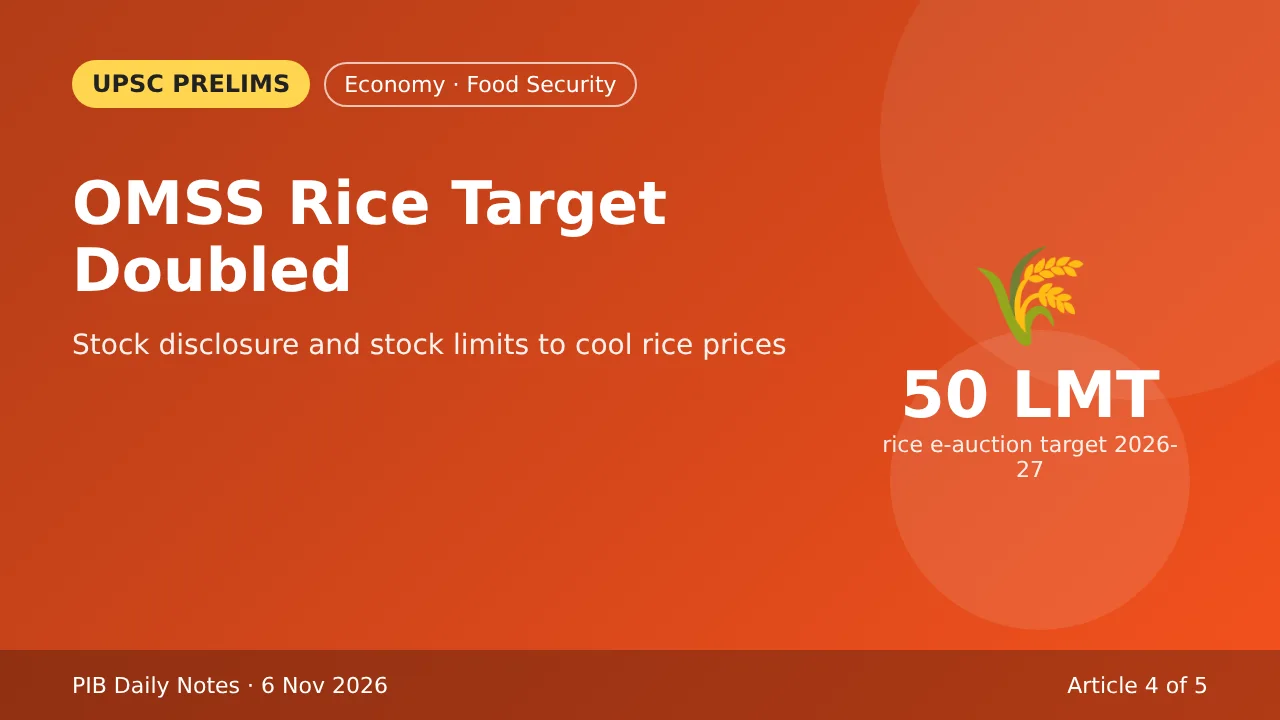
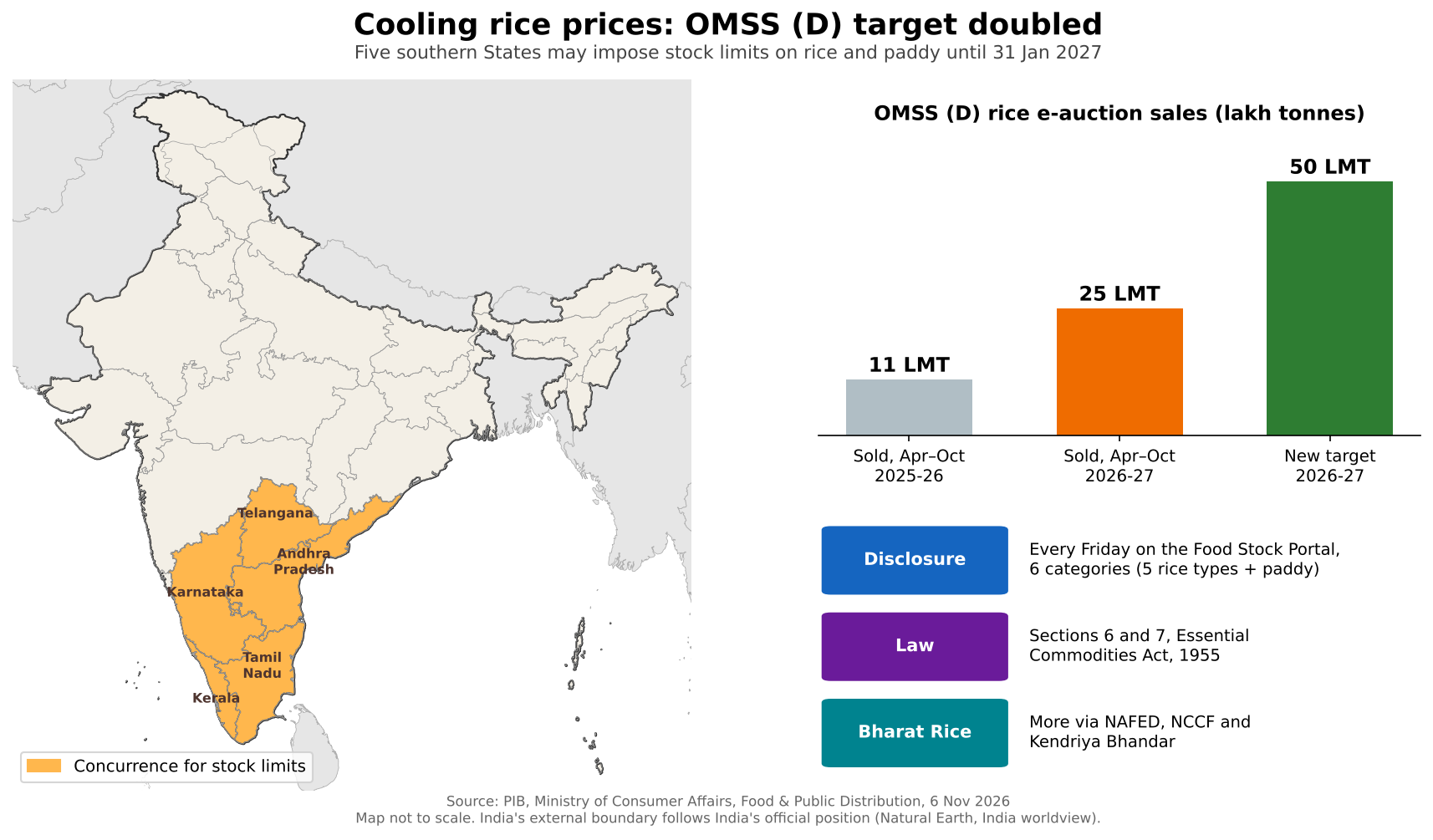
On 6 November 2026, the Department of Food and Public Distribution doubled the target for rice sales through e-auctions under the Open Market Sale Scheme (Domestic) [OMSS (D)] for 2026-27 from 25 to 50 lakh metric tonnes (LMT). It also ordered mandatory weekly disclosure of rice and paddy stocks to curb hoarding and cool prices.
News Summary
25 LMT of rice had already been sold through OMSS (D) e-auctions up to 31 October 2026, against 11 LMT in the same period of the previous year.
Stock disclosure: all traders and wholesalers, retailers, big chain retailers and processors or millers must declare stocks every Friday on the Food Stock Portal, in six categories: basmati, non-basmati premium, non-basmati, parboiled and broken rice, and paddy.
Unregistered entities or those breaching stock limits face action under Sections 6 and 7 of the Essential Commodities Act, 1955.
Stock limits: the Centre gave concurrence to Andhra Pradesh, Karnataka, Kerala, Tamil Nadu and Telangana to impose stock limits on rice and paddy, where needed, until 31 January 2027.
Bharat Rice: additional allocation to NAFED, NCCF and Kendriya Bhandar, with a focus on the Southern States.
Prelims Facts & Static Linkages
How OMSS (D) works
The Food Corporation of India (FCI) sells surplus wheat and rice from the Central Pool at pre-determined reserve prices through e-auctions to private buyers such as traders, millers and processors.
Purpose: to raise market supply in the lean season, moderate open-market prices and cut the carrying cost of stocks above buffer norms.
It is a market intervention tool, separate from the Targeted Public Distribution System under the National Food Security Act, 2013.
Tools to manage food prices
Tool
What it does
Buffer stock norms
Minimum Central Pool stocks for each quarter
OMSS (D)
Sale of surplus FCI grain in the open market
Essential Commodities Act, 1955
Stock limits and control orders against hoarding
Price Stabilisation Fund
Buffer of pulses and onions, among others, run by the Department of Consumer Affairs
Bharat brand
Rice, atta and dal sold at subsidised retail prices through NAFED, NCCF and Kendriya Bhandar
Key terms
Central Pool: grain procured by FCI and State agencies at Minimum Support Price (MSP) for the PDS and buffer.
Stock limit: the maximum quantity a trader may hold, imposed through a control order under Section 3 of the ECA.
Section 6 and 7 of the ECA: confiscation of stocks and penalties for breaking control orders.
Decentralised Procurement (DCP): States procure and distribute grain themselves on behalf of the Centre.
Likely Prelims angles
Who runs OMSS (D) and how sales are made (FCI, e-auctions).
The legal basis for stock limits (Essential Commodities Act).
The difference between buffer stocks and operational stocks.
Quick Revision
The OMSS (D) rice target for 2026-27 was doubled from 25 to 50 LMT.
25 LMT was sold by 31 October 2026, against 11 LMT a year earlier.
All rice and paddy stockists must report every Friday on the Food Stock Portal.
Five southern States may impose stock limits until 31 January 2027.
More Bharat Rice goes to NAFED, NCCF and Kendriya Bhandar.
Practice MCQ
Q. With reference to the Open Market Sale Scheme (Domestic), consider the following statements:
1. Under the scheme, the Food Corporation of India sells surplus wheat and rice through e-auctions.
2. Grain sold under the scheme is distributed to Antyodaya Anna Yojana households.
3. One aim of the scheme is to moderate open-market prices of food grains.
Which of the statements given above is/are correct?
(a) 1 and 2 only
(b) 1 and 3 only
(c) 2 and 3 only
(d) 1, 2 and 3
Answer: (b). OMSS (D) sales go to private buyers in the open market, not through the PDS.
Related PYQs
PYQ 1 (UPSC CSE Prelims 2020)
Which of the following factors/policies were affecting the price of rice in India in the recent past?
1. Minimum Support Price
2. Government's trading
3. Government's stockpiling
4. Consumer subsidies
Select the correct answer using the code given below:
(a) 1, 2 and 4 only
(b) 1, 3 and 4 only
(c) 2 and 3 only
(d) 1, 2, 3 and 4
Answer: (d).
PYQ 2 (UPSC CSE Prelims 2024)
Consider the following statements:
1. India is a member of the International Grains Council.
2. A country needs to be a member of the International Grains Council for exporting or importing rice and wheat.
Which of the statements given above is/are correct?



 28
Nov 2026
 28
Nov 2026
 28
Nov 2026














0 comments
Discussion
No comments yet. Be the first.