Piprahwa Relics of the Buddha Displayed at Tawang Monastery
The Sacred Relics of Shakyamuni Buddha from Piprahwa were shown to the public at Gaden Namgyal Lhatse (Tawang Monastery)
DDecode Civils
· 4 min read
Piprahwa Relics of the Buddha Displayed at Tawang Monastery
Why in News
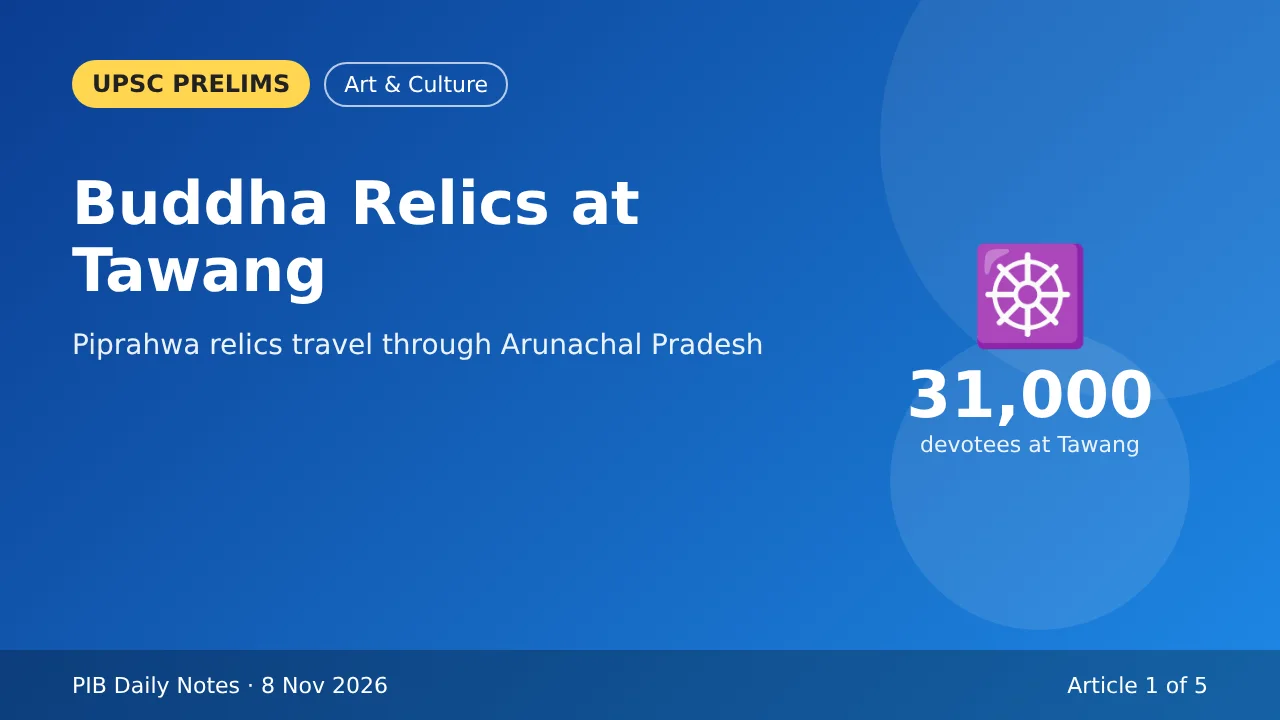
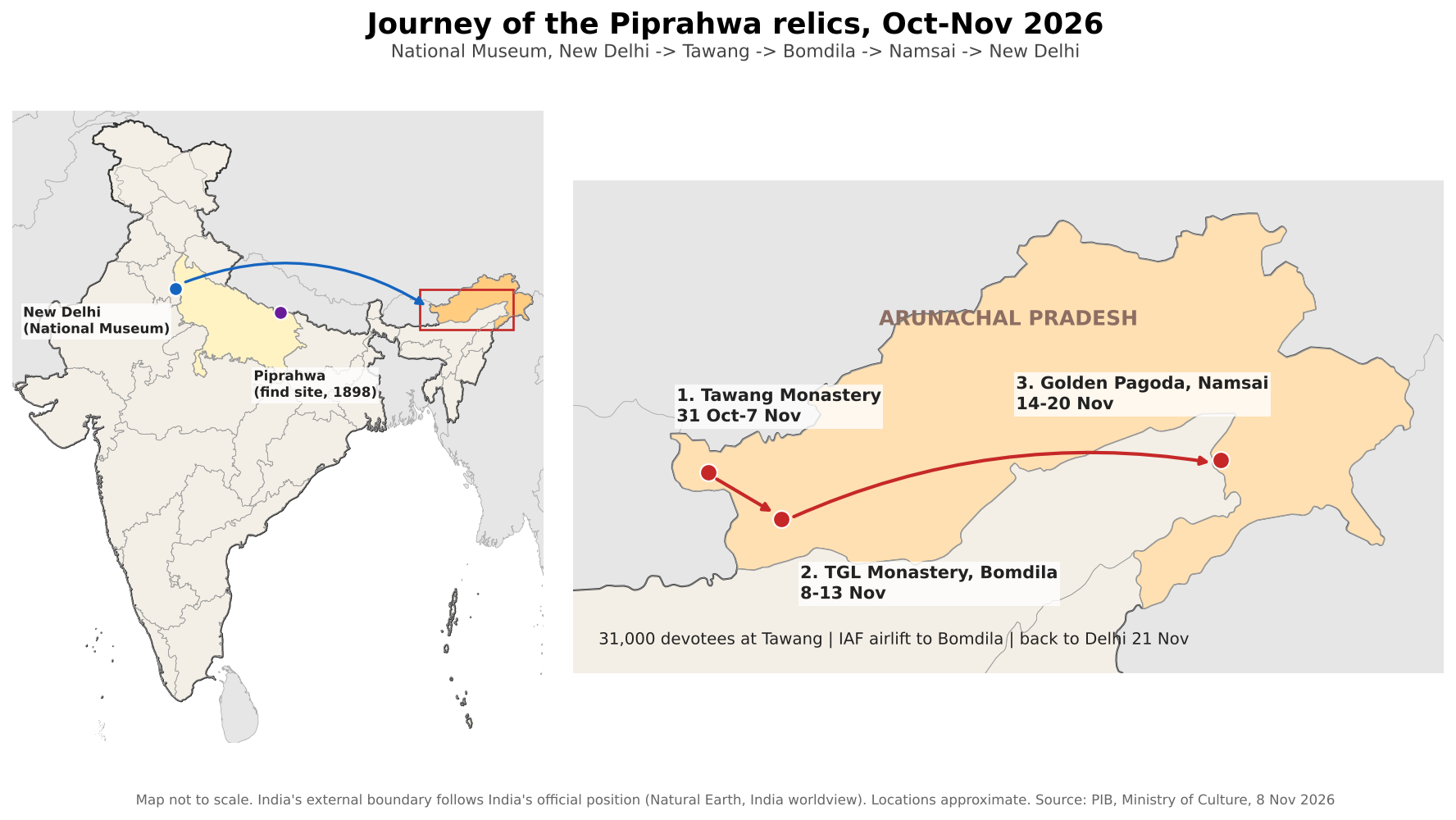
The Sacred Relics of Shakyamuni Buddha from Piprahwa were shown to the public at Gaden Namgyal Lhatse (Tawang Monastery), Arunachal Pradesh, from 31 October to 7 November 2026. About 31,000 devotees visited. The relics moved to Bomdila on 8 November, carried by the Indian Air Force.
News Summary
The exposition was organised by the Ministry of Culture with the Government of Arunachal Pradesh and the International Buddhist Confederation (IBC), New Delhi.
The relics came from the National Museum, New Delhi, and were received by Chief Minister Pema Khandu in the presence of Union Culture Minister Gajendra Singh Shekhawat.
Two exhibitions were opened at the monastery:
"Unearthing the Sacred Piprahwa" by the IBC, on the discovery of the relics in 1898.
"Crossroads of Dhamma" by the National Museum, on Buddhist art and heritage.
On 2 November, the IBC held a conference, "Buddhism: Dissemination in the Himalayan Region and Beyond", at the Kalawangpo Convention Centre, Tawang.
Itinerary: Tawang (31 Oct–7 Nov), TGL Monastery (Lower Gompa), Bomdila (8–13 Nov), Golden Pagoda, Namsai (14–20 Nov), and back to the National Museum on 21 November.
Prelims Facts & Static Linkages
The Piprahwa relics
Site: Piprahwa, in Siddharthnagar district, Uttar Pradesh, close to the Nepal border.
1898:William Claxton Peppé dug a stupa there and found caskets with bone fragments, ash and jewels.
Inscription: a Brahmi inscription on one casket says the relics are of the Buddha, enshrined by the Sakya clan.
1971–77: the Archaeological Survey of India, under K.M. Srivastava, found more relic caskets and sealings. These helped identify Piprahwa–Ganwaria with ancient Kapilavastu.
2025: an auction of Peppé-family gems from the find was stopped after India objected, and the gems were brought back to India.
Monasteries on the route
Monastery
District
Key fact
Tawang (Gaden Namgyal Lhatse)
Tawang
Largest monastery in India; Gelugpa school; founded 1680–81 by Merak Lama Lodre Gyatso
TGL Monastery (Lower Gompa)
West Kameng (Bomdila)
Gelugpa centre of the Monpa people
Golden Pagoda (Kongmu Kham)
Namsai
Theravada pagoda of the Tai-Khamti community
Buddhist schools to revise
Theravada (Sthaviravada): the "way of the elders"; followed in Sri Lanka, Myanmar and Thailand, and by the Tai-Khamti of Arunachal.
Mahasanghika: broke away at the Second Buddhist Council (Vaishali). Its idea of a superhuman Buddha helped the rise of Mahayana.
Mahayana: Bodhisattva ideal and image worship; dominant in Tibet, China and Japan.
Vajrayana: the tantric form that shapes Himalayan Buddhism in Ladakh, Sikkim and Arunachal.
Symbols in early (aniconic) Buddhist art
Lotus or elephant: birth.
Horse: the great departure (Mahabhinishkramana).
Bodhi tree: enlightenment.
Wheel (Dharmachakra): the first sermon at Sarnath.
Stupa: the Mahaparinibbana.
Empty seat: the meditation of the Buddha.
Relics as soft power
Indian relics have travelled abroad for public veneration, for example to Mongolia (2022), Thailand (2024) and Vietnam (2025).
The IBC, set up in 2012, is a global Buddhist umbrella body based in New Delhi and supported by the Ministry of Culture.
Quick Revision
Piprahwa relics were found by W.C. Peppé in 1898 in Siddharthnagar, Uttar Pradesh.
The casket inscription names the Sakyas as the people who enshrined the relics.
ASI digs of 1971–77 linked Piprahwa with Kapilavastu.
Tawang Monastery is India's largest and belongs to the Gelugpa school.
The Golden Pagoda at Namsai is a Theravada shrine.
The relics returned to the National Museum on 21 November 2026.
Practice MCQ
Q. With reference to the Piprahwa relics, consider the following statements:
1. They were first excavated by the Archaeological Survey of India in the 1970s.
2. An inscription on a casket found at the site attributes the relics to the Buddha.
3. Piprahwa is located in present-day Uttar Pradesh.
Which of the statements given above is/are correct?
(a) 1 only
(b) 2 and 3 only
(c) 1 and 3 only
(d) 1, 2 and 3
Answer: (b). The first excavation was by W.C. Peppé in 1898. The ASI dug the site again in 1971–77.
Related PYQs
PYQ 1 (UPSC CSE Prelims 2024)
With reference to ancient India, Gautama Buddha was generally known by which of the following epithets?
1. Nayaputta
2. Shakyamuni
3. Tathagata
Select the correct answer using the code given below:
(a) 1 only
(b) 2 and 3 only
(c) 1, 2 and 3
(d) None of the above are epithets of Gautama Buddha
Answer: (b).
PYQ 2 (UPSC CSE Prelims 2026)
What does an empty seat represent in early Buddhist iconography?
(a) The meditation of the Buddha
(b) The Buddha's First Sermon
(c) The Buddha's Mahaparinibbana
(d) The Buddha's Mahabhinishkramana
Answer: (a).
PYQ 3 (UPSC CSE Prelims 2020)
With reference to the religious history of India, consider the following statements:
1. Sthaviravadins belong to Mahayana Buddhism.
2. Lokottaravadin sect was an offshoot of Mahasanghika sect of Buddhism.
3. The deification of Buddha by Mahasanghikas fostered the Mahayana Buddhism.
Which of the statements given above is/are correct?



 28
Nov 2026
 28
Nov 2026
 28
Nov 2026














0 comments
Discussion
No comments yet. Be the first.