Pralay Quasi-Ballistic Missile: Induction Now Imminent
Defence Research and Development Organisation (DRDO) successfully flight-tested the quasi-ballistic missile 'Pralay' from Dr APJ Abdul Kalam Island
DDecode Civils
· 3 min read
Pralay Quasi-Ballistic Missile: Induction Now Imminent
Why in News
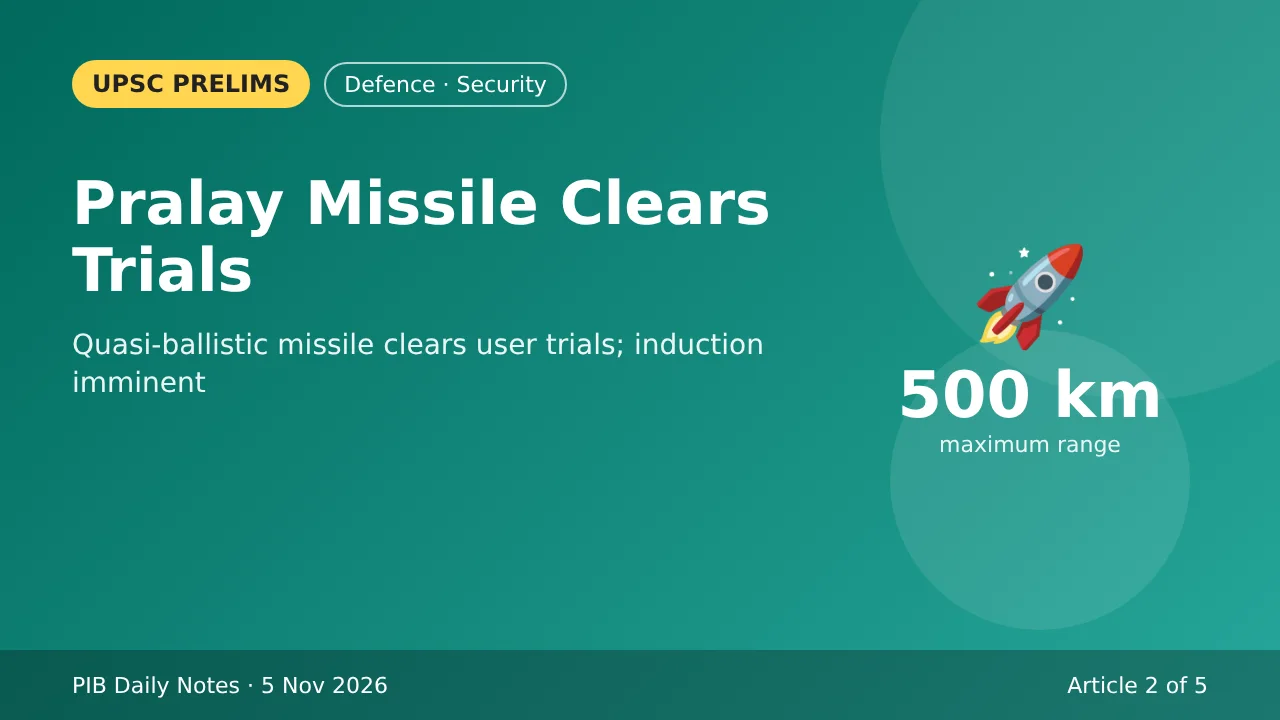
The Defence Research and Development Organisation (DRDO) successfully flight-tested the quasi-ballistic missile 'Pralay' from Dr APJ Abdul Kalam Island, off the Odisha coast, on 5 November 2026. The test was part of user evaluation trials, and DRDO said the system's induction is now imminent.
News Summary
All test objectives were met, as confirmed by range instruments of the Integrated Test Range (ITR), Chandipur.
The missile was developed indigenously by Research Centre Imarat (RCI), Hyderabad, with other DRDO laboratories.
Bharat Dynamics Limited (BDL), a Development-cum-Production Partner, produced the system.
Senior officials of DRDO, the Defence Forces and industry watched the test.
Raksha Mantri Rajnath Singh said the missile will boost the military's operational preparedness against emerging threats.
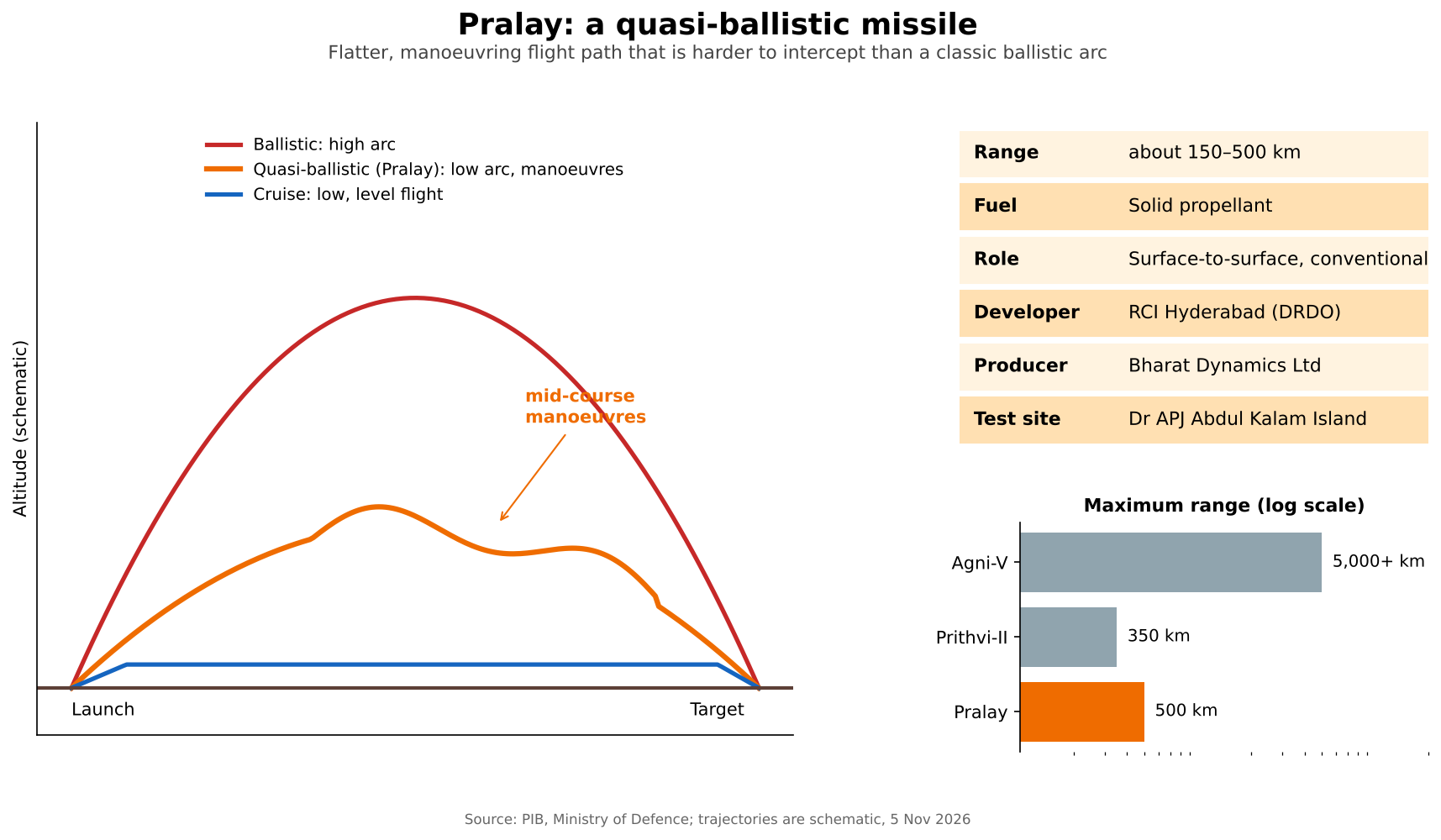
Range: about 150–500 km, with a payload of roughly 500–1,000 kg of conventional warheads.
Propulsion:solid-propellant rocket motor, which allows quick launch from a road-mobile launcher.
Lineage: derived from the Prithvi Defence Vehicle (PDV), an exo-atmospheric interceptor of India's Ballistic Missile Defence programme.
First test: December 2021. It is meant for the Army and the Indian Air Force, filling the gap between artillery rockets and longer-range missiles.
Ballistic, quasi-ballistic and cruise missiles
Feature
Ballistic
Quasi-ballistic
Cruise
Path
High arc, mostly unpowered after burnout
Low, flatter arc with manoeuvres
Low altitude, level flight
Propulsion
Rocket
Rocket
Jet engine (turbofan or ramjet)
Guidance
Mainly in boost phase
Throughout flight
Throughout flight
Example
Agni series
Pralay
BrahMos, Nirbhay
Why quasi-ballistic matters
A lower trajectory shortens radar warning time.
Mid-course manoeuvres make the path hard to predict, so interceptors struggle to engage it.
Conventional warheads give a non-nuclear precision strike option at tactical ranges.
Key places and institutions
Dr APJ Abdul Kalam Island (formerly Wheeler Island), Odisha: DRDO's main missile test site.
ITR Chandipur, Balasore, Odisha: tracks missile tests with radars and telemetry.
RCI Hyderabad: part of the Dr APJ Abdul Kalam Missile Complex. It leads missile avionics and guidance.
BDL: a defence PSU under the Ministry of Defence that makes missiles.
MTCR: India joined the Missile Technology Control Regime in 2016. Its threshold is 300 km range and 500 kg payload.
India's missile family to know
Agni series: surface-to-surface ballistic missiles. Agni-V has a range of over 5,000 km and was tested with MIRV technology under Mission Divyastra in March 2024.
Prithvi-II: India's first indigenous surface-to-surface ballistic missile, with a range of about 350 km.
BrahMos: supersonic cruise missile made by an India–Russia joint venture.
Nirbhay: long-range subsonic cruise missile.
Integrated Guided Missile Development Programme (IGMDP): launched in 1983 under Dr APJ Abdul Kalam. It produced Prithvi, Agni, Trishul, Akash and Nag.
Quick Revision
Pralay was test-fired on 5 November 2026 from Dr APJ Abdul Kalam Island.
It is a solid-fuelled, surface-to-surface quasi-ballistic missile.



 28
Nov 2026
 28
Nov 2026
 28
Nov 2026














0 comments
Discussion
No comments yet. Be the first.