Shram Samvad: Spreading Awareness of the Four Labour Codes
Ministry of Labour and Employment (MoLE) and the Madhya Pradesh Labour Department held "Shram Samvad"
DDecode Civils
· 3 min read
Shram Samvad: Spreading Awareness of the Four Labour Codes
Why in News
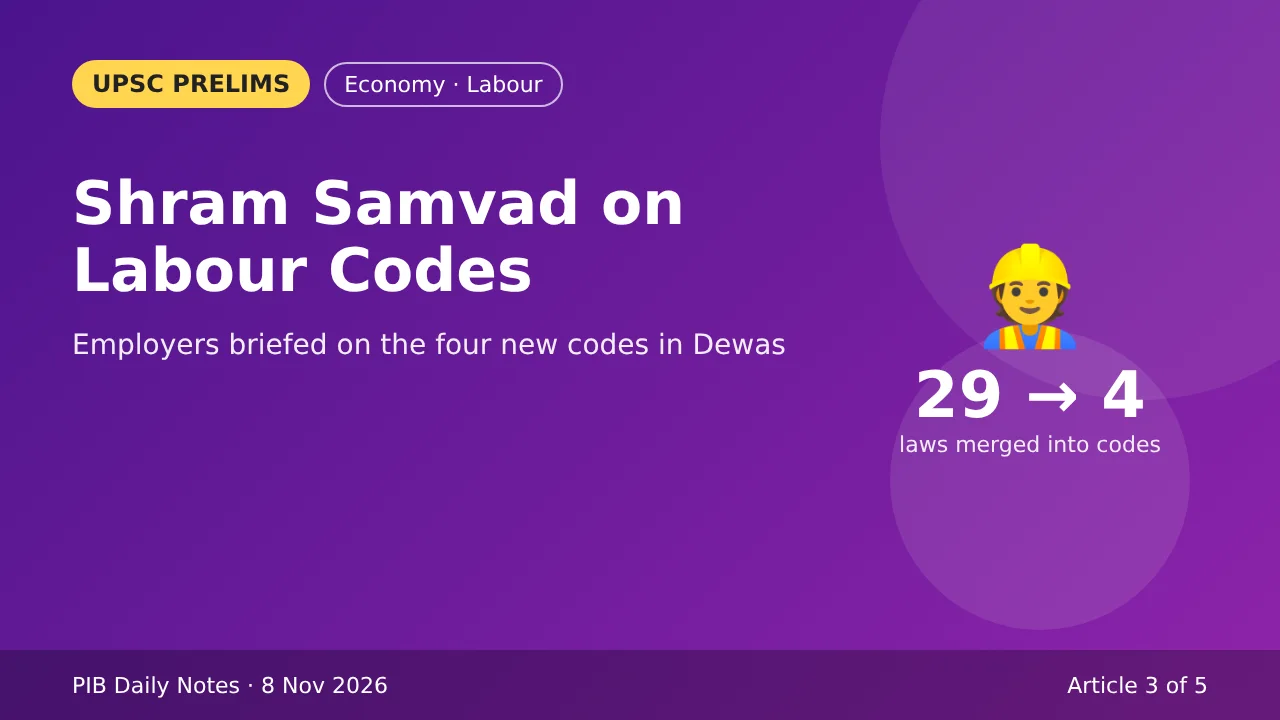
The Ministry of Labour and Employment (MoLE) and the Madhya Pradesh Labour Department held "Shram Samvad", a district-level awareness and capacity-building programme on the Labour Codes, welfare and social protection, at Dewas, Madhya Pradesh, on 5 November 2026.
News Summary
Partners were the Association of Industries Madhya Pradesh and Sun Pharmaceutical Industries Ltd.
It was aimed at employers and at HR, legal and finance professionals. Over 100 participants attended.
Officials from EPFO, ESIC, the Chief Labour Commissioner (Central) and the Directorate General of Labour Welfare (DGLW) took part.
Sessions covered employer compliance under each of the four Labour Codes and the Central Rules made under them.
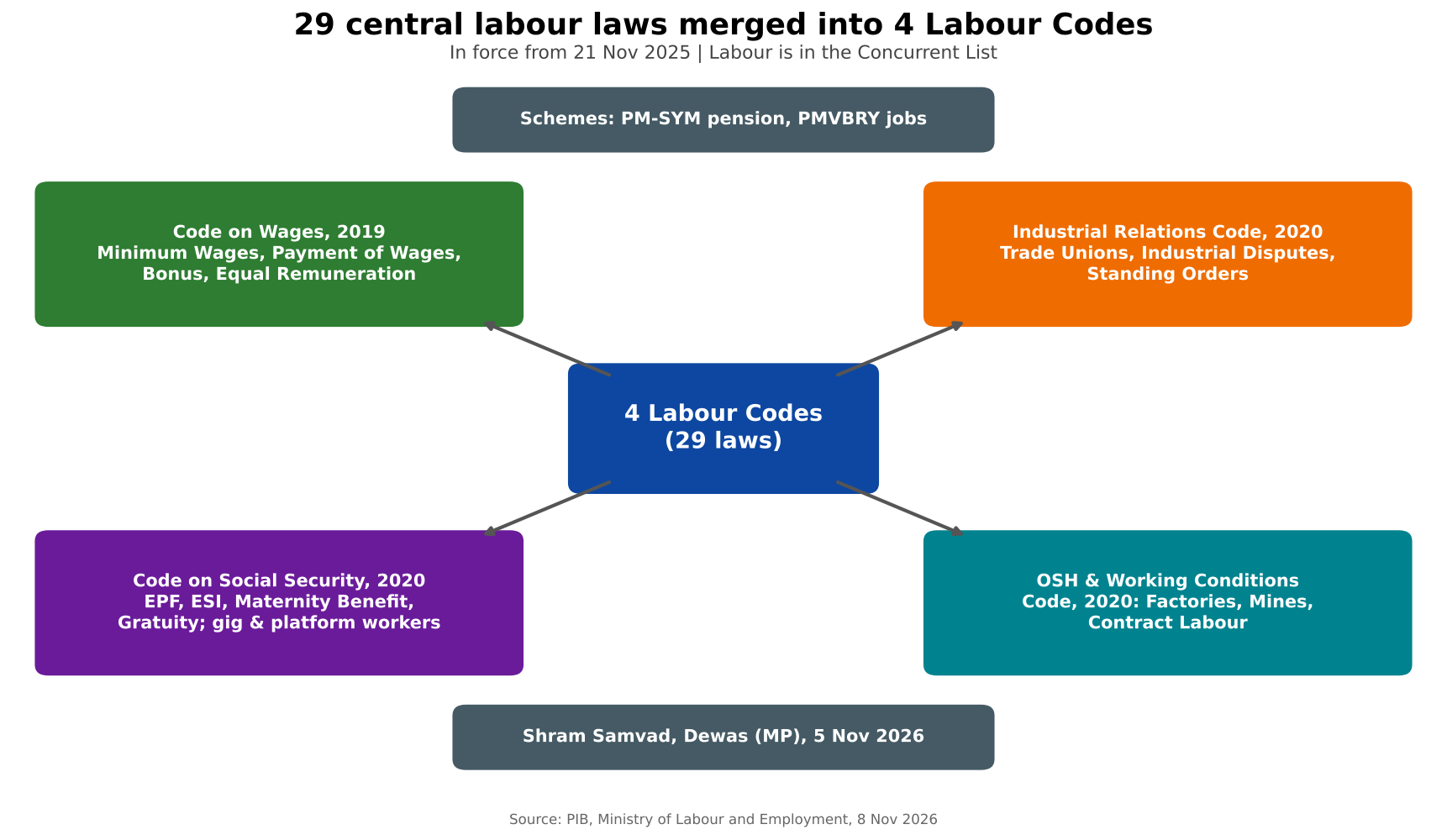
EPF Act, ESI Act, Maternity Benefit Act, Payment of Gratuity Act and others
Occupational Safety, Health and Working Conditions Code
2020
Factories Act, Mines Act, Contract Labour Act and others
Key features to remember
Floor wage: the Centre sets a national floor wage, and no State minimum wage can be lower.
Gig and platform workers are defined in law for the first time, under the Code on Social Security.
Fixed-term employees get gratuity after one year of service, instead of five.
Single registration, licence and return for establishments.
Women may work night shifts, with their consent and safety measures.
Inspector-cum-facilitator replaces the old inspector system.
Schemes discussed at Shram Samvad
PM-SYM (2019): a voluntary pension scheme for unorganised workers aged 18–40 earning up to ₹15,000 a month. It pays ₹3,000 a month after age 60. The worker's contribution is matched 50:50 by the Centre.
PMVBRY: an employment-linked incentive scheme run by EPFO. First-time employees get up to ₹15,000 in two instalments, and employers get up to ₹3,000 a month for each new job. It covers jobs created between 1 August 2025 and 31 July 2027.
Institutions
EPFO: a statutory body under the EPF Act, 1952, under MoLE.
ESIC: a statutory body under the ESI Act, 1948, giving health and cash benefits.
Chief Labour Commissioner (Central): heads the Central Industrial Relations Machinery.
Quick Revision
Four codes replaced 29 central labour laws.
They took effect on 21 November 2025.
Labour is a Concurrent List subject.
The Code on Social Security covers gig and platform workers.
PM-SYM gives ₹3,000 a month after 60 to unorganised workers.
PMVBRY rewards new formal jobs through EPFO.
Practice MCQ
Q. With reference to the Labour Codes in India, consider the following statements:
1. Gig and platform workers are covered under the Code on Social Security, 2020.
2. The Industrial Relations Code, 2020 subsumes the Factories Act, 1948.
3. Labour is a subject in the State List of the Seventh Schedule.
Which of the statements given above is/are correct?
(a) 1 only
(b) 1 and 2 only
(c) 2 and 3 only
(d) 1, 2 and 3
Answer: (a). The Factories Act went into the OSH Code, and labour is in the Concurrent List.
Related PYQs
PYQ 1 (UPSC CSE Prelims 2026)
Which of the following international conventions have not been ratified by India?
1. Employment Policy Convention
2. Abolition of Forced Labour Convention
3. International Convention on the Protection of the Rights of All Migrant Workers and Members of Their Families
4. Geneva Convention Relative to the Protection of Civilian Persons in Time of War



 28
Nov 2026
 28
Nov 2026
 28
Nov 2026














0 comments
Discussion
No comments yet. Be the first.