Soreng, Sikkim: India's First Organic Fisheries Cluster
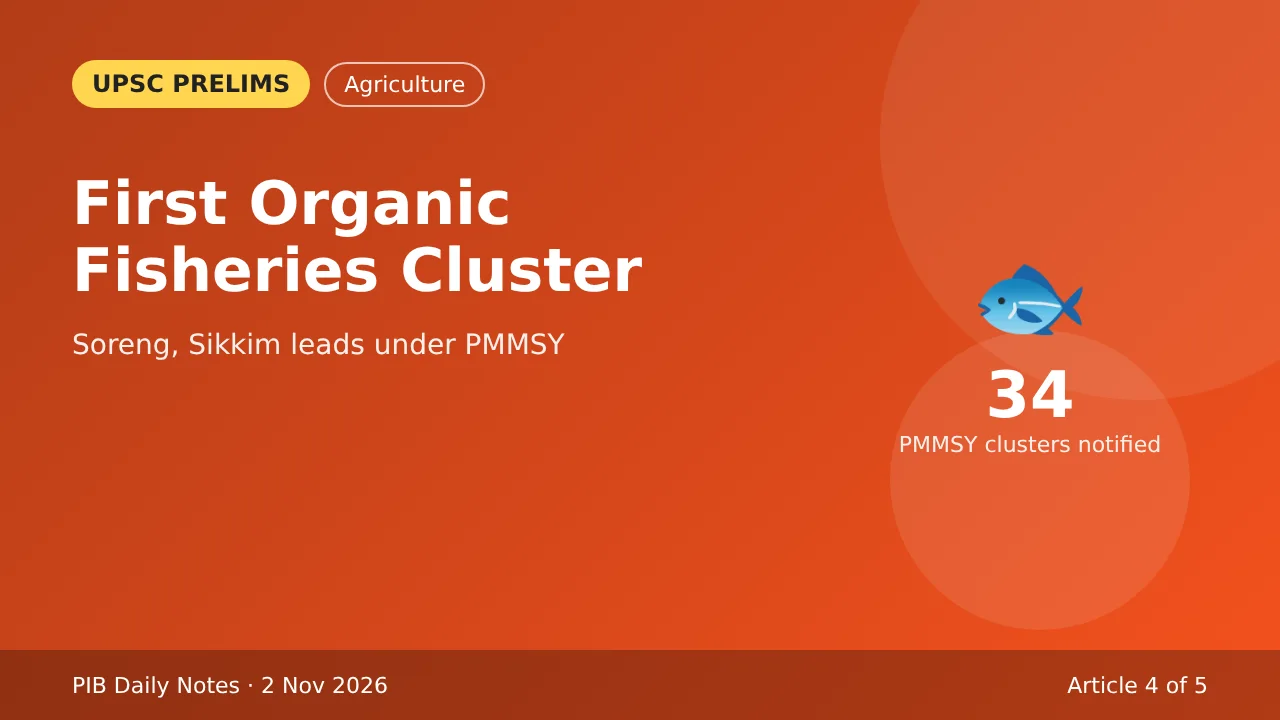
During a visit to Sikkim on 2 November 2026, the Union Fisheries Minister highlighted Soreng district as India's first Organic Fisheries Cluster
DDecode Civils
· 3 min read
Soreng, Sikkim: India's First Organic Fisheries Cluster
Why in News
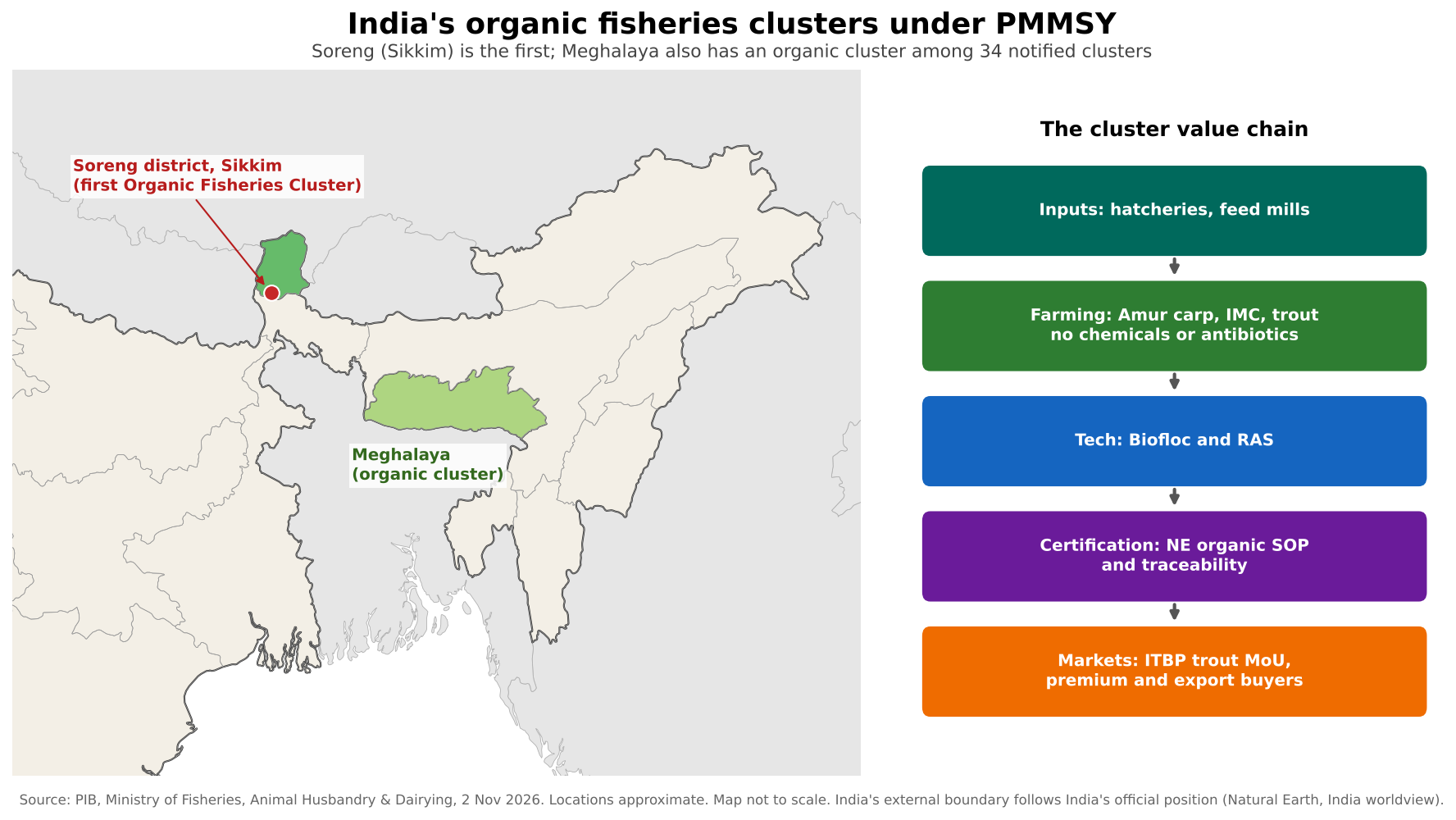
During a visit to Sikkim on 2 November 2026, the Union Fisheries Minister highlighted Soreng district as India's first Organic Fisheries Cluster under the Pradhan Mantri Matsya Sampada Yojana (PMMSY). He also launched a Standard Operating Procedure (SOP) for Organic Certification of Fisheries in the North-Eastern Region.
News Summary
Projects worth ₹375 lakh under PMMSY were inaugurated. They cover hatcheries, feed mills, cold storage, Biofloc and Recirculating Aquaculture Systems (RAS).
Under PMMSY, 34 fisheries production and processing clusters have been notified, including organic clusters in Sikkim and Meghalaya.
The Soreng cluster farms fish without harmful chemicals, antibiotics or pesticides. It focuses on Amur carp, Indian Major Carps and trout.
The SOP gives a framework for organic production and traceability, to help organic fish reach premium domestic and export markets.
Sikkim signed an MoU with the Indo-Tibetan Border Police (ITBP) to buy locally farmed rainbow trout.
Kisan Credit Cards went to fish farmers, and five farmers got cheques under the State's Mukhya Mantri Matsya Uthpadhan Yojana.
Prelims Facts & Static Linkages
Why a cluster approach
One area, whole value chain: production, processing, value addition and marketing are planned together.
Economies of scale: shared hatcheries, feed mills and cold chains cut costs for small farmers.
Branding: a single identity, such as "organic Sikkim fish", earns a market premium.
Credit and insurance: easier to deliver through cooperatives and Fish Farmer Producer Organisations.
Fit with geography: cold Himalayan streams suit trout, while ponds suit carps.
Fish named in the release
Fish
Type
Note
Rainbow trout
Coldwater
Needs clean, cold, oxygen-rich water
Amur carp
Improved common carp
Fast-growing strain
Catla, rohu, mrigal
Indian Major Carps
Warm-water pond fish
Technologies to know
Biofloc: microbes convert fish waste into protein-rich flocs that the fish eat, cutting feed and water use.
RAS: water is filtered and reused in tanks, allowing dense farming on little land and water.
Static linkages
PMMSY: launched in 2020 with an outlay of ₹20,050 crore, the largest-ever investment in Indian fisheries. It is run by the Department of Fisheries.
Sikkim became India's first fully organic State in 2016.
Organic certification:NPOP (APEDA, for exports) and PGS-India (for domestic markets).
KCC for fisheries: extended to fish farmers and animal husbandry in 2018–19.
India is the world's second-largest fish producer.
Department of Fisheries: became a separate department in 2019, under the new Ministry of Fisheries, Animal Husbandry and Dairying.
Why organic fisheries in the North-East
Clean water: hill streams and low chemical use suit organic farming.
Existing ecosystem: Sikkim's organic farming base can be extended to fish.
Premium prices: certified organic fish can reach high-value domestic and export markets.
Nutrition and jobs: local fish production cuts dependence on supplies from other States.
Quick Revision
Soreng, Sikkim is India's first notified Organic Fisheries Cluster under PMMSY.
There are 34 PMMSY clusters, with organic ones in Sikkim and Meghalaya.
An SOP for organic certification of fisheries in the North-East was launched.
Focus species: Amur carp, Indian Major Carps and trout.
Sikkim's MoU with ITBP covers rainbow trout supply.
Biofloc and RAS are water-saving technologies backed by PMMSY.
Sikkim became India's first fully organic State in 2016.
Practice MCQ
Q. With reference to fisheries in India, consider the following statements:
1. Soreng in Sikkim is India's first Organic Fisheries Cluster under PMMSY.
2. In a Recirculating Aquaculture System, water is filtered and reused.
3. Rainbow trout is a warm-water fish suited to plains ponds.
Which of the statements given above is/are correct?
(a) 1 only
(b) 1 and 2 only
(c) 2 and 3 only
(d) 1, 2 and 3
Answer: (b). Rainbow trout is a coldwater fish.
Related PYQs
PYQ 1 (UPSC CSE Prelims 2023)
With reference to the role of biofilters in Recirculating Aquaculture System, consider the following statements:
1. Biofilters provide waste treatment by removing uneaten fish feed.
2. Biofilters convert ammonia present in fish waste to nitrate.
3. Biofilters increase phosphorus as nutrient for fish in water.
How many of the statements given above are correct?



 28
Nov 2026
 28
Nov 2026
 28
Nov 2026














0 comments
Discussion
No comments yet. Be the first.