Researchers at the Jawaharlal Nehru Centre for Advanced Scientific Research (JNCASR), Bengaluru, an autonomous institute of the Department of Science and Technology (DST)
DDecode Civils
· 4 min read
Terahertz Chip for 6G: Waves That Cross Barriers
Why in News
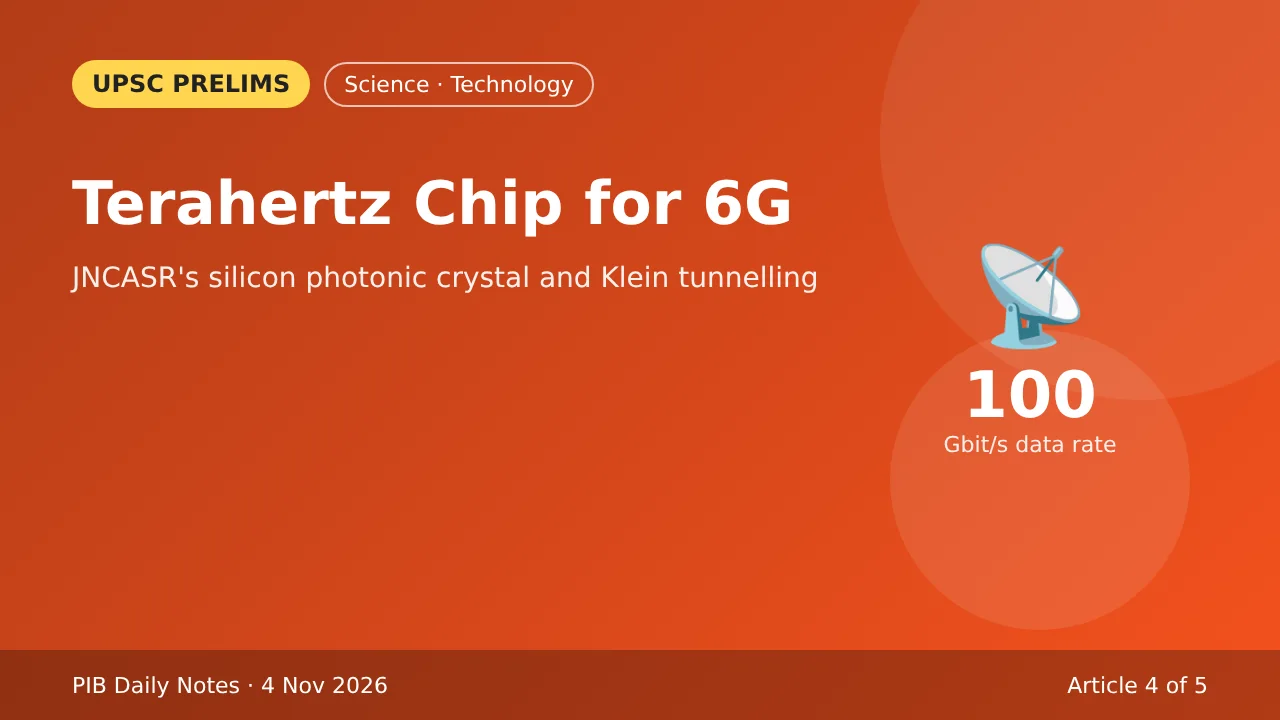
Researchers at the Jawaharlal Nehru Centre for Advanced Scientific Research (JNCASR), Bengaluru, an autonomous institute of the Department of Science and Technology (DST), built a silicon chip that lets terahertz waves pass through an engineered barrier with very little loss while carrying data at 100 Gbit/s. The work was published in Advanced Materials.
News Summary
The problem: in compact circuits, bends, junctions and sudden changes in a waveguide scatter or reflect terahertz signals and weaken them.
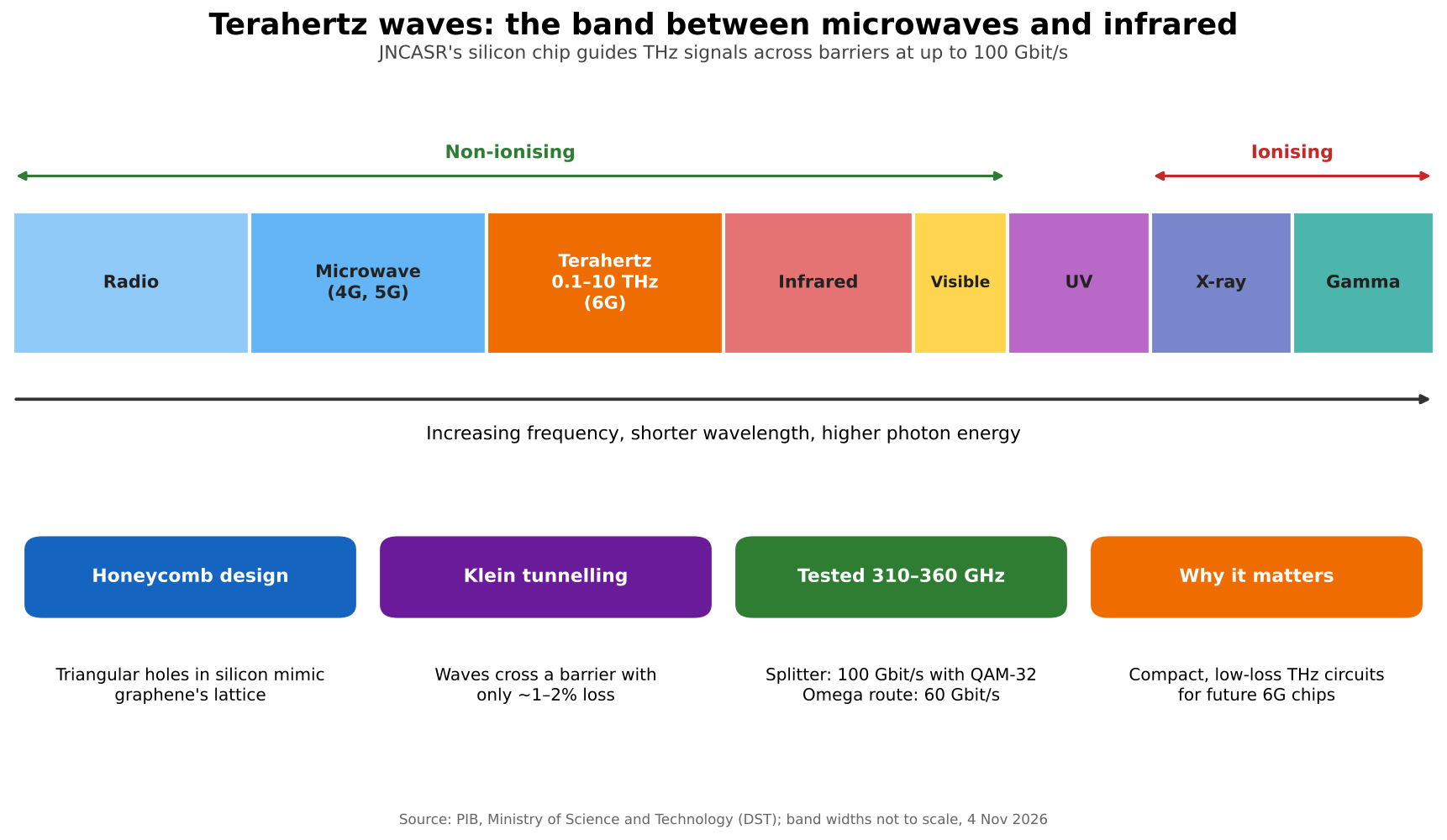
The design: a silicon photonic crystal with triangular holes in a pattern that mimics the honeycomb lattice of graphene. A barrier was made by changing the hole sizes over a short stretch.
The effect:photonic Klein tunnelling, where waves cross a barrier almost without reflection.
Results: one barrier caused only about 1–2% loss and two barriers about 2–3%. A normal waveguide loses much more.
Tests: three devices on high-resistivity silicon, measured across 310–360 GHz. A double-barrier device carried 48 Gbit/s, an omega-shaped route with four sharp bends carried 60 Gbit/s, and a power splitter carried 100 Gbit/s using QAM-32.
At that rate, a 5 GB film could move in under half a second.
Prelims Facts & Static Linkages
Key concepts in the study
Terahertz (THz) waves: roughly 0.1 to 10 THz, between microwaves and infrared. They are non-ionising and offer very wide bandwidth.
Photonic crystal: a material with a repeating pattern that controls how light or THz waves move, much as a semiconductor crystal controls electrons.
Topological photonics: waves travel along the edge between two regions and resist certain kinds of backscattering.
Valley photonic crystal: uses two "valleys" in the wave's energy map, borrowed from the physics of graphene, to guide signals.
Klein tunnelling: a relativistic effect in which particles pass through a high barrier with near-total transmission, first seen with electrons in graphene.
QAM (Quadrature Amplitude Modulation): packs data into both the amplitude and phase of a wave. QAM-32 carries 5 bits per symbol.
Generations of mobile networks
Generation
Key feature
Typical bands
4G
All-IP mobile broadband
Below 6 GHz
5G
Low latency, massive device links
Sub-6 GHz and mmWave (24–100 GHz)
6G (expected ~2030)
Terabit speeds, sensing with communication
Sub-THz and THz (above 100 GHz)
India's 6G push
Bharat 6G Vision: released in March 2023, aiming for India to be a leading supplier of 6G technology by 2030.
Bharat 6G Alliance: launched in July 2023 to link industry, academia and government.
ITU IMT-2030: the global framework for 6G, from the International Telecommunication Union, a UN agency based in Geneva.
Why silicon matters: high-resistivity silicon works with existing chip-making methods, so these designs can scale up.
Next step: the team plans to tune the barriers electrically, thermally or mechanically, so a device could switch signals between paths on demand.
Likely Prelims angles
The position of THz waves in the electromagnetic spectrum.
5G vs 6G frequency bands.
Graphene's honeycomb structure and its unusual electron behaviour.
Quick Revision
JNCASR Bengaluru, under DST, built a THz silicon chip for 6G.
It uses photonic Klein tunnelling in a valley photonic crystal.
A barrier adds only about 1–2% loss.
Data rates reached 100 Gbit/s with QAM-32.
THz waves lie between microwaves and infrared.
The Bharat 6G Alliance was launched in July 2023.
Practice MCQ
Q. With reference to terahertz (THz) radiation, consider the following statements:
1. It lies between the microwave and infrared regions of the electromagnetic spectrum.
2. It is a form of ionising radiation like X-rays.
3. It is expected to be used in sixth-generation (6G) wireless networks.
Which of the statements given above is/are correct?
(a) 1 only
(b) 1 and 3 only
(c) 2 and 3 only
(d) 1, 2 and 3
Answer: (b). THz radiation is non-ionising.
Related PYQs
PYQ 1 (UPSC CSE Prelims 2025)
Consider the following statements:
I. It is expected that Majorana 1 chip will enable quantum computing.
II. Majorana 1 chip has been introduced by Amazon Web Services (AWS).
III. Deep learning is a subset of machine learning.
How many of the statements given above are correct?
(a) Only one
(b) Only two
(c) All the three
(d) None
Answer: (b).
PYQ 2 (UPSC CSE Prelims 2026)
Which of the following statements with regard to drone swarms is/are correct?
1. They use Terahertz band of frequency to communicate with the command centre.
2. Individual drones in the swarm can communicate with other drones in the swarm.
3. GPS Spoofing is a commonly used technique to counter drone swarm.



 28
Nov 2026
 28
Nov 2026
 28
Nov 2026














0 comments
Discussion
No comments yet. Be the first.