UBC 63 Turns Out to Be Two Star Clusters After a Close Flyby
IIA Bengaluru, found that the open star cluster UBC 63, about 4,892 light years away, is really two separate clusters, UBC 63A and UBC 63B
DDecode Civils
· 3 min read
UBC 63 Turns Out to Be Two Star Clusters After a Close Flyby
Why in News
A team led by Indian astronomers from Gauhati University and the Indian Institute of Astrophysics (IIA), Bengaluru, found that the open star cluster UBC 63, about 4,892 light years away, is really two separate clusters, UBC 63A and UBC 63B. The study used data from the European Space Agency's Gaia mission and was published in the Astronomical Journal, the Ministry of Science and Technology said on 5 November 2026.
News Summary
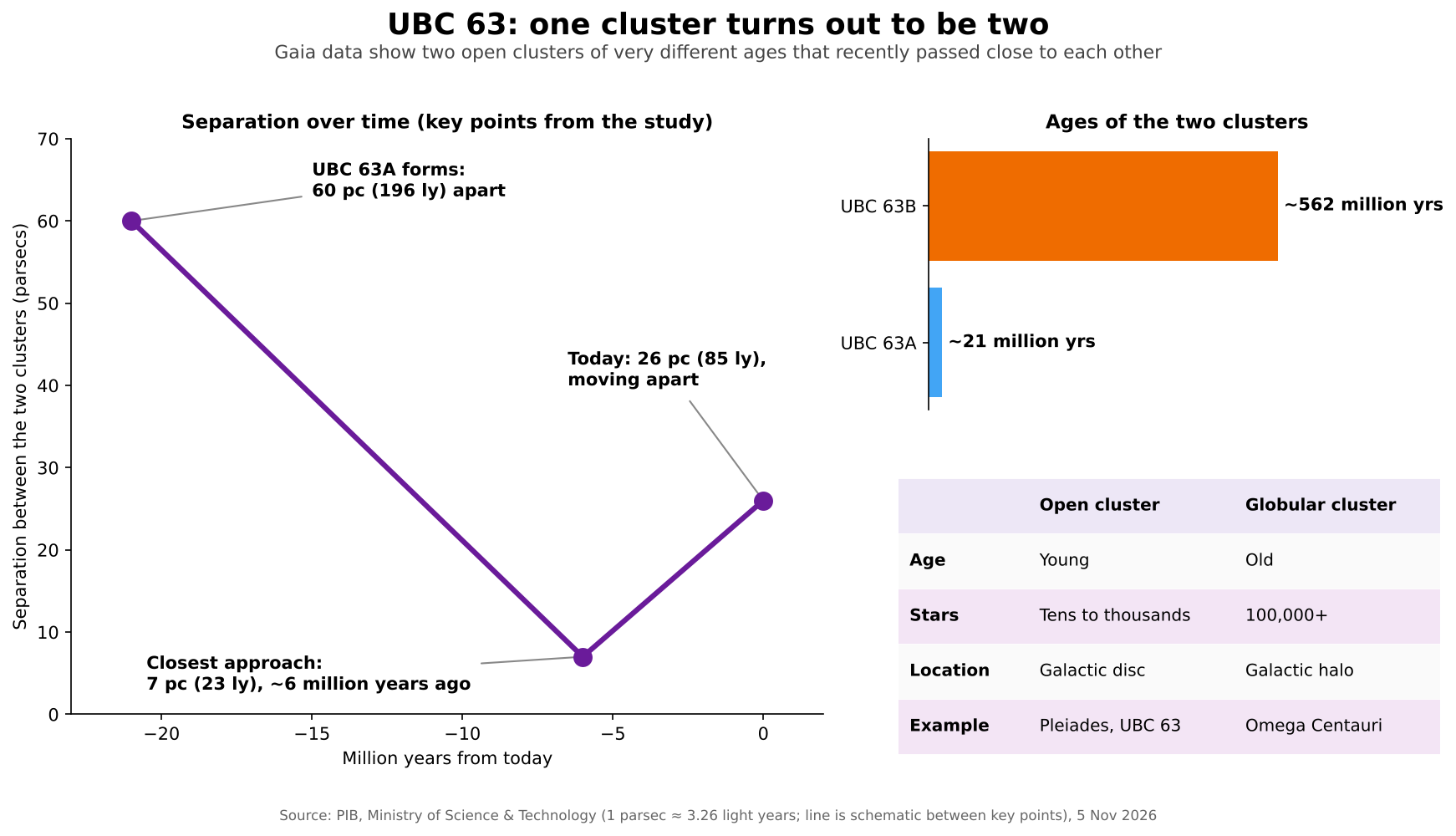
The two clusters have very different ages. UBC 63A is about 21 million years old, while UBC 63B is about 562 million years old, so they did not form together.
The stars formed two distinct sequences on a colour–magnitude diagram, the first clue.
Machine learning and simulations on high-performance computers confirmed two populations.
When UBC 63A formed, the pair were about 60 parsecs (196 light years) apart. About 6 million years ago they came within 7 parsecs (23 light years).
Today they are about 26 parsecs (85 light years) apart and not gravitationally bound, so they are moving apart.
The team included a DST INSPIRE fellow and partners from Italy, China and Japan.
Prelims Facts & Static Linkages
Open and globular star clusters
A star cluster is a group of stars born from the same cloud of gas and dust and held together by gravity.
Open clusters are young, loose groups of tens to a few thousand stars in the disc of the Milky Way. Examples are the Pleiades and the Hyades.
Globular clusters are old, dense, spherical groups of hundreds of thousands of stars in the galactic halo. Omega Centauri is the largest in the Milky Way.
Open clusters break up over time through tides and encounters, which is why a caught-in-the-act flyby is rare.
Key concepts to revise
Term
Meaning
Light year
Distance light travels in a year, about 9.46 trillion km
Parsec
About 3.26 light years
Colour–magnitude diagram
Plot of star brightness against colour, a form of the Hertzsprung–Russell diagram
Main sequence
The long, stable hydrogen-burning stage of a star's life
Gaia and Indian astronomy
Gaia, launched by ESA in December 2013, mapped the positions, distances and motions of over a billion stars from the Sun–Earth L2 point. It ended observations in 2025.
IIA, Bengaluru is an autonomous institute of the Department of Science and Technology (DST). It runs the Indian Astronomical Observatory at Hanle, Ladakh, and the Kodaikanal Solar Observatory.
Star lifetimes: massive stars burn fuel much faster, so they live far shorter lives than low-mass stars.
Likely Prelims angles
Which kind of cluster is older, and where in the galaxy each kind lies.
Units of distance: the astronomical unit, the light year and the parsec, in increasing order.
Space observatories and their makers, such as Gaia (ESA), James Webb (NASA, ESA and CSA) and AstroSat (ISRO).
Quick Revision
UBC 63 is an open cluster about 4,892 light years away.
It is now known to be two clusters, UBC 63A (about 21 million years) and UBC 63B (about 562 million years).
They passed within 7 parsecs about 6 million years ago and are now 26 parsecs apart.
The data came from ESA's Gaia mission.
Open clusters lie in the galactic disc; globular clusters lie in the halo.
Practice MCQ
Q. With reference to star clusters, consider the following statements:
1. Open clusters are generally younger than globular clusters.
2. Globular clusters are found mainly in the halo of the Milky Way.
3. The Pleiades is a globular cluster.
Which of the statements given above is/are correct?
(a) 1 only
(b) 1 and 2 only
(c) 2 and 3 only
(d) 1, 2 and 3
Answer: (b). The Pleiades is an open cluster.
Related PYQs
PYQ 1 (UPSC CSE Prelims 2024)
Consider the following statements:
Statement-I: Giant stars live much longer than dwarf stars.
Statement-II: Compared to dwarf stars, giant stars have a greater rate of nuclear reactions.
Which one of the following is correct in respect of the above statements?
(a) Both Statement-I and Statement-II are correct and Statement-II explains Statement-I
(b) Both Statement-I and Statement-II are correct, but Statement-II does not explain Statement-I
(c) Statement-I is correct, but Statement-II is incorrect
(d) Statement-I is incorrect, but Statement-II is correct




 28
Nov 2026
 28
Nov 2026
 28
Nov 2026














0 comments
Discussion
No comments yet. Be the first.