ULX-8: A Black Hole Feeding Beyond the Eddington Limit
Ultraluminous X-ray sources (ULXs) are, apart from galactic centres, the brightest X-ray emitters in nearby galaxies.
DDecode Civils
· 3 min read
ULX-8: A Black Hole Feeding Beyond the Eddington Limit
Why in News
Astronomers from the Indian Institute of Astrophysics (IIA) and the Raman Research Institute (RRI), both autonomous institutes of the Department of Science and Technology (DST), studied 24 years of X-ray data on NGC 4490 ULX-8. It is one of the brightest X-ray sources in a nearby galaxy, and the data show it is most likely powered by a stellar-mass black hole.
News Summary
Ultraluminous X-ray sources (ULXs) are, apart from galactic centres, the brightest X-ray emitters in nearby galaxies.
They host a neutron star or black hole that pulls in matter from a companion star. The infalling gas heats up and emits X-rays.
ULX-8 lies in the interacting galaxy pair NGC 4490/4485.
The team used data from Chandra, XMM-Newton and Swift, taken between 2000 and 2024.
The source stayed very bright, though its brightness varied. It showed no switches between accretion states, unlike many black-hole X-ray binaries.
The results point to a black hole accreting at or above the Eddington limit.
The study appeared in the Monthly Notices of the Royal Astronomical Society, with researchers from IISER Mohali and IUCAA.
Prelims Facts & Static Linkages
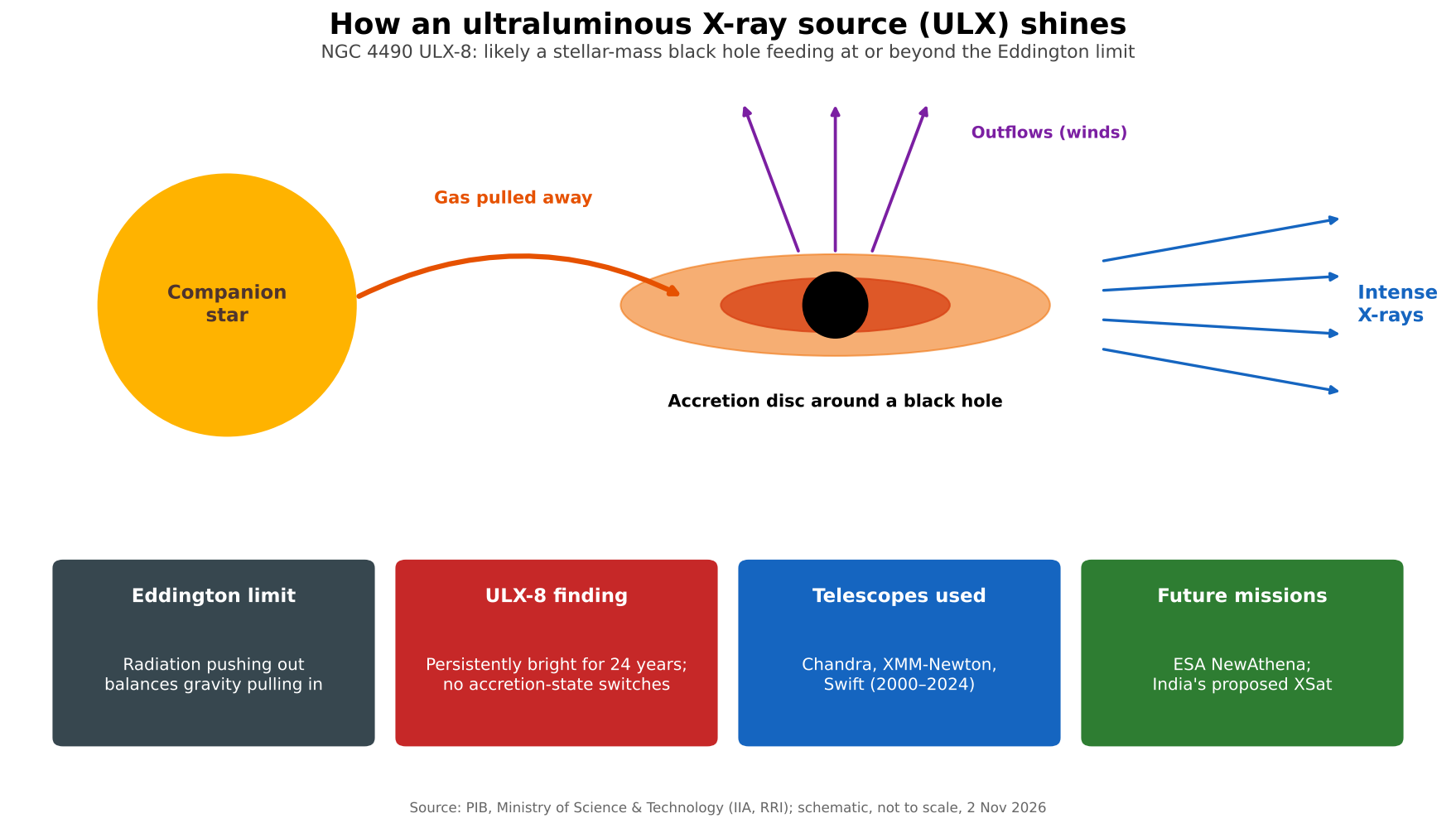
How a ULX shines
Companion star: a normal star loses gas to its compact partner.
Accretion disc: the gas spirals inward and heats to millions of degrees.
X-ray emission: the hot inner disc glows strongly in X-rays.
Eddington limit: the brightness at which outward radiation pressure balances inward gravity. ULXs appear to exceed it.
Outflows: super-Eddington accretion drives powerful winds of gas.
Compact objects compared
Object
Formed from
Key fact
White dwarf
Low-mass star
Below the Chandrasekhar limit (about 1.4 solar masses)
Neutron star
Supernova of a massive star
Extremely dense; pulsars are spinning neutron stars
Stellar-mass black hole
Collapse of a very massive star
Light cannot escape beyond the event horizon
Supermassive black hole
Galaxy centres
Millions to billions of solar masses
X-ray telescopes to know
Chandra (NASA, 1999) and Swift (NASA, 2004).
XMM-Newton (European Space Agency, 1999).
AstroSat (ISRO, 2015): India's first multi-wavelength space observatory.
XPoSat (ISRO, 2024): India's first X-ray polarimetry mission.
Future: ESA's NewAthena and India's proposed XSat timing and spectroscopy mission.
Why X-rays need space telescopes
The Earth's atmosphere absorbs X-rays, so they must be observed from space.
Long-term monitoring by several missions lets astronomers track slow changes in a source over decades.
Indian institutions in the study
IIA, Bengaluru: runs the Indian Astronomical Observatory at Hanle, Ladakh, and the Vainu Bappu Observatory at Kavalur, Tamil Nadu.
RRI, Bengaluru: founded by C. V. Raman in 1948.
IUCAA, Pune: an inter-university centre for astronomy and astrophysics set up by the UGC.
Likely Prelims angles
The meaning of the Eddington and Chandrasekhar limits.
Matching X-ray missions with their space agencies.
Quick Revision
NGC 4490 ULX-8 was tracked for 24 years (2000–2024).
It is likely a stellar-mass black hole accreting beyond the Eddington limit.
IIA and RRI are both in Bengaluru, under DST.
Data came from Chandra, XMM-Newton and Swift.
Chandrasekhar limit: about 1.4 solar masses.
Future missions such as NewAthena and XSat will study ULXs in more detail.
X-ray astronomy must be done from space.
Practice MCQ
Q. With reference to ultraluminous X-ray sources (ULXs), consider the following statements:
1. They are powered by neutron stars or black holes drawing matter from a companion star.
2. They appear brighter than the Eddington limit suggests.
3. X-rays from ULXs can be studied easily with ground-based telescopes.
Which of the statements given above is/are correct?
(a) 1 only
(b) 1 and 2 only
(c) 2 and 3 only
(d) 1, 2 and 3
Answer: (b). The atmosphere absorbs X-rays, so space telescopes are needed.
Related PYQs
PYQ 1 (UPSC CSE Prelims 2023)
Consider the following pairs:
Objects in space
Description
1. Cepheids
Giant clouds of dust and gas in space
2. Nebulae
Stars which brighten and dim periodically
3. Pulsars
Neutron stars that are formed when massive stars run out of fuel and collapse
How many of the above pairs are correctly matched?
(a) Only one
(b) Only two
(c) All three
(d) None
Answer: (a).
PYQ 2 (UPSC CSE Prelims 2020)
"The experiment will employ a trio of spacecraft flying in formation in the shape of an equilateral triangle that has sides one million kilometres long, with lasers shining between the craft." The experiment in question refers to



 28
Nov 2026
 28
Nov 2026
 28
Nov 2026














0 comments
Discussion
No comments yet. Be the first.