VISTAR: A ₹4,371 Crore Push for India's Statistical System
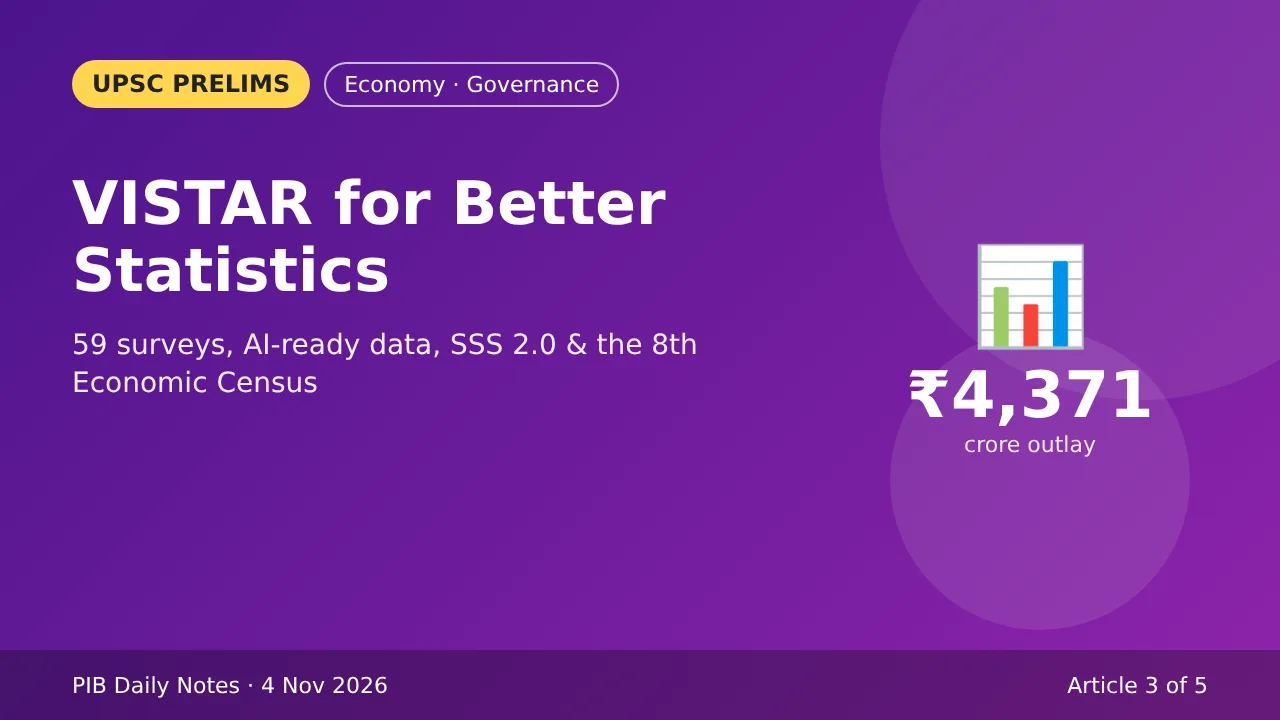
On 4 November 2026, the Union Cabinet approved the Viksit Bharat Initiative for Statistical Transformation, Analytics & Research (VISTAR)
DDecode Civils
· 4 min read
VISTAR: A ₹4,371 Crore Push for India's Statistical System
Why in News
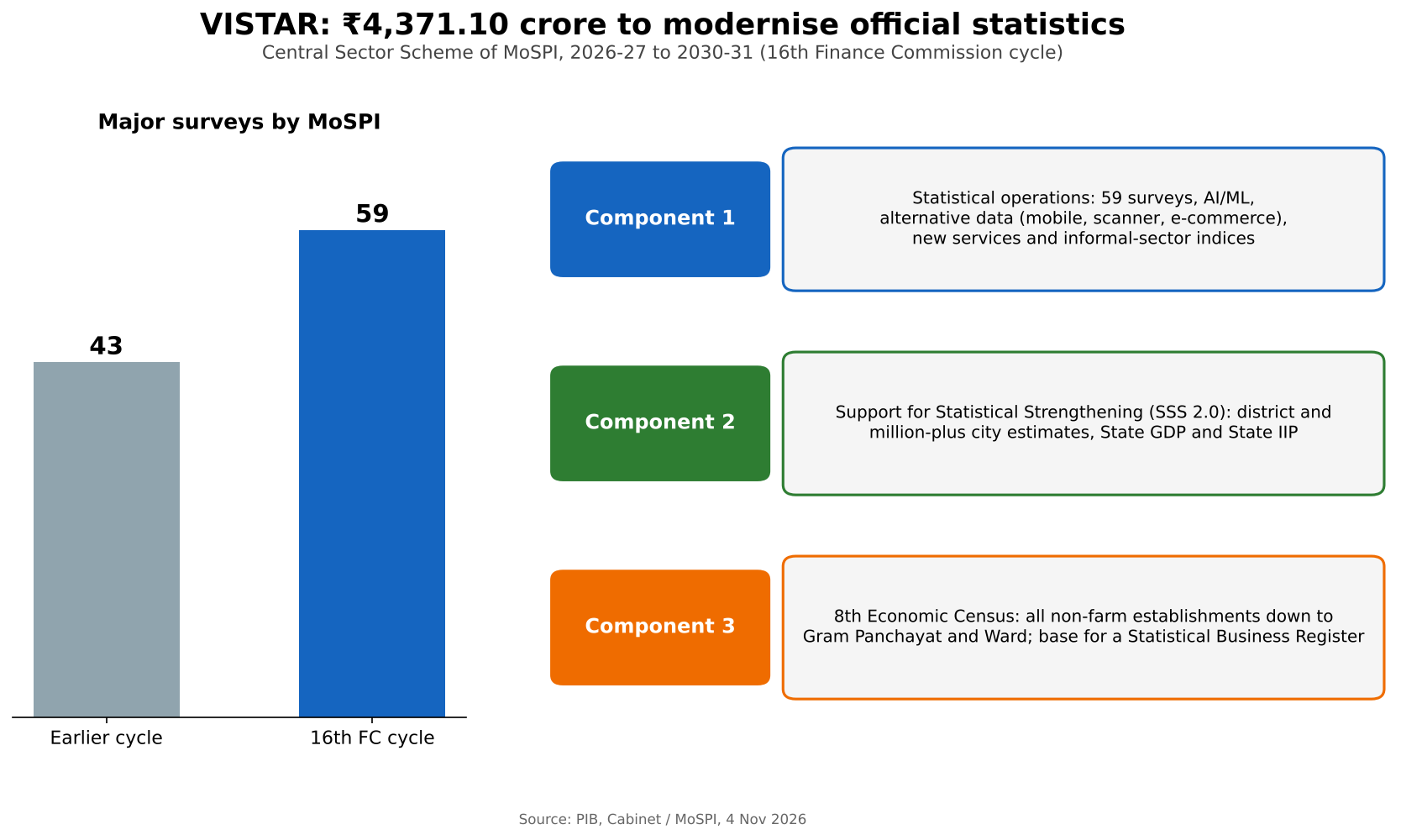
On 4 November 2026, the Union Cabinet approved the Viksit Bharat Initiative for Statistical Transformation, Analytics & Research (VISTAR), a Central Sector Scheme of the Ministry of Statistics and Programme Implementation (MoSPI) for 2026-27 to 2030-31, with an outlay of ₹4,371.10 crore.
News Summary
VISTAR aims at a real-time, future-ready official statistics system with better timeliness, granularity and interoperability, and AI-ready datasets.
It brings all statistical and data management activities of MoSPI under one scheme, so funds can move to urgent policy needs.
MoSPI plans 59 surveys in the 16th Finance Commission cycle, against 43 major surveys earlier.
New measures planned: a Headline Index of Services Production and an Index of Unincorporated Sector Enterprises.
Alternative data from mobile phones, scanners and e-commerce will supplement surveys and reduce the burden on respondents.
AI and machine learning will be built into data processing, validation and analysis.
Prelims Facts & Static Linkages
The three components
Component 1, Comprehensive Statistical Operations: large surveys, research on methods, digitalisation and data governance. It includes an internship scheme and research grants.
Component 2, Support for Statistical Strengthening (SSS 2.0): deliverable-linked funds for States and UTs to produce district-level and million-plus city estimates in PLFS, HCES and ASUSE, and to compile State/District GDP and State IIP.
Component 3, the 8th Economic Census: counts all non-farm establishments and their workers down to Gram Panchayat and Ward level. It will be the base for a National Statistical Business Register (SBR).
India's statistical institutions
Body
Key fact
MoSPI
Formed in 1999 by merging the Department of Statistics and the Department of Programme Implementation
National Statistics Office (NSO)
Formed in 2019 by merging the CSO and NSSO
National Statistical Commission
Set up in 2005 on the Rangarajan Commission (2001) recommendation
Labour Bureau
Attached office of the Ministry of Labour; compiles CPI for industrial workers
Office of the Economic Adviser (DPIIT)
Compiles the Wholesale Price Index
Key surveys to know
Periodic Labour Force Survey (PLFS): started in 2017 for employment data.
Household Consumption Expenditure Survey (HCES): the basis for poverty and CPI weights.
Annual Survey of Industries (ASI): the main source on the factory sector, run under the Collection of Statistics Act, 2008.
Economic Census: the first was held in 1977, and the 7th in 2019 with CSC e-Governance as partner.
Why better statistics matter
Policy targeting: granular district data helps direct schemes to the right places and people.
Informal economy: the Economic Census and ASUSE show the size of the unorganised sector, which is hard to capture in GDP.
Credibility: timely, transparent data builds trust among investors, rating agencies and international bodies such as the IMF, whose data standards India follows.
Central Sector vs Centrally Sponsored
Central Sector Scheme: fully funded and run by the Union, as with VISTAR.
Centrally Sponsored Scheme: shared funding and run by States, as with the FTSC scheme above.
Quick Revision
VISTAR is a Central Sector Scheme of MoSPI worth ₹4,371.10 crore.
It runs from 2026-27 to 2030-31, matching the 16th Finance Commission cycle.
Surveys rise from 43 to 59.
New indices: services production and unincorporated enterprises.
The 8th Economic Census is a component.
SSS 2.0 funds States for district-level data.
Practice MCQ
Q. With reference to the VISTAR scheme, consider the following statements:
1. It is a Centrally Sponsored Scheme implemented by the States.
2. It includes conducting the 8th Economic Census.
3. The Economic Census covers both farm and non-farm establishments.
Which of the statements given above is/are correct?
(a) 1 and 2 only
(b) 2 only
(c) 2 and 3 only
(d) 1, 2 and 3
Answer: (b). VISTAR is a Central Sector Scheme, and the Economic Census covers non-farm establishments.
Related PYQs
PYQ 1 (UPSC CSE Prelims 2022)
In India, which one of the following compiles information on industrial disputes, closures, retrenchments and lay-offs in factories employing workers?
(a) Central Statistics Office
(b) Department for Promotion of Industry and Internal Trade
(c) Labour Bureau
(d) National Technical Manpower Information System
Answer: (c).
PYQ 2 (UPSC CSE Prelims 2026)
Which one of the following represents the three key sub-indices of the Financial Inclusion Index (FI-Index) of the Reserve Bank of India (RBI)?
(a) Credit access, Insurance depth, and Pension coverage
(b) Banking access, GDP contribution, and Financial literacy



 28
Nov 2026
 28
Nov 2026
 28
Nov 2026














0 comments
Discussion
No comments yet. Be the first.