
Euthanasia
Why in news: U.K. introduced the Terminally Ill Adults (End of Life) Bill, also known as the Assisted Dying Bill. Allows terminally ill adults in England and Wales with less than six months to live to choose assisted death under strict safeguards. It would require validation by…

Why in news: U.K. introduced the Terminally Ill Adults (End of Life) Bill, also known as the Assisted Dying Bill.
- Allows terminally ill adults in England and Wales with less than six months to live to choose assisted death under strict safeguards. It would require validation by two doctors, a psychiatrist, a senior lawyer, and a social worker.
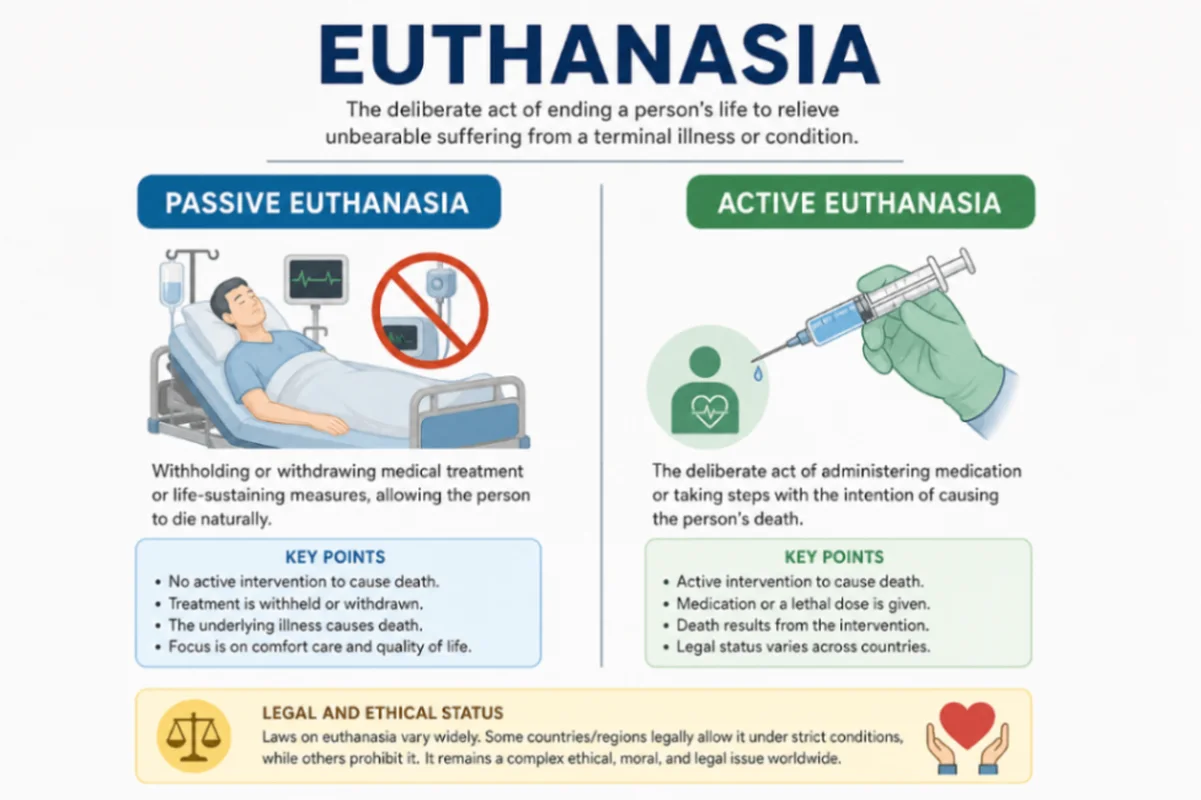
- The distinction between “active” and “passive” euthanasia goes beyond the binary of “act versus omission”, said SC judge. The distinction lies in the source of the harm that leads to death, not merely the nature of the conduct.
- Active euthanasia involves causing death by introducing a new, external agency of harm such as a lethal injection. In such cases, death is not the result of the patient’s underlying illness but of an intervention. Illegal in India.
- Passive euthanasia means allowing death to occur. By withdrawing or withholding life support, the physician is not creating a new risk of death. Doctors allow the underlying fatal condition to take its natural course. This happens by not continuing medical interventions that were artificially prolonging life.
Indian Supreme Court:
- Gian Kaur v State of Punjab (1996) distinguished suicide from acceleration of natural death. Held right to live with dignity includes right to die with dignity when life is ebbing out.
- 196th Law Commission Report (2006) recommended no criminal liability for withdrawal in best interests.
- Aruna Shanbaug case (2011) led to guidelines on withholding treatment. Court relied on comparative jurisprudence.
- 241st Law Commission Report reiterated earlier suggestions.
- Medical Treatment of Terminally-Ill Patients Bill, 2016 published but no follow-up.
- Common Cause (2018) laid down procedures for withdrawal of life support. Included provision for Advance Medical Directives (AMDs). Need for judicial intervention due to absence of law. Court expressed hope for a specific Law. 2023 judgment simplified procedure for AMDs. 2024 government guidelines issued for public consultation.
Indian Government:
- Ministry of Health released draft Guidelines for Withdrawal of Life Support in Terminally Ill Patients to operationalise the Supreme Court’s 2018 and 2023 orders on right to die with dignity for all Indians.
- Guidelines include:
- Setting up of Primary and Secondary Medical Boards at level of hospital, which will determine when further medical treatment may not be beneficial to a terminally ill patient;
- Nomination of doctors by district CMO or equivalent to hospital-level Secondary Medical Boards, which will confirm or reject opinion of Primary Medical Boards. Secondary Medical Board members must be different from those on the Primary Medical Board.
- There is no dedicated legislation in India on withholding/withdrawing life-sustaining treatment. But SC’s judgment and these guidelines make it clear that withholding/withdrawing life-sustaining treatment is legal.
- SC in Common Cause vs Union of India (2018) recognised right to die with dignity under Article 21.
- Withdrawal of life-sustaining treatment takes place either through informed refusal by a patient with decision-making capacity or through an advance medical directive (‘living will’). SC in its 2018 judgment also laid down framework for making advance medical directives or living wills and simplified it in 2023.
- Living wills are written documents made by a person of age 18 years or older with decision-making capacity, expressing their will on how they would wish to be treated if they lose such capacity.
- It should detail at least two surrogate decision-makers — anyone whom the person trusts, from family to neighbours, who can make decisions on behalf of the person if they lose decision-making capacity. It becomes legal when it is signed in presence of executor and 2 witnesses, and attested before a notary or gazetted officer.
- Hospital must notify decisions on withdrawing life-sustaining treatment to the local judicial magistrate.
- Government Medical College Hospital in Kerala’s Kollam district opened a ‘Living Will Information Counter’ to spread awareness & became the first hospital in the country to establish such a counter.
Preparing for UPSC?
Talk to us about the right programme for your attempt.
Keep reading
Related articles
 03
Jul 2026
03
Jul 2026
Current Affairs · Governance
HPV Vaccination
The Hindu, Page 10, Editorial - A shot at life, Mandsaur’s model for HPV vaccination - GS-2-Health Why in news: The Government of India launched a nationwide cervical cancer campaign in February 2026, providing free HPV…
Decode Civils · 3 Jul 2026
 26
Jun 2026
26
Jun 2026
Current Affairs · Governance
FCRA Amendment Rules 2026
Subject - GS Paper-II (Governance & Social Justice) Subtopic - NGOs, civil society, and government policies. Source - The Hindu (26th June 2026 - Page 8 - Editorial Section) Onerous rules Why in news: The Foreign…
Decode Civils · 26 Jun 2026
 03
May 2026
03
May 2026
Current Affairs · Governance
Mizoram Full Functional Literacy
Why in news: Mizoram declared a fully literate state, becoming the first state in India to achieve full functional literacy. Mizoram recorded 98.20% literacy rate as per the PLFS Survey 2023-24 (above 95% benchmark). In 2024, Ladakh became the first administrative unit to…
Decode Civils · 3 May 2026
Our programmes
Courses for your attempt

PSIR EXCELLENCE PROGRAM PRO (OFFLINE): Batch-2
An Enrichment Course that can help you add 50+ marks in your PSIR Scores.

PSIR EXCELLENCE PROGRAM PRO (ONLINE): Batch-2
An Enrichment Course that can help you add 50+ marks in your PSIR Scores.

PSIR EXCELLENCE PROGRAM- BASE (OFFLINE): Batch-2
An Enrichment Course that can help you add 50+ marks in your PSIR Scores.
PSIR EXCELLENCE PROGRAM BASE (ONLINE): Batch-2
An Enrichment Course that can help you add 50+ marks in your PSIR Scores.

Mains Excellence Program Pro for Mains 2027 - Final Batch
Your One-Stop Solution for UPSC 2027 Mains: - MEP Faculties have an experience of 22 UPSC CSE Mains, 10 Interviews and 5 Final Selections. - Faculties include Mudit Jain Sir (AIR-222, 207, 173), Sourabh Arbole Sir (6…
Batch 2027 Starts 14 Sep 2026

Mains Excellence Program Plus for Mains 2027 - Final Batch
Your One-Stop Solution for UPSC 2027 Mains: - MEP Faculties have an experience of 22 UPSC CSE Mains, 10 Interviews and 5 Final Selections. - Faculties include Mudit Jain Sir (AIR-222, 207, 173), Sourabh Arbole Sir (6…
Batch 2027 Starts 14 Sep 2026

Mains Excellence Program Basic for Mains 2027 - Final Batch
Your One-Stop Solution for UPSC 2027 Mains: - MEP Faculties have an experience of 22 UPSC CSE Mains, 10 Interviews and 5 Final Selections. - Faculties include Mudit Jain Sir (AIR-222, 207, 173), Sourabh Arbole Sir (6…
Batch 2027 Starts 14 Sep 2026
Foundation + Advanced Ethics Base (Offline)
Is Ethics Paper Doable via Philosophical Gyan or Specific Thematic Preparation is Needed? Last 5 Years' Analysis & 54 Distinct Themes asked by UPSC answer the above question. Thematic preparation and advanced ethics…
Batch 2027 Starts 14 Sep 2026
Foundation + Advanced Ethics Base (Online)
Is Ethics Paper Doable via Philosophical Gyan or Specific Thematic Preparation is Needed? Last 5 Years' Analysis & 54 Distinct Themes asked by UPSC answer the above question. Thematic preparation and advanced ethics…
Batch 2027 Starts 14 Sep 2026
Foundation + Advanced Ethics Plus (Offline)
Is Ethics Paper Doable via Philosophical Gyan or Specific Thematic Preparation is Needed? Last 5 Years' Analysis & 54 Distinct Themes asked by UPSC answer the above question. Thematic preparation and advanced ethics…
Batch 2027 Starts 14 Sep 2026
Foundation + Advanced Ethics Plus (Online)
Is Ethics Paper Doable via Philosophical Gyan or Specific Thematic Preparation is Needed? Last 5 Years' Analysis & 54 Distinct Themes asked by UPSC answer the above question. Thematic preparation and advanced ethics…
Batch 2027 Starts 14 Sep 2026

Year Long Current Affairs Base (Pre + Mains)
Master Current Affairs the way UPSC demands—through conceptual understanding, issue-based analysis, and exam-oriented preparation. With a proven track record across UPSC and State PSC examinations, our course helps you…
Batch 2027 Starts 16 Aug 2026


0 comments
Discussion
No comments yet. Be the first.