
Gram Sabhas and Panchayats
The Hindu, Page 6, Editorial - Yes and no - GS-2-Polity Why in News: A Rural Development Ministry report based on surveys examines citizen participation in gram sabhas and highlights concerns over participation fatigue.…

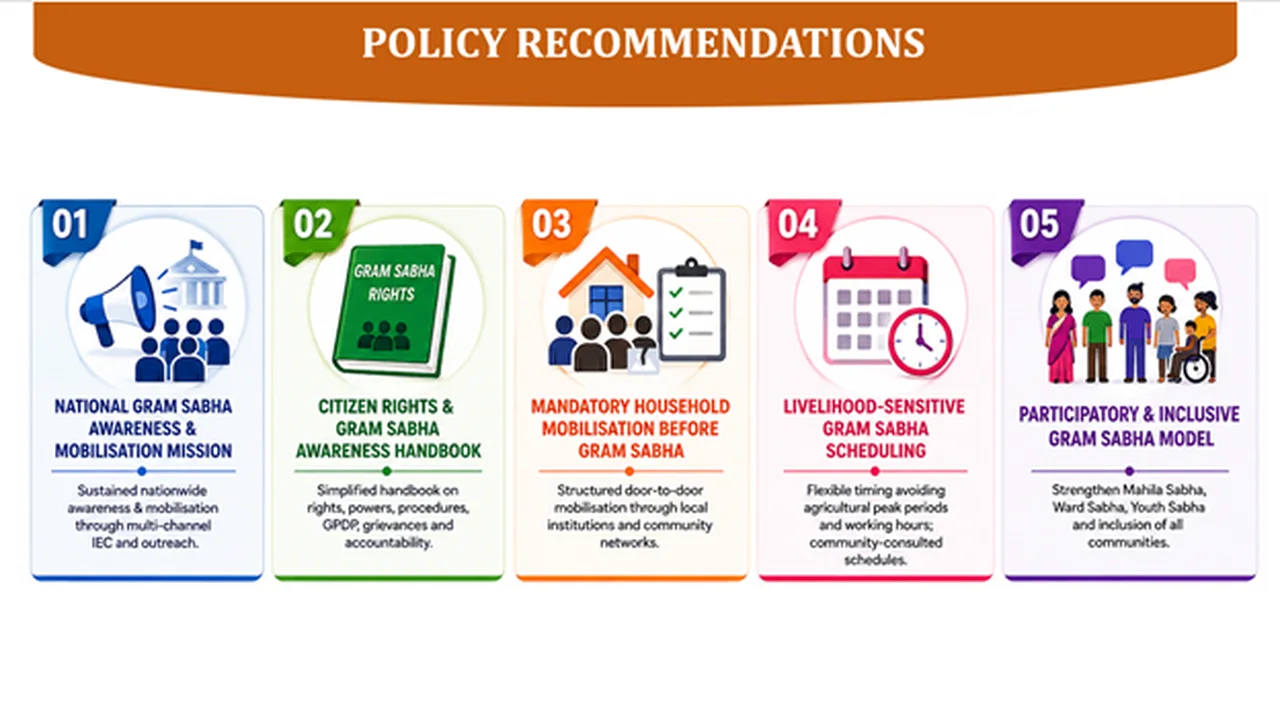
The Hindu, Page 6, Editorial - Yes and no - GS-2-Polity
Why in News: A Rural Development Ministry report based on surveys examines citizen participation in gram sabhas and highlights concerns over participation fatigue.
Findings of the Report
- The report states that "participation fatigue" has reduced citizen participation in gram sabhas. It proposes measures such as more meetings and greater oversight.
- 18%–28% of respondents cited lack of outcomes as the reason for low participation.
- The report recommends greater use of the NIRNAY app.
- It also recommends uploading meeting minutes in real time.
- More than half of the barriers to participation are related to livelihoods.
Challenges to Gram Sabha Functioning
- The 73rd Constitutional Amendment empowers gram sabhas. Governments have reduced gram sabhas to clearinghouses for Central and State schemes.
- Increased digital compliance leaves panchayat secretaries with less time to facilitate discussions.
- Workers have reportedly been informed that MGNREGA demands were "not entered in the system" because of server errors.
- State has failed to institutionalise attendance as a paid component of social protection.
- It argues that gram sabhas have remained a platform dominated by landlords and contractors.
Fiscal Constraints
- According to the report, 13% of gram sabha time is spent identifying local issues. Only 4% of the time is spent discussing revenue generation.
- Gram panchayats have been systematically constrained from raising their own taxes. This has made them dependent on grants.
- The 14th and 15th Finance Commission grants linked panchayat expenditure to priorities such as drinking water and sanitation. Local priorities are therefore limited to flagship programmes such as Jal Jeevan Mission and Swachh Bharat Mission.
PESA and Gram Sabhas
- The report states that PESA Act areas have "reasonably strong physical infrastructure." Under the Provisions of the Panchayats (Extension to the Scheduled Areas) Act, 1996 (PESA) and related Forest Rights laws, gram sabhas have the right to provide prior informed consent for land acquisition and mining.
- State routinely bypasses gram sabhas or cites low participation to manufacture consent. The Hasdeo Arand protests are cited in this context. Gram sabhas have the right to say "no", and this should be acknowledged.
More in News on Panchayats & Gram Sabhas
AI-tool ‘SabhaSaar’
Why in news: On Independence Day, AI-powered tool ‘SabhaSaar’ launched in Tripura, later extended to other states.
- SabhaSaar generates structured minutes of Gram Sabha meetings from video/audio recordings using AI.
- Panchayat officials can upload recordings via e-GramSwaraj login; ensures uniformity of minutes nationwide.
- Built on Bhashini, AI-powered language translation platform bridging literacy, language, digital divides. Tool transcribes, translates, summarizes in Indian languages (Hindi, Bengali, Tamil, Telugu, Marathi, Gujarati) + English.
- Gram Sabhas must meet 4 times a year (Jan 26, May 1, Aug 15, Oct 2). Panchayat NIRNAY portal launched for real-time monitoring of Gram Sabha meetings. NIRNAY allows scheduling, agenda circulation, citizen notifications, ensuring participation & transparency.
- Gram Sabha = bedrock of Panchayati Raj System; April 24 celebrated as Panchayati Raj Day (since 73rd Amendment Act, 1993). India has 2,55,397 village panchayats (MoPR data). (LSG = State List, Entry 5).
- BHASHINI launched by PM (2022) under the National Language Technology Mission. Aims to provide translation services in 22 scheduled Indian languages to break linguistic barriers and improve digital access.
- AI-based language translation tool enabling real-time translation across Indian languages.
- Seeks to build a National Public Digital Platform for languages and increase Indian language content online.
- Designed to integrate technology in governance with multi-language support.
- Promotes national integration, inclusivity, and digital empowerment using AI tools.
Other digital initiatives for Gram Panchayats
- eGramSwaraj is a web-based portal for transparency in decentralized planning, progress reporting, financial management, work-based accounting, and asset details.
- AuditOnline launched to ensure timely audit of Panchayat accounts and for maintaining audit records.
- Common Service Centres (CSCs) set up in rural areas and Gram Panchayats to provide citizen-centric services online. CSCs function through a Special Purpose Vehicle (SPV) under the Ministry of Electronics and IT.
Panchayat Devolution Index
Why in news: Ministry of Panchayati Raj released the Panchayat Devolution Index based on a study by the Indian Institute of Public Administration.
- IIPA studied 172 panchayats in 68 districts across India to measure performance on six parameters: framework, functions, finances, functionaries, capacity building, accountability.
- Index scales states from 0-100 & was last published in 2014; over the past decade, the national average score rose from 39.92 to 43.89.
- Karnataka, Kerala and Tamil Nadu topped the index.
- Uttar Pradesh and Bihar recorded the biggest improvement. Manipur, Arunachal Pradesh and Jharkhand are the lowest-scoring states.
- Manipur, Arunachal Pradesh and Haryana have seen the biggest declines in the past decade.
- As of 2024, there are 2.62 lakh panchayats in India, up from 2.48 lakh in 2013–14.
Preparing for UPSC?
Talk to us about the right programme for your attempt.
Keep reading
Related articles
 25
Apr 2026
25
Apr 2026
Current Affairs · Polity
Women Reservation
What: The Legal Framework The core of this reservation lies in the 106th Constitutional Amendment Act, 2023 (Nari Shakti Vandan Adhiniyam). The Mandate: It reserves 33% (one-third) of seats for women in the Lok Sabha, State Legislative Assemblies, and the Delhi Legislative…
Decode Civils · 25 Apr 2026
 25
Apr 2026
25
Apr 2026
Current Affairs · Polity
16th Finance Commission
Why in news: 16th FC recommended that Centre retain 41% share of tax devolution to States as in force since 2021. ₹1.4 lakh crore States Grant include Rural and Urban Local Body and Disaster Management Grants. It tweaked formula that decides the division of the share among the…
Decode Civils · 25 Apr 2026
 25
Apr 2026
25
Apr 2026
Current Affairs · Polity
8th Pay Commission
Why in news: The Union Cabinet has approved the Terms of Reference (ToR) for the eighth CPC, which will determine the pay structure and retirement benefits of Union government employees, including defence personnel. The 8th CPC will comprise one chairperson, one part-time…
Decode Civils · 25 Apr 2026
Our programmes
Courses for your attempt

PSIR EXCELLENCE PROGRAM PRO (OFFLINE): Batch-2
An Enrichment Course that can help you add 50+ marks in your PSIR Scores.

PSIR EXCELLENCE PROGRAM PRO (ONLINE): Batch-2
An Enrichment Course that can help you add 50+ marks in your PSIR Scores.

PSIR EXCELLENCE PROGRAM- BASE (OFFLINE): Batch-2
An Enrichment Course that can help you add 50+ marks in your PSIR Scores.

PSIR EXCELLENCE PROGRAM BASE (ONLINE): Batch-2
An Enrichment Course that can help you add 50+ marks in your PSIR Scores.

Mains Excellence Program Pro for Mains 2027 - Final Batch
Your One-Stop Solution for UPSC 2027 Mains: - MEP Faculties have an experience of 22 UPSC CSE Mains, 10 Interviews and 5 Final Selections. - Faculties include Mudit Jain Sir (AIR-222, 207, 173), Sourabh Arbole Sir (6…
Batch 2027 Starts 14 Sep 2026

Mains Excellence Program Plus for Mains 2027 - Final Batch
Your One-Stop Solution for UPSC 2027 Mains: - MEP Faculties have an experience of 22 UPSC CSE Mains, 10 Interviews and 5 Final Selections. - Faculties include Mudit Jain Sir (AIR-222, 207, 173), Sourabh Arbole Sir (6…
Batch 2027 Starts 14 Sep 2026

Mains Excellence Program Basic for Mains 2027 - Final Batch
Your One-Stop Solution for UPSC 2027 Mains: - MEP Faculties have an experience of 22 UPSC CSE Mains, 10 Interviews and 5 Final Selections. - Faculties include Mudit Jain Sir (AIR-222, 207, 173), Sourabh Arbole Sir (6…
Batch 2027 Starts 14 Sep 2026
Foundation + Advanced Ethics Base (Offline)
Is Ethics Paper Doable via Philosophical Gyan or Specific Thematic Preparation is Needed? Last 5 Years' Analysis & 54 Distinct Themes asked by UPSC answer the above question. Thematic preparation and advanced ethics…
Batch 2027 Starts 14 Sep 2026
Foundation + Advanced Ethics Base (Online)
Is Ethics Paper Doable via Philosophical Gyan or Specific Thematic Preparation is Needed? Last 5 Years' Analysis & 54 Distinct Themes asked by UPSC answer the above question. Thematic preparation and advanced ethics…
Batch 2027 Starts 14 Sep 2026
Foundation + Advanced Ethics Plus (Offline)
Is Ethics Paper Doable via Philosophical Gyan or Specific Thematic Preparation is Needed? Last 5 Years' Analysis & 54 Distinct Themes asked by UPSC answer the above question. Thematic preparation and advanced ethics…
Batch 2027 Starts 14 Sep 2026
Foundation + Advanced Ethics Plus (Online)
Is Ethics Paper Doable via Philosophical Gyan or Specific Thematic Preparation is Needed? Last 5 Years' Analysis & 54 Distinct Themes asked by UPSC answer the above question. Thematic preparation and advanced ethics…
Batch 2027 Starts 14 Sep 2026

Year Long Current Affairs Base (Pre + Mains)
Master Current Affairs the way UPSC demands—through conceptual understanding, issue-based analysis, and exam-oriented preparation. With a proven track record across UPSC and State PSC examinations, our course helps you…
Batch 2027 Starts 16 Aug 2026


0 comments
Discussion
No comments yet. Be the first.