
8th Pay Commission
Why in news: The Union Cabinet has approved the Terms of Reference (ToR) for the eighth CPC, which will determine the pay structure and retirement benefits of Union government employees, including defence personnel. The 8th CPC will comprise one chairperson, one part-time…

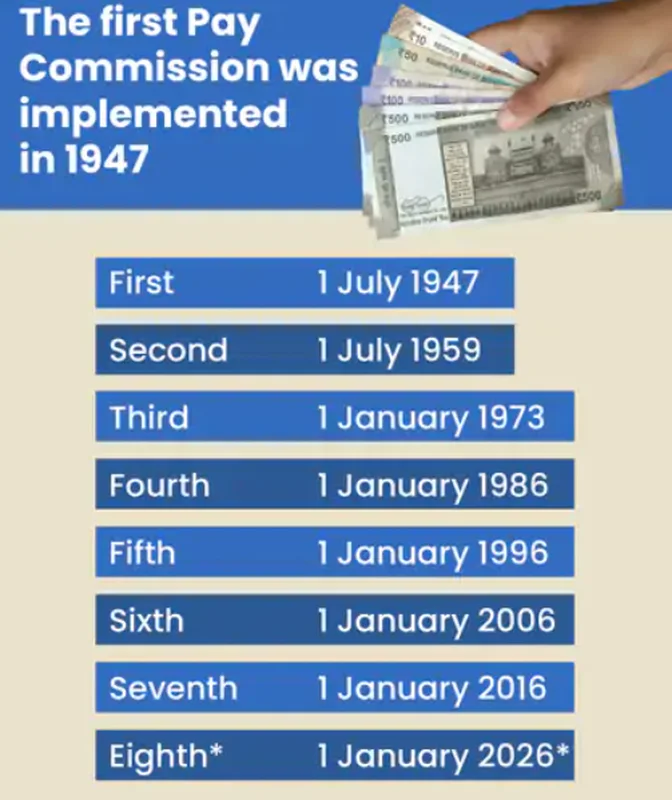
Why in news: The Union Cabinet has approved the Terms of Reference (ToR) for the eighth CPC, which will determine the pay structure and retirement benefits of Union government employees, including defence personnel.
- The 8th CPC will comprise one chairperson, one part-time member, and one member-secretary, and is expected to submit its recommendations within 18 months of its constitution i.e. in April 2027 but will be effective retrospectively from January 1, 2026.
- Justice Ranjana Prakash Desai (retd.) has been appointed as the Chairperson. Other members include IIM Bangalore Professor Pulak Ghosh (Part-time Member) and Petroleum Secretary Pankaj Jain (Member-Secretary).
- The CPC’s recommendations will directly affect around 50 lakh Central government employees.
- While formulating its report, the Commission is required to consider multiple economic and fiscal factors, including:
- The current economic conditions of the country.
- Fiscal prudence and sustainable expenditure.
- The need to maintain adequate resources for developmental and welfare programmes.
- Unfunded liabilities of non-contributory pensions.
- The impact of pay revisions on State finances.
- Existing emolument structure of govt employees.
- Compare public and private sector pay structures.
- The establishment of 8th Central Pay Commission continues India’s periodic review mechanism for government pay and pension reforms, following the 7th CPC, whose recommendations were implemented in 2016.
- The compression ratio (lowest to highest salary) was 1:12.5 in the 7th CPC when measured against the Apex Scale, though the ratio relative to the absolute highest salary of the Cabinet Secretary is 1:13.9. It is used to ensure pay equity while remaining competitive for high-level talent.
- Pension bill for 2025-26 is estimated at ₹2.76 lakh crore out of the total revenue expenditure of ₹39.44 lakh crore.
- It is not mandatory to set the commission every 10 years.
- It is an executive body, established by government resolution (administrative order) under its executive power, not a constitutional one, though it operates within the constitutional framework to advise on employee remuneration, making its recommendations advisory. It is a temporary commission set up periodically.
Preparing for UPSC?
Talk to us about the right programme for your attempt.
Keep reading
Related articles
 03
Jul 2026
03
Jul 2026
Current Affairs · Polity
Gram Sabhas and Panchayats
The Hindu, Page 6, Editorial - Yes and no - GS-2-Polity Why in News: A Rural Development Ministry report based on surveys examines citizen participation in gram sabhas and highlights concerns over participation fatigue.…
Decode Civils · 3 Jul 2026
 25
Apr 2026
25
Apr 2026
Current Affairs · Polity
Women Reservation
What: The Legal Framework The core of this reservation lies in the 106th Constitutional Amendment Act, 2023 (Nari Shakti Vandan Adhiniyam). The Mandate: It reserves 33% (one-third) of seats for women in the Lok Sabha, State Legislative Assemblies, and the Delhi Legislative…
Decode Civils · 25 Apr 2026
 25
Apr 2026
25
Apr 2026
Current Affairs · Polity
16th Finance Commission
Why in news: 16th FC recommended that Centre retain 41% share of tax devolution to States as in force since 2021. ₹1.4 lakh crore States Grant include Rural and Urban Local Body and Disaster Management Grants. It tweaked formula that decides the division of the share among the…
Decode Civils · 25 Apr 2026
Our programmes
Courses for your attempt

PSIR EXCELLENCE PROGRAM PRO (OFFLINE): Batch-2
An Enrichment Course that can help you add 50+ marks in your PSIR Scores.

PSIR EXCELLENCE PROGRAM PRO (ONLINE): Batch-2
An Enrichment Course that can help you add 50+ marks in your PSIR Scores.

PSIR EXCELLENCE PROGRAM- BASE (OFFLINE): Batch-2
An Enrichment Course that can help you add 50+ marks in your PSIR Scores.
PSIR EXCELLENCE PROGRAM BASE (ONLINE): Batch-2
An Enrichment Course that can help you add 50+ marks in your PSIR Scores.

Mains Excellence Program Pro for Mains 2027 - Final Batch
Your One-Stop Solution for UPSC 2027 Mains: - MEP Faculties have an experience of 22 UPSC CSE Mains, 10 Interviews and 5 Final Selections. - Faculties include Mudit Jain Sir (AIR-222, 207, 173), Sourabh Arbole Sir (6…
Batch 2027 Starts 14 Sep 2026

Mains Excellence Program Plus for Mains 2027 - Final Batch
Your One-Stop Solution for UPSC 2027 Mains: - MEP Faculties have an experience of 22 UPSC CSE Mains, 10 Interviews and 5 Final Selections. - Faculties include Mudit Jain Sir (AIR-222, 207, 173), Sourabh Arbole Sir (6…
Batch 2027 Starts 14 Sep 2026

Mains Excellence Program Basic for Mains 2027 - Final Batch
Your One-Stop Solution for UPSC 2027 Mains: - MEP Faculties have an experience of 22 UPSC CSE Mains, 10 Interviews and 5 Final Selections. - Faculties include Mudit Jain Sir (AIR-222, 207, 173), Sourabh Arbole Sir (6…
Batch 2027 Starts 14 Sep 2026
Foundation + Advanced Ethics Base (Offline)
Is Ethics Paper Doable via Philosophical Gyan or Specific Thematic Preparation is Needed? Last 5 Years' Analysis & 54 Distinct Themes asked by UPSC answer the above question. Thematic preparation and advanced ethics…
Batch 2027 Starts 14 Sep 2026
Foundation + Advanced Ethics Base (Online)
Is Ethics Paper Doable via Philosophical Gyan or Specific Thematic Preparation is Needed? Last 5 Years' Analysis & 54 Distinct Themes asked by UPSC answer the above question. Thematic preparation and advanced ethics…
Batch 2027 Starts 14 Sep 2026
Foundation + Advanced Ethics Plus (Offline)
Is Ethics Paper Doable via Philosophical Gyan or Specific Thematic Preparation is Needed? Last 5 Years' Analysis & 54 Distinct Themes asked by UPSC answer the above question. Thematic preparation and advanced ethics…
Batch 2027 Starts 14 Sep 2026
Foundation + Advanced Ethics Plus (Online)
Is Ethics Paper Doable via Philosophical Gyan or Specific Thematic Preparation is Needed? Last 5 Years' Analysis & 54 Distinct Themes asked by UPSC answer the above question. Thematic preparation and advanced ethics…
Batch 2027 Starts 14 Sep 2026

Year Long Current Affairs Base (Pre + Mains)
Master Current Affairs the way UPSC demands—through conceptual understanding, issue-based analysis, and exam-oriented preparation. With a proven track record across UPSC and State PSC examinations, our course helps you…
Batch 2027 Starts 16 Aug 2026


0 comments
Discussion
No comments yet. Be the first.