
16th Finance Commission
Why in news: 16th FC recommended that Centre retain 41% share of tax devolution to States as in force since 2021. ₹1.4 lakh crore States Grant include Rural and Urban Local Body and Disaster Management Grants. It tweaked formula that decides the division of the share among the…

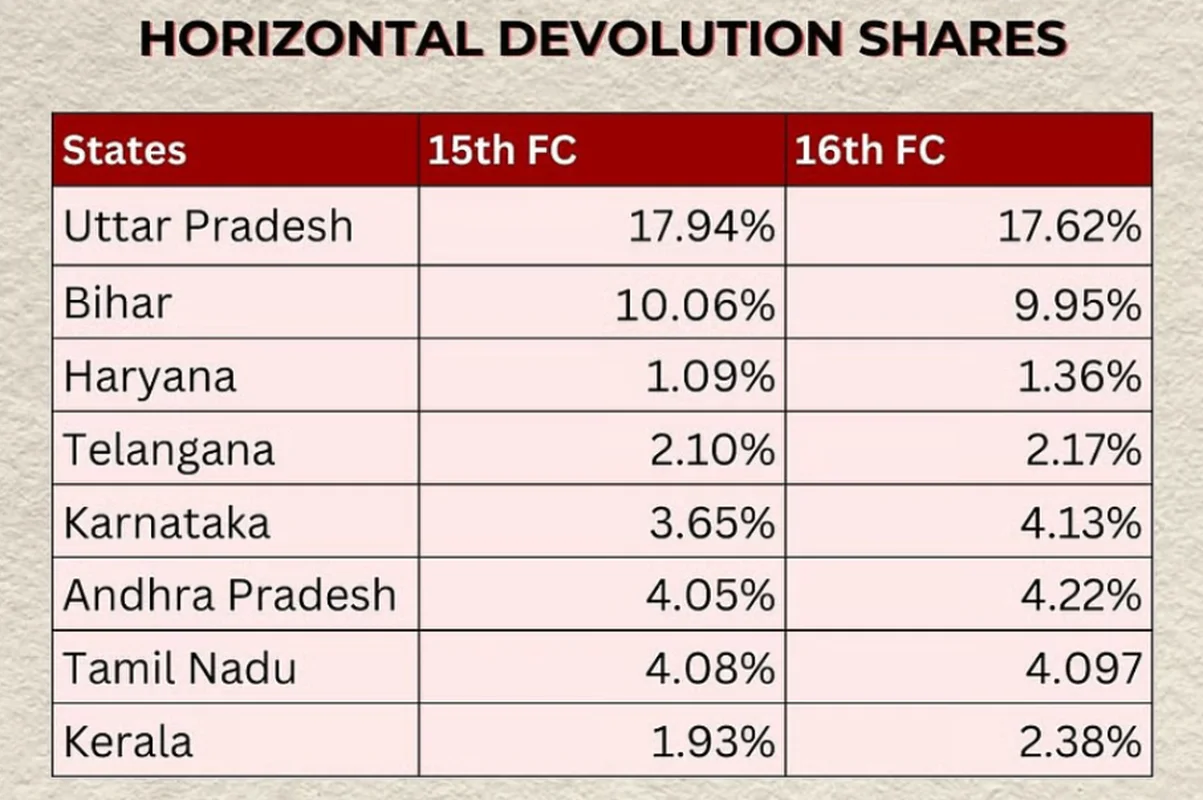
Why in news: 16th FC recommended that Centre retain 41% share of tax devolution to States as in force since 2021.
- ₹1.4 lakh crore States Grant include Rural and Urban Local Body and Disaster Management Grants.
- It tweaked formula that decides the division of the share among the States. 5 southern States assigned a collectively higher share under the distribution scheme of the 16th FC than in the past.
- Kerala’s degree of rise is only next to Haryana’s 24.52%, while the third slot goes to Karnataka.
Changes in Devolution Formula
- FC-16 has reworked the earlier “tax effort” criterion into a broader “contribution to GDP” measure. Weight raised from 2.5% (FC-15) to 10%. This is intended to reward productive and efficient States.
- Weight accorded to demographic performance has been reduced. Reflects the view that penalising population growth is not appropriate when India is close to the peak of its demographic dividend.
- Weight for population size has been increased.
- FC-16 flags shrinking of the effective divisible pool due to cesses and surcharges but stops short of correcting this.
Horizontal Devolution Formula (16th FC vs 15th FC)
- Income Distance: 42.5% (Reduced from 45%). Population (2011): 17.5% (Increased from 15%).
- Area: 10% (Reduced from 15%). Forest & Ecology: 10% (Retained).
- Demographic Performance: 10% (Reduced from 12.5%). Contribution to GDP: 10% (Replaces Tax-Fiscal Effort)
- Maharashtra, Gujarat, Karnataka benefit structurally. Bihar, Jharkhand, Uttar Pradesh do not benefit.
Finance Commission and urban local governments
- FM tabled the 16th Finance Commission report in the Lok Sabha.
- Recommended allocation of ₹3.5 lakh crore to urban local governments for the next 5 years.
- Funds are devolved to ULGs through transfers by the Central and State governments in the form of grants.
- Allocation of ₹10,000 crore to the urbanisation premium grant could incentivise rural-urban transition.
- Commission allocated 45% of local government grants to ULGs, increased from 36%.
- More than 60% of grants to ULGs were basic grants.
- Tied grants can be used for basic services such as sanitation and water supply.
- Untied grants can be used for location-specific needs excluding salary and establishment expenses.
Divisible pool concerns
- Divisible pool excludes cesses, surcharges, and collection costs. Between 2013–2019, for every ₹100, about ₹93–95 formed the divisible pool. Remaining ₹5–7 collected as cesses and surcharges.
- In 2021-22, for every ₹100, ₹86.5 formed taxes and duties while ₹13.5 was cesses and surcharges.
- Share of divisible pool in Gross Tax Revenue to remain below 90% (81%) for the sixth consecutive year.
- Underlying divisible pool shrinking due to increasing reliance on cesses and surcharges.
- Constitution does not permit a cap on cesses and surcharges.
- FC argues Centre requires these funds for war, famine, and pandemics.
Constitutional provisions and Finance Commission framework
- 16th Finance Commission under the chairmanship of Dr. Arvind Panagariya submitted report for 2026-31.
- Central government accepted its recommendations.
- Article 270 provides for distribution of net tax proceeds between Centre and States.
- Shared taxes include corporation tax, personal income tax, Central GST, and Centre’s share of IGST.
- Distribution based on recommendations of the Finance Commission constituted under Article 280.
Trends in vertical and horizontal devolution
- Till the 13th Finance Commission (2010-15), vertical devolution fixed at 32%.
- Since the 14th Finance Commission (2015-20), vertical devolution increased to 42%.
- Revised to 41% in the 15th Finance Commission (2020-26) due to reorganisation of Jammu and Kashmir.
- Horizontal devolution since 13th FC gave higher weight to equity and needs compared to efficiency.
- Share of southern and western States marginally increased & big north and central States decreased.
Preparing for UPSC?
Talk to us about the right programme for your attempt.
Keep reading
Related articles
 03
Jul 2026
03
Jul 2026
Current Affairs · Polity
Gram Sabhas and Panchayats
The Hindu, Page 6, Editorial - Yes and no - GS-2-Polity Why in News: A Rural Development Ministry report based on surveys examines citizen participation in gram sabhas and highlights concerns over participation fatigue.…
Decode Civils · 3 Jul 2026
 25
Apr 2026
25
Apr 2026
Current Affairs · Polity
Women Reservation
What: The Legal Framework The core of this reservation lies in the 106th Constitutional Amendment Act, 2023 (Nari Shakti Vandan Adhiniyam). The Mandate: It reserves 33% (one-third) of seats for women in the Lok Sabha, State Legislative Assemblies, and the Delhi Legislative…
Decode Civils · 25 Apr 2026
 25
Apr 2026
25
Apr 2026
Current Affairs · Polity
8th Pay Commission
Why in news: The Union Cabinet has approved the Terms of Reference (ToR) for the eighth CPC, which will determine the pay structure and retirement benefits of Union government employees, including defence personnel. The 8th CPC will comprise one chairperson, one part-time…
Decode Civils · 25 Apr 2026
Our programmes
Courses for your attempt

PSIR EXCELLENCE PROGRAM PRO (OFFLINE): Batch-2
An Enrichment Course that can help you add 50+ marks in your PSIR Scores.

PSIR EXCELLENCE PROGRAM PRO (ONLINE): Batch-2
An Enrichment Course that can help you add 50+ marks in your PSIR Scores.

PSIR EXCELLENCE PROGRAM- BASE (OFFLINE): Batch-2
An Enrichment Course that can help you add 50+ marks in your PSIR Scores.

PSIR EXCELLENCE PROGRAM BASE (ONLINE): Batch-2
An Enrichment Course that can help you add 50+ marks in your PSIR Scores.

Mains Excellence Program Pro for Mains 2027 - Final Batch
Your One-Stop Solution for UPSC 2027 Mains: - MEP Faculties have an experience of 22 UPSC CSE Mains, 10 Interviews and 5 Final Selections. - Faculties include Mudit Jain Sir (AIR-222, 207, 173), Sourabh Arbole Sir (6…
Batch 2027 Starts 14 Sep 2026

Mains Excellence Program Plus for Mains 2027 - Final Batch
Your One-Stop Solution for UPSC 2027 Mains: - MEP Faculties have an experience of 22 UPSC CSE Mains, 10 Interviews and 5 Final Selections. - Faculties include Mudit Jain Sir (AIR-222, 207, 173), Sourabh Arbole Sir (6…
Batch 2027 Starts 14 Sep 2026

Mains Excellence Program Basic for Mains 2027 - Final Batch
Your One-Stop Solution for UPSC 2027 Mains: - MEP Faculties have an experience of 22 UPSC CSE Mains, 10 Interviews and 5 Final Selections. - Faculties include Mudit Jain Sir (AIR-222, 207, 173), Sourabh Arbole Sir (6…
Batch 2027 Starts 14 Sep 2026
Foundation + Advanced Ethics Base (Offline)
Is Ethics Paper Doable via Philosophical Gyan or Specific Thematic Preparation is Needed? Last 5 Years' Analysis & 54 Distinct Themes asked by UPSC answer the above question. Thematic preparation and advanced ethics…
Batch 2027 Starts 14 Sep 2026
Foundation + Advanced Ethics Base (Online)
Is Ethics Paper Doable via Philosophical Gyan or Specific Thematic Preparation is Needed? Last 5 Years' Analysis & 54 Distinct Themes asked by UPSC answer the above question. Thematic preparation and advanced ethics…
Batch 2027 Starts 14 Sep 2026
Foundation + Advanced Ethics Plus (Offline)
Is Ethics Paper Doable via Philosophical Gyan or Specific Thematic Preparation is Needed? Last 5 Years' Analysis & 54 Distinct Themes asked by UPSC answer the above question. Thematic preparation and advanced ethics…
Batch 2027 Starts 14 Sep 2026
Foundation + Advanced Ethics Plus (Online)
Is Ethics Paper Doable via Philosophical Gyan or Specific Thematic Preparation is Needed? Last 5 Years' Analysis & 54 Distinct Themes asked by UPSC answer the above question. Thematic preparation and advanced ethics…
Batch 2027 Starts 14 Sep 2026

Year Long Current Affairs Base (Pre + Mains)
Master Current Affairs the way UPSC demands—through conceptual understanding, issue-based analysis, and exam-oriented preparation. With a proven track record across UPSC and State PSC examinations, our course helps you…
Batch 2027 Starts 16 Aug 2026


0 comments
Discussion
No comments yet. Be the first.