
Women Reservation
What: The Legal Framework The core of this reservation lies in the 106th Constitutional Amendment Act, 2023 (Nari Shakti Vandan Adhiniyam). The Mandate: It reserves 33% (one-third) of seats for women in the Lok Sabha, State Legislative Assemblies, and the Delhi Legislative…

What: The Legal Framework
The core of this reservation lies in the 106th Constitutional Amendment Act, 2023 (Nari Shakti Vandan Adhiniyam).
- The Mandate: It reserves 33% (one-third) of seats for women in the Lok Sabha, State Legislative Assemblies, and the Delhi Legislative Assembly.
- Article 330A: A new article inserted to provide reservation for women in the Lok Sabha.
- Article 332A: A new article inserted to provide reservation for women in State Legislative Assemblies.
- Article 239AA: Amended to ensure the 33% quota applies to the National Capital Territory of Delhi.
- Rotation of Seats: Reserved seats will be rotated after every delimitation exercise to ensure different constituencies are represented by women over time.
Why: The Rationale
The push for this act is rooted in addressing deep-seated political inequality.
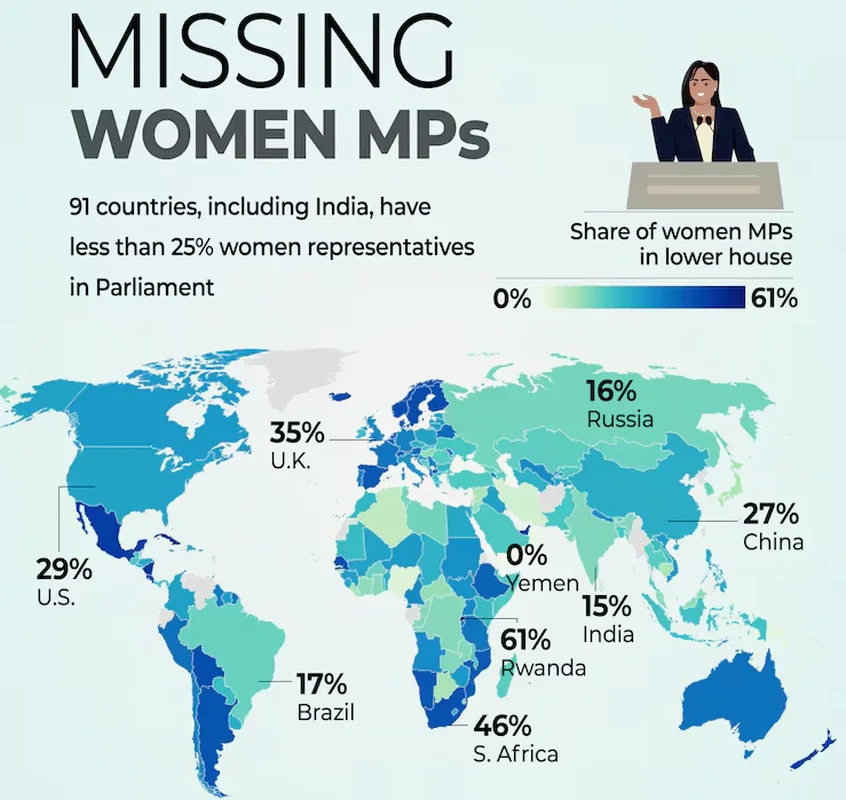
- Under-representation: Despite making up nearly half the population, women hold only about 15% of seats in the current Lok Sabha.
- The "Glass Ceiling": Political parties often hesitate to give tickets to women, citing "winnability," despite data showing women candidates often perform better.
- Diverse Perspectives: Women’s presence ensures that policies regarding healthcare, education, and safety receive more nuanced and empathetic attention.
- Socio-Economic Development: Research from local panchayats shows that women leaders prioritize infrastructure like clean water and schools.
- Political Empowerment: Reservation acts as a "nudge" to break the male-dominated structure of Indian politics and encourage female leadership at the top.
How: The Implementation Mechanism
The implementation is unique and conditional, which has been a major point of discussion.
- The Census Link: The reservation will only come into effect after the first Census is conducted following the commencement of the Act.
- Delimitation Exercise: Once the Census data is out, a Delimitation Commission will redraw constituency boundaries, and seats will be earmarked for women.
- Sub-reservation: One-third of the seats already reserved for SC/STs will now be reserved for women of those categories.
- Direct Election Only: The quota applies to seats filled by direct election (Lok Sabha and Assemblies) and not the Rajya Sabha or State Legislative Councils.
- 15-Year Term: The Act includes a "sunset clause," meaning the reservation lasts for 15 years unless extended by a future Parliament.
Positives (+ve): The Impact
- Inclusivity: It moves India closer to the global average of women in parliament (currently ~26%) and improves its standing on the Gender Gap Index.
- Role Models: Increased visibility of female MPs and MLAs will inspire a new generation of girls to enter public service and leadership.
- Policy Shift: Expect a shift toward "human development" metrics rather than just purely economic or industrial metrics in legislative debates.
- Institutional Change: Political parties will be forced to create internal wings and training programs to scout and mentor female candidates.
- Enhanced Democracy: A parliament that reflects the true diversity of its citizens is considered more legitimate and representative.
Issues with the Act
- Implementation Delay: By linking it to the Census and Delimitation, the actual reservation likely won't happen until the 2029 or 2034 elections.
- The "Proxy" Risk: Critics fear the "Sarpanch Pati" (proxy) culture seen in villages—where husbands rule through their wives—might move to Parliament.
- Lack of Internal Party Quotas: The Act mandates seats in the House, but does not force parties to nominate women for non-reserved seats.
- Rotation Problems: Continuous rotation of seats might discourage MPs from working hard in their constituency if they know it will be reserved/unreserved in the next term.
Solutions & Way Forward
- Decoupling: Government could consider an amendment to delink the reservation from the Census/Delimitation to implement it sooner.
- Internal Party Reforms: Parties should voluntarily adopt a minimum quota (e.g., 33%) for ticket distribution across all seats, not just reserved ones.
- Capacity Building: Investing in leadership training and mentorship programs for women to ensure they can lead independently of male relatives.
- OBC Consideration: A future review or commission could look into the feasibility of adding an OBC sub-quota to ensure "quota within quota" for all.
- Upper House Inclusion: Expanding the reservation to the Rajya Sabha and State Legislative Councils to ensure women are part of the "House of Elders" too.
Preparing for UPSC?
Talk to us about the right programme for your attempt.
Keep reading
Related articles
 03
Jul 2026
03
Jul 2026
Current Affairs · Polity
Gram Sabhas and Panchayats
The Hindu, Page 6, Editorial - Yes and no - GS-2-Polity Why in News: A Rural Development Ministry report based on surveys examines citizen participation in gram sabhas and highlights concerns over participation fatigue.…
Decode Civils · 3 Jul 2026
 25
Apr 2026
25
Apr 2026
Current Affairs · Polity
16th Finance Commission
Why in news: 16th FC recommended that Centre retain 41% share of tax devolution to States as in force since 2021. ₹1.4 lakh crore States Grant include Rural and Urban Local Body and Disaster Management Grants. It tweaked formula that decides the division of the share among the…
Decode Civils · 25 Apr 2026
 25
Apr 2026
25
Apr 2026
Current Affairs · Polity
8th Pay Commission
Why in news: The Union Cabinet has approved the Terms of Reference (ToR) for the eighth CPC, which will determine the pay structure and retirement benefits of Union government employees, including defence personnel. The 8th CPC will comprise one chairperson, one part-time…
Decode Civils · 25 Apr 2026
Our programmes
Courses for your attempt

PSIR EXCELLENCE PROGRAM PRO (OFFLINE): Batch-2
An Enrichment Course that can help you add 50+ marks in your PSIR Scores.

PSIR EXCELLENCE PROGRAM PRO (ONLINE): Batch-2
An Enrichment Course that can help you add 50+ marks in your PSIR Scores.

PSIR EXCELLENCE PROGRAM- BASE (OFFLINE): Batch-2
An Enrichment Course that can help you add 50+ marks in your PSIR Scores.
PSIR EXCELLENCE PROGRAM BASE (ONLINE): Batch-2
An Enrichment Course that can help you add 50+ marks in your PSIR Scores.

Mains Excellence Program Pro for Mains 2027 - Final Batch
Your One-Stop Solution for UPSC 2027 Mains: - MEP Faculties have an experience of 22 UPSC CSE Mains, 10 Interviews and 5 Final Selections. - Faculties include Mudit Jain Sir (AIR-222, 207, 173), Sourabh Arbole Sir (6…
Batch 2027 Starts 14 Sep 2026

Mains Excellence Program Plus for Mains 2027 - Final Batch
Your One-Stop Solution for UPSC 2027 Mains: - MEP Faculties have an experience of 22 UPSC CSE Mains, 10 Interviews and 5 Final Selections. - Faculties include Mudit Jain Sir (AIR-222, 207, 173), Sourabh Arbole Sir (6…
Batch 2027 Starts 14 Sep 2026

Mains Excellence Program Basic for Mains 2027 - Final Batch
Your One-Stop Solution for UPSC 2027 Mains: - MEP Faculties have an experience of 22 UPSC CSE Mains, 10 Interviews and 5 Final Selections. - Faculties include Mudit Jain Sir (AIR-222, 207, 173), Sourabh Arbole Sir (6…
Batch 2027 Starts 14 Sep 2026
Foundation + Advanced Ethics Base (Offline)
Is Ethics Paper Doable via Philosophical Gyan or Specific Thematic Preparation is Needed? Last 5 Years' Analysis & 54 Distinct Themes asked by UPSC answer the above question. Thematic preparation and advanced ethics…
Batch 2027 Starts 14 Sep 2026
Foundation + Advanced Ethics Base (Online)
Is Ethics Paper Doable via Philosophical Gyan or Specific Thematic Preparation is Needed? Last 5 Years' Analysis & 54 Distinct Themes asked by UPSC answer the above question. Thematic preparation and advanced ethics…
Batch 2027 Starts 14 Sep 2026
Foundation + Advanced Ethics Plus (Offline)
Is Ethics Paper Doable via Philosophical Gyan or Specific Thematic Preparation is Needed? Last 5 Years' Analysis & 54 Distinct Themes asked by UPSC answer the above question. Thematic preparation and advanced ethics…
Batch 2027 Starts 14 Sep 2026
Foundation + Advanced Ethics Plus (Online)
Is Ethics Paper Doable via Philosophical Gyan or Specific Thematic Preparation is Needed? Last 5 Years' Analysis & 54 Distinct Themes asked by UPSC answer the above question. Thematic preparation and advanced ethics…
Batch 2027 Starts 14 Sep 2026

Year Long Current Affairs Base (Pre + Mains)
Master Current Affairs the way UPSC demands—through conceptual understanding, issue-based analysis, and exam-oriented preparation. With a proven track record across UPSC and State PSC examinations, our course helps you…
Batch 2027 Starts 16 Aug 2026


0 comments
Discussion
No comments yet. Be the first.