
Indus Water Treaty
Why in news: Following the Pahalgam terror attack by TRF killing 26 tourists, the Cabinet Committee on Security decided to hold the IWT of 1960 in abeyance. IWT has no exit clause or provision for unilateral abrogation. Article XII (4): The treaty can only end with a “duly…

Why in news: Following the Pahalgam terror attack by TRF killing 26 tourists, the Cabinet Committee on Security decided to hold the IWT of 1960 in abeyance. IWT has no exit clause or provision for unilateral abrogation.
- Article XII (4): The treaty can only end with a “duly ratified treaty” between both governments.
- Articles 60 and 62 of the Vienna Convention on the Law of Treaties (VCLT) justify revocation, though India is not a party and Pakistan hasn’t ratified it. “Abeyance” is not recognised legal term under VCLT, which only allows for “suspension” if there’s a “fundamental change of circumstances” (Article 62).
- Legal Precedent: In 1997 Gabcíkovo-Nagymaros case, ICJ rejected Hungary’s termination of a treaty on the basis of political, economic, environmental shifts as not constituting fundamental changes.
India’s leverage and limitations:
- India may stop sharing water flow data, flush reservoirs, alter hydro project operations.
- India uses only ~1 MAF of permitted 3.60 MAF storage on western rivers. Has developed irrigation on only 0.642 million acres, though permitted for 1.34 million acres in J&K and Ladakh.
- On eastern rivers, India uses 90%+ of the 33 MAF allocation, aided by Bhakra (Satluj), Pong (Beas), and Ranjit Sagar/Thein dams (Ravi).
- Major hydroelectric projects on western rivers include: Kishanganga (Kishanganga River (a tributary of the Jhelum)), Chenab Dams (Ratle, Salal, Baglihar). Upcoming: Kiru, Pakal Dul (Marusudar River (a tributary of the Chenab)), and Ratle.
Impacts on Pakistan:
- Over 80% of Pak’s agriculture and 33% of hydropower rely on Indus basin waters.
- Disruption may cause tensions, particularly b/w Punjab vs. Sindh over canals like Cholistan.
- India released water from Baglihar and Salal dams in J&K. The activity, termed “flushing the reservoir”, clears silt and is a routine practice, but Pakistan was not notified, contrary to IWT norms.

Hydropower Disputes:
- Kishanganga & Ratle have drawn objections from Pak.
- In 2013, the Court of Arbitration permitted diversion by India under strict conditions (e.g., minimum flow).
- In the Ratle case, India sought a neutral expert, Pakistan preferred the Court of Arbitration; the World Bank allowed both, causing India to boycott proceedings.
Regional and International Ramifications
- During the 2017 Doklam standoff, China withheld data from India but not Bangladesh.
- As India and Bangladesh prepare to renew the Ganga Water Treaty in 2026, the IWT episode may strain talks.
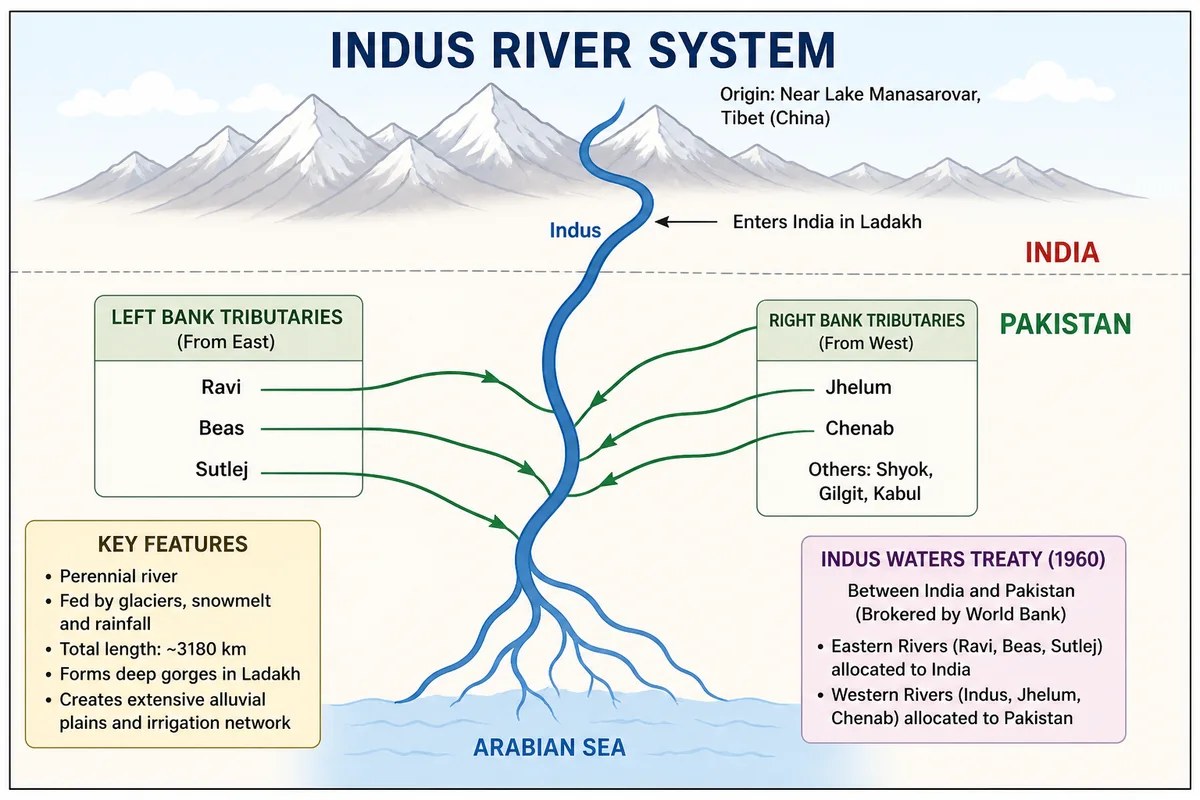
| Indus River system: |
- It consists of six rivers: Indus, Jhelum, Chenab, Ravi, Beas, and Sutlej.
- Indus and Sutlej are antecedent rivers, originating in Tibet and cutting deep gorges through the Himalayas.
- Jhelum, Chenab, Ravi, and Beas originate in India.
- The Indus Basin spans China, India, Pakistan, and Afghanistan.
- In India, it covers Ladakh, J&K, Chandigarh, Himachal Pradesh, Punjab, Haryana, and Rajasthan.
- Drainage area of Indus in India is approx 3,21,289 sq. km, accounting for 9.8% of India’s geographical area.
| Indus Water Treaty: |
- It was signed in 1960 in Karachi by Nehru and Ayub Khan. Broker & Signatory: World Bank.
- India controls 3 eastern rivers (Ravi, Beas, Sutlej). Pak controls 3 western rivers (Indus, Jhelum, Chenab).
- About 80% of the water volume is allocated to Pakistan and 20% to India. India’s rights on western rivers: Limited to non-consumptive uses such as hydropower, navigation, irrigation, without substantially altering the flow.
- The treaty established a Permanent Indus Commission with representatives from both countries to exchange data and resolve routine issues.
- A 3-tier dispute resolution mechanism: Commission → Neutral Expert → Court of Arbitration.
| About Court of Arbitration: |
- International tribunal to resolve disputes between parties (usually states) through binding arbitral process instead of traditional court litigation. It assists in appointing arbitrators, supervises arbitral proceedings, and ensures arbitral awards are enforceable under international law. Permanent Court of Arbitration was established in 1899. HQ: Hague. Facilitates arbitration in territorial, maritime, and investment disputes.
Preparing for UPSC?
Talk to us about the right programme for your attempt.
Keep reading
Related articles
 03
Jul 2026
03
Jul 2026
Current Affairs · Economy
Hormuz Crisis and Energy Security
The Hindu, Page 6, Editorial - The case for building India’s coal chemistry capability - GS-3-Economy Why in News: The Strait of Hormuz crisis highlighted India's energy security challenges and renewed focus on coal…
Decode Civils · 3 Jul 2026
 03
Jul 2026
03
Jul 2026
Current Affairs · Governance
HPV Vaccination
The Hindu, Page 10, Editorial - A shot at life, Mandsaur’s model for HPV vaccination - GS-2-Health Why in news: The Government of India launched a nationwide cervical cancer campaign in February 2026, providing free HPV…
Decode Civils · 3 Jul 2026
 03
Jul 2026
03
Jul 2026
Current Affairs · Polity
Gram Sabhas and Panchayats
The Hindu, Page 6, Editorial - Yes and no - GS-2-Polity Why in News: A Rural Development Ministry report based on surveys examines citizen participation in gram sabhas and highlights concerns over participation fatigue.…
Decode Civils · 3 Jul 2026
Our programmes
Courses for your attempt

PSIR EXCELLENCE PROGRAM PRO (OFFLINE): Batch-2
An Enrichment Course that can help you add 50+ marks in your PSIR Scores.

PSIR EXCELLENCE PROGRAM PRO (ONLINE): Batch-2
An Enrichment Course that can help you add 50+ marks in your PSIR Scores.

PSIR EXCELLENCE PROGRAM- BASE (OFFLINE): Batch-2
An Enrichment Course that can help you add 50+ marks in your PSIR Scores.
PSIR EXCELLENCE PROGRAM BASE (ONLINE): Batch-2
An Enrichment Course that can help you add 50+ marks in your PSIR Scores.

Mains Excellence Program Pro for Mains 2027 - Final Batch
Your One-Stop Solution for UPSC 2027 Mains: - MEP Faculties have an experience of 22 UPSC CSE Mains, 10 Interviews and 5 Final Selections. - Faculties include Mudit Jain Sir (AIR-222, 207, 173), Sourabh Arbole Sir (6…
Batch 2027 Starts 14 Sep 2026

Mains Excellence Program Plus for Mains 2027 - Final Batch
Your One-Stop Solution for UPSC 2027 Mains: - MEP Faculties have an experience of 22 UPSC CSE Mains, 10 Interviews and 5 Final Selections. - Faculties include Mudit Jain Sir (AIR-222, 207, 173), Sourabh Arbole Sir (6…
Batch 2027 Starts 14 Sep 2026

Mains Excellence Program Basic for Mains 2027 - Final Batch
Your One-Stop Solution for UPSC 2027 Mains: - MEP Faculties have an experience of 22 UPSC CSE Mains, 10 Interviews and 5 Final Selections. - Faculties include Mudit Jain Sir (AIR-222, 207, 173), Sourabh Arbole Sir (6…
Batch 2027 Starts 14 Sep 2026
Foundation + Advanced Ethics Base (Offline)
Is Ethics Paper Doable via Philosophical Gyan or Specific Thematic Preparation is Needed? Last 5 Years' Analysis & 54 Distinct Themes asked by UPSC answer the above question. Thematic preparation and advanced ethics…
Batch 2027 Starts 14 Sep 2026
Foundation + Advanced Ethics Base (Online)
Is Ethics Paper Doable via Philosophical Gyan or Specific Thematic Preparation is Needed? Last 5 Years' Analysis & 54 Distinct Themes asked by UPSC answer the above question. Thematic preparation and advanced ethics…
Batch 2027 Starts 14 Sep 2026
Foundation + Advanced Ethics Plus (Offline)
Is Ethics Paper Doable via Philosophical Gyan or Specific Thematic Preparation is Needed? Last 5 Years' Analysis & 54 Distinct Themes asked by UPSC answer the above question. Thematic preparation and advanced ethics…
Batch 2027 Starts 14 Sep 2026
Foundation + Advanced Ethics Plus (Online)
Is Ethics Paper Doable via Philosophical Gyan or Specific Thematic Preparation is Needed? Last 5 Years' Analysis & 54 Distinct Themes asked by UPSC answer the above question. Thematic preparation and advanced ethics…
Batch 2027 Starts 14 Sep 2026

Year Long Current Affairs Base (Pre + Mains)
Master Current Affairs the way UPSC demands—through conceptual understanding, issue-based analysis, and exam-oriented preparation. With a proven track record across UPSC and State PSC examinations, our course helps you…
Batch 2027 Starts 16 Aug 2026


0 comments
Discussion
No comments yet. Be the first.