
Muskan Dagar (AIR-72 CSE-22) GS 470 Marks & Ethics 141 Marks
Muskan Dagar secured AIR-72 in CSE-22 and is the GS TOPPER with 470 Marks & GS-4 TOPPER with 141 Marks! Here she has detailed her strategy. Introduction I am Muskan Dagar. I come from Village Sehlanga, District Jhajjar, Haryana. I have secured AIR 72 in UPSC CSE 2022. This…

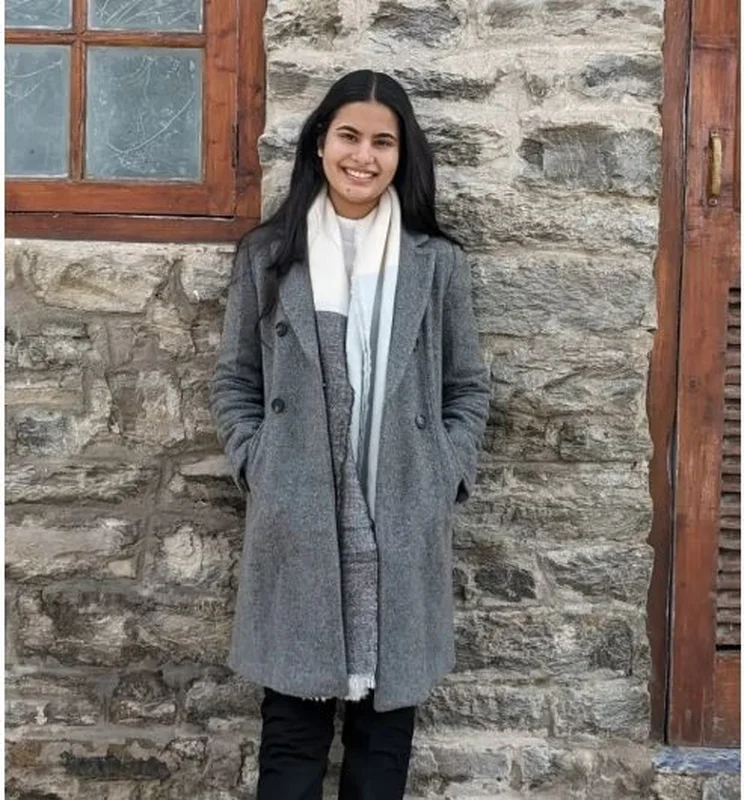
Muskan Dagar secured AIR-72 in CSE-22 and is the GS TOPPER with 470 Marks & GS-4 TOPPER with 141 Marks! Here she has detailed her strategy.
Introduction
I am Muskan Dagar. I come from Village Sehlanga, District Jhajjar, Haryana. I have secured AIR 72 in UPSC CSE 2022. This was my 2nd attempt. In my first attempt, I had secured AIR 474, and was allocated the Indian Civil Accounts Service. My optional is History.
I completed 12th standard from Apeejay School, Charkhi Dadri. Thereafter, I completed my B.Sc. in Physical Science form Hindu College, University of Delhi in 2020.
Journey of Preparation
I started my preparation in 3rd year of college, during which I took coaching for my optional, since coming from Science background, History was a new subject for me. All other basics I started covering only when the lockdown hit in March 2020, and I was stuck at home, during my final semester.
Is coaching necessary?
Short answer - No.
Long answer - I took coaching for History since I was unsure of the subject when I first started reading it, but looking back, it was entirely avoidable. When it came to GS, I decided that it would most probably be a waste of time and money. I wanted to prepare from my home in the village, and wanted to avoid the additional costs of living in Delhi. Apart from that, I felt that I could grasp the concepts from the books themselves. Whenever I felt stuck in something, I would go onto the web or YouTube to clear my doubts.
Prelims
My focus during prelims preparation was on gaining conceptual clarity and covering all the necessary topics with multiple revisions. My strategy was to solve an optimum amount of tests (25-30) to enforce logical clarity. From these tests, I would find out my shortcomings, like need for more revision in some topics, or wrong logic, or simply fear of negative marking. In subsequent tests, I tried to improve on these limitations. I forced myself to solve the questions, using common sense as my biggest tool. That helped me gain good logical clarity which helped in the actual exams.
I also solved all available PYQs to grasp the pattern and gain better clarity. During the actual exam the most important thing I felt was having self-confidence. During my first prelims, I got anxious on seeing the paper and as a result made quite a few silly mistakes that could have been avoided otherwise. Thus the second time, I knew I had to keep my nerves steady so that my mind can think clearly.
I did not prepare for CSAT separately. I felt that my background came in handy for that. All I did before the exam was solve 2 years PYQs so that I wasn’t going into the paper blindly. But if you feel like you need to prepare for the paper, given the level of toughness these days, please prepare well for it. Overconfidence in this respect can be detrimental. Practice and devise a strategy to approach the paper.
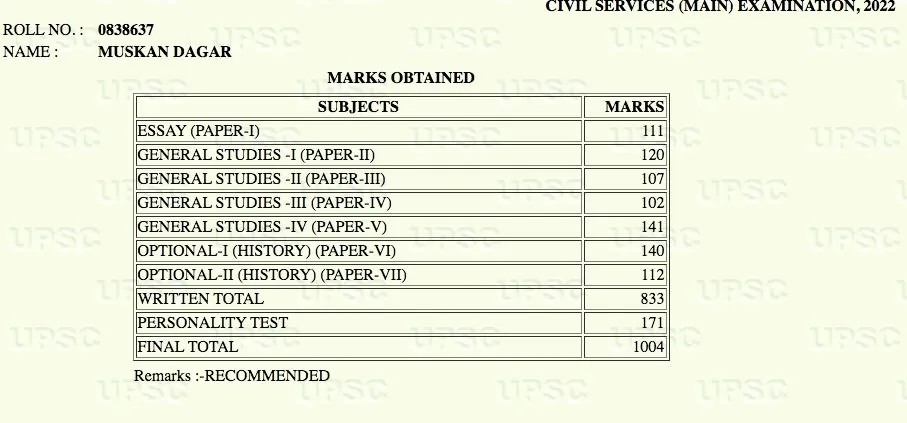
Mains
I improved my GS marks from 401 to 470 in my second attempt. Thus I would like to discuss the changes I made to achieve it.
The first shortcoming I found in my answers from the previous year was a lack of content and a lack of complete grasp on the topics asked, especially when it came to current affairs. To overcome this, I firstly went back to the syllabus and ensured comprehensive coverage of all the topics mentioned. To achieve this, I also took help from Rushikesh Reddy Sir’s notes available online. Secondly, I diligently covered the current affairs from the newspaper and Mains 365 as primary material, and used Forum IAS’s Dipin Sir’s CA PDFs to supplement any gaps.
The second shortcoming was not actually answering what was asked. We tend to read the question, form a perception of what is asked, and get to writing straight away. This time I made it a point to read the question 3-4 times while writing the answer so that I don’t stray away from the demand of the question.
I also worked on enrichment of my answers with relevant facts, case studies as well as examples that I picked up from test series model answers, topper copies, newspaper, etc.
Alongside, I practised brainstorming for each question so that I could come up with a comprehensive answer.
Booklist
My booklist had nothing new in it, I followed all the same standard sources, but supplemented them with reports like NITI Aayog’s India @ 75, as well as using google to look up topics not covered.
Answer Writing
I started answer writing when I had covered majority of the syllabus at least twice. Main focus on answer writing was only during the time between prelims and mains.
I focused on the structure and presentation of my answer as much as the content.
Certain Aspects I Focused Upon
-
- Meaningful introduction, containing definition/data/quote/background, as relevant.
-
- Appropriate headings, taking language directly from the question, to enforce the fact that you are answering the question appropriately
-
- Breaking up the answer into relevant parts - eg. Administrative reasons, social reasons, etc; Structural and non-structural measures, etc.
-
- Making diagrams as and when necessary, particularly in geography (maps, processes), IR (maps), Internal Security (maps) and Disaster Management (maps)
-
- Trying to inculcate facts and examples, and writing them a bit separately from the point, to improve their visibility, by making them as sub-points.
-
- Including relevant way forwards, wherever possible
-
- Making it a point to put a well thought out conclusion after every answer
-
- Not leaving any question this time. For questions I did not know well, I wrote as much as I did know, and then left the rest of the page(s) for that answer blank, so as not to waste time there. I attempted such questions in the end
-
- I attempted questions 1 to 5 first, then questions 11 to 20, and after that questions 6 to 10. This was to try to attempt the initial questions well, so that to form a positive impression, and then successively attempting the 15 markers because there is need to write more in them, and they can fetch more marks as well.
I recommend practising, be it for prelims or mains, for actual improvement, with working on the shortcomings you might encounter. Practice for the sake for practice is to be avoided.
I hope my insights can be of help when it comes to your preparation. All the best!
Preparing for UPSC?
Talk to us about the right programme for your attempt.
Keep reading
Related articles
 28
May 2026
28
May 2026
Topper Strategies · Mains General Studies
Nidhi Goyal (AIR-202 CSE-22) GS-3 107 Marks
Hi All, I have analyzed the data of 200 Toppers' marksheets and numbers are telling as far as GS-3 scores are concerned (200/933 Marksheets): Average Score: 84.20 Highest Score: 107 Marks Lowest Score: 63 Marks Score…
Decode Civils · 28 May 2026
 28
May 2026
28
May 2026
Topper Strategies · Mains General Studies
Dwij Goel (AIR-71 CSE-22) GS-2 124 Marks
Hi Guys, My name is Dwij Goel and I have secured AIR 71 in UPSC CSE 2022. I come from a small town named Kharkhauda,near Meerut, U.P. After finishing my basic education from Meerut, I have done B.Tech in mechanical engineering from NIT- Bhopal. After my graduation in 2019, I…
Decode Civils · 28 May 2026
 28
May 2026
28
May 2026
Topper Strategies · Mains General Studies
Surbhi Goyal (AIR-78 CSE-21) GS-2 125 Marks
Surbhi Goyal secured AIR-78 in CSE-21 in her 3rd attempt. She scored 'a grand' 125 marks in GS-2 paper and below is her GS-2 strategy: My complete GS-2 Strategy Booklist: Polity - M. Laxmikant (For prelims also), 2nd ARC report number 6 Governance - 2nd ARC Reports (4, 9, 10…
Decode Civils · 28 May 2026
Our programmes
Courses for your attempt

PSIR EXCELLENCE PROGRAM PRO (OFFLINE): Batch-2
An Enrichment Course that can help you add 50+ marks in your PSIR Scores.

PSIR EXCELLENCE PROGRAM PRO (ONLINE): Batch-2
An Enrichment Course that can help you add 50+ marks in your PSIR Scores.

PSIR EXCELLENCE PROGRAM- BASE (OFFLINE): Batch-2
An Enrichment Course that can help you add 50+ marks in your PSIR Scores.
PSIR EXCELLENCE PROGRAM BASE (ONLINE): Batch-2
An Enrichment Course that can help you add 50+ marks in your PSIR Scores.

Mains Excellence Program Pro for Mains 2027 - Final Batch
Your One-Stop Solution for UPSC 2027 Mains: - MEP Faculties have an experience of 22 UPSC CSE Mains, 10 Interviews and 5 Final Selections. - Faculties include Mudit Jain Sir (AIR-222, 207, 173), Sourabh Arbole Sir (6…
Batch 2027 Starts 14 Sep 2026

Mains Excellence Program Plus for Mains 2027 - Final Batch
Your One-Stop Solution for UPSC 2027 Mains: - MEP Faculties have an experience of 22 UPSC CSE Mains, 10 Interviews and 5 Final Selections. - Faculties include Mudit Jain Sir (AIR-222, 207, 173), Sourabh Arbole Sir (6…
Batch 2027 Starts 14 Sep 2026

Mains Excellence Program Basic for Mains 2027 - Final Batch
Your One-Stop Solution for UPSC 2027 Mains: - MEP Faculties have an experience of 22 UPSC CSE Mains, 10 Interviews and 5 Final Selections. - Faculties include Mudit Jain Sir (AIR-222, 207, 173), Sourabh Arbole Sir (6…
Batch 2027 Starts 14 Sep 2026
Foundation + Advanced Ethics Base (Offline)
Is Ethics Paper Doable via Philosophical Gyan or Specific Thematic Preparation is Needed? Last 5 Years' Analysis & 54 Distinct Themes asked by UPSC answer the above question. Thematic preparation and advanced ethics…
Batch 2027 Starts 14 Sep 2026
Foundation + Advanced Ethics Base (Online)
Is Ethics Paper Doable via Philosophical Gyan or Specific Thematic Preparation is Needed? Last 5 Years' Analysis & 54 Distinct Themes asked by UPSC answer the above question. Thematic preparation and advanced ethics…
Batch 2027 Starts 14 Sep 2026
Foundation + Advanced Ethics Plus (Offline)
Is Ethics Paper Doable via Philosophical Gyan or Specific Thematic Preparation is Needed? Last 5 Years' Analysis & 54 Distinct Themes asked by UPSC answer the above question. Thematic preparation and advanced ethics…
Batch 2027 Starts 14 Sep 2026
Foundation + Advanced Ethics Plus (Online)
Is Ethics Paper Doable via Philosophical Gyan or Specific Thematic Preparation is Needed? Last 5 Years' Analysis & 54 Distinct Themes asked by UPSC answer the above question. Thematic preparation and advanced ethics…
Batch 2027 Starts 14 Sep 2026

Year Long Current Affairs Base (Pre + Mains)
Master Current Affairs the way UPSC demands—through conceptual understanding, issue-based analysis, and exam-oriented preparation. With a proven track record across UPSC and State PSC examinations, our course helps you…
Batch 2027 Starts 16 Aug 2026


0 comments
Discussion
No comments yet. Be the first.