
Vidushi Singh (AIR-13 CSE-22) Economics 276 Marks
Hi All, Vidushi Singh secured AIR-13 in CSE-22 with Economics Optional in her 1st attempt. Following is her strategy. Introduction I am Vidushi Singh, AIR 13 in UPSC Civil Services Examination 2022. I have completed my B. A. (Hons.) Economics from Shri Ram College of Commerce…


Hi All,
Vidushi Singh secured AIR-13 in CSE-22 with Economics Optional in her 1st attempt. Following is her strategy.
Introduction
I am Vidushi Singh, AIR 13 in UPSC Civil Services Examination 2022. I have completed my B. A. (Hons.) Economics from Shri Ram College of Commerce, University of Delhi in 2021. This was my first attempt at the exam and my optional subject was Economics.
Vidushi's Blog: https://otakueconomist.blogspot.com/
Economics Optional Preparation
I enrolled in Economics Optional Course at Next IAS by Dr. Vibhas Jha, in June 2021. This went on until October 2021. This course helped me in consolidating my notes, especially for paper 1. This course did help me immensely, but disproportionately more in paper 1. Paper 2 portions were sort of rushed through, and therefore paper 2 was one paper which I mostly covered after prelims. Furthermore, I did not limit myself to just this course alone. Along with the recorded lectures (which I watched at 2x speed to save time), I read all the standard books suggested by previous toppers.
Booklist:
Paper 1:
- Microeconomics: Advanced Economic Theory by H. L. Ahuja
- Macroeconomics: Froyen and H. L. Ahuja
- International Economics: Salvatore, and some portions of Paul Krugman’s readings
- Development Theory: Debraj Ray (I did buy M. L. Jhingan, but it wasn’t very helpful)
- Public Finance: DU Readings and selected portions of H. L. Bhatia
Paper 2:
- Pre Independence: Tirthankar Roy
- Post Independence: Mishra and Puri formed the basic skeleton of notes, and this was supplemented by selective reading of Uma Kapila’s Indian Economy Performance and Policies. Above these 2 sources were Yash Jaluka Sir’s (AIR 4 UPSC CSE-2020) Notes, which became my sole go-to source for any and every form of value addition for Paper 2. Also, for some very specific topics like Capital Formation in Agriculture, I did refer to IGNOU Notes as well, to understand the overarching trends in various sectors.
My focus was disproportionately more on paper 1 before prelims and hence paper 2 was covered mostly in August 2022 which was 1.5 months before mains. However, because I had already worked very hard for paper 1, this was not as daunting as it sounds.
Answer Writing:
After looking at PYQs from 2013, I realised that mastering PYQs will be much more fruitful relative to any test series. There is repetition of themes, and sometimes the whole question verbatim gets repeated (eg. question on the impact of use of debit and credit cards on money multiplier came in 2014 and was repeated in 2022). Since there is huge repetition, I wrote on average around 30-35 questions per sub-heading.
The only good source for PYQ solutions that I came across was Abhishek Dudhal Sir’s e-book, which had solutions to papers ranging from 1995-2020. Post prelims, I also enrolled in Mains Advanced Course at Next IAS wherein Vibhas Sir shared the structure of answers for both paper 1 and 2 and this greatly helped in realising how to write good answers.
Some paper specific pointers:
Paper 1:
- It is very important to directly address the demand of the question in the introduction itself. Paper 1 is fairly technical, and beating around the bush will definitely make a bad impression.
- Mentioning a few assumptions even if it isn’t explicitly asked, gives the idea that you are well versed with the model and concept.
- Drawing the correct diagram is of course very if not the most important thing in any economics answer.
- Body of the diagram is generally an elaboration of the diagram made, therefore, it is extremely important to be effective, exact, and precise while writing this.
- Concluding answers with some contemporary example or connection with the real world bridges the theory with application.
Paper 2:
- Introduction can be any data, figure, quote or example which directly meets the demand of the question.
- Body should include tables, charts, wherever necessary. Furthermore, it is very important to quote economists here, as it reflects that your opinions have some sound basis. I quoted at least 2-3 economists per answer. There is a school of thought which says that incessant quoting of economists backfires, but I think 135 is a decent enough score to repudiate that.
- Conclusion here can be some connection with an economic theory (eg. in a question about Income Distribution, discussing Kuznets Curve and Idiosyncratic Growth in India’s Perspective is a necessity).
Miscellaneous Points:
- Economics is indeed a difficult subject and a hold over the models will any day triumph over verbose explanations. Therefore, it is important to get things started in the right manner with conceptual clarity.
- Additionally, it is also advisable that the syllabus should be covered before prelims, as managing optional, essay and GS is a cumbersome task. Answer writing of PYQs should at least be practised before prelims so that it doesn't eat up a lot of time between prelims and mains.
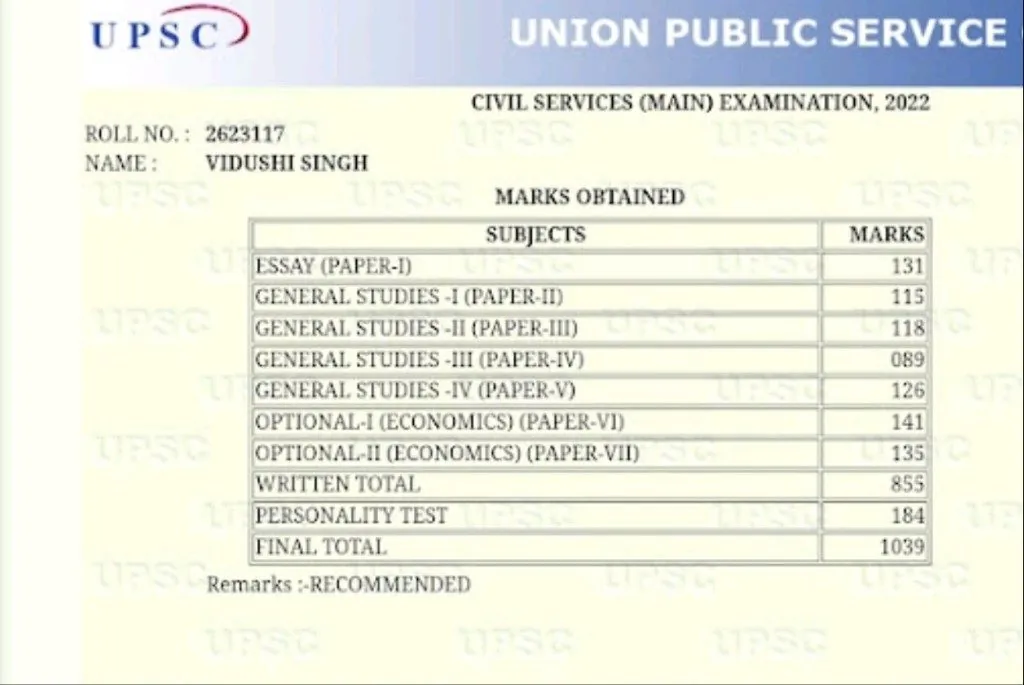
- Finally, I scored 276 (141+135), which is decent enough, but not the highest. Yet I managed to get a good rank. Therefore, I believe that the main examination is all about balancing things right. I knew beforehand that with my level of preparation, crossing 280 will be a herculean task. Hence I accordingly laid greater emphasis on GS and Essay papers to bridge the marks deficit created by Optional.
- Optional alone does not decide your rank, it is 7 papers + Personality Test which decides where your name will be in the final merit list. Therefore too much time in the 2 optional papers is not advisable.
- This paper can completely be prepared by giving 2-3 hours every day during the integrated preparation (i.e., before prelims specific prep) and it also demands 50% of time between prelims and mains (4-5 hours). With this division, economics optional can be managed pretty well!
Preparing for UPSC?
Talk to us about the right programme for your attempt.
Keep reading
Related articles
 28
May 2026
28
May 2026
Topper Strategies · Optionals
Avinash (AIR-17 CSE-22) Philosophy 319 Marks
Hi All, This is the 6th Topper Journey & Strategy post from the Batch of 2023. Philosophy optional performance over the years has been a cause of concern for those who have opted this optional. The numbers are…
Decode Civils · 28 May 2026
 28
May 2026
28
May 2026
Topper Strategies · Optionals
Jatin Jain (AIR-91 CSE-22) Sociology + Comprehensive Strategy
Hi All, This is the 8th Topper Journey & Strategy post from the Batch of 2023. Following is journey & strategy of Jatin Jain who cleared CSE-22 with AIR-91. This was his 3rd attempt. In his 1st attempt he missed…
Decode Civils · 28 May 2026
 28
May 2026
28
May 2026
Topper Strategies · Optionals
My Geography Strategy - 4 Mains
There are optional subjects. Then there are Popular optional subjects. And then there is GEOGRAPHY! One of the most 'loved' subject WRT number of Aspirants opting for it and perhaps the most 'hated' subject because of…
Decode Civils · 28 May 2026
Our programmes
Courses for your attempt

PSIR EXCELLENCE PROGRAM PRO (OFFLINE): Batch-2
An Enrichment Course that can help you add 50+ marks in your PSIR Scores.

PSIR EXCELLENCE PROGRAM PRO (ONLINE): Batch-2
An Enrichment Course that can help you add 50+ marks in your PSIR Scores.

PSIR EXCELLENCE PROGRAM- BASE (OFFLINE): Batch-2
An Enrichment Course that can help you add 50+ marks in your PSIR Scores.
PSIR EXCELLENCE PROGRAM BASE (ONLINE): Batch-2
An Enrichment Course that can help you add 50+ marks in your PSIR Scores.

Mains Excellence Program Pro for Mains 2027 - Final Batch
Your One-Stop Solution for UPSC 2027 Mains: - MEP Faculties have an experience of 22 UPSC CSE Mains, 10 Interviews and 5 Final Selections. - Faculties include Mudit Jain Sir (AIR-222, 207, 173), Sourabh Arbole Sir (6…
Batch 2027 Starts 14 Sep 2026

Mains Excellence Program Plus for Mains 2027 - Final Batch
Your One-Stop Solution for UPSC 2027 Mains: - MEP Faculties have an experience of 22 UPSC CSE Mains, 10 Interviews and 5 Final Selections. - Faculties include Mudit Jain Sir (AIR-222, 207, 173), Sourabh Arbole Sir (6…
Batch 2027 Starts 14 Sep 2026

Mains Excellence Program Basic for Mains 2027 - Final Batch
Your One-Stop Solution for UPSC 2027 Mains: - MEP Faculties have an experience of 22 UPSC CSE Mains, 10 Interviews and 5 Final Selections. - Faculties include Mudit Jain Sir (AIR-222, 207, 173), Sourabh Arbole Sir (6…
Batch 2027 Starts 14 Sep 2026
Foundation + Advanced Ethics Base (Offline)
Is Ethics Paper Doable via Philosophical Gyan or Specific Thematic Preparation is Needed? Last 5 Years' Analysis & 54 Distinct Themes asked by UPSC answer the above question. Thematic preparation and advanced ethics…
Batch 2027 Starts 14 Sep 2026
Foundation + Advanced Ethics Base (Online)
Is Ethics Paper Doable via Philosophical Gyan or Specific Thematic Preparation is Needed? Last 5 Years' Analysis & 54 Distinct Themes asked by UPSC answer the above question. Thematic preparation and advanced ethics…
Batch 2027 Starts 14 Sep 2026
Foundation + Advanced Ethics Plus (Offline)
Is Ethics Paper Doable via Philosophical Gyan or Specific Thematic Preparation is Needed? Last 5 Years' Analysis & 54 Distinct Themes asked by UPSC answer the above question. Thematic preparation and advanced ethics…
Batch 2027 Starts 14 Sep 2026
Foundation + Advanced Ethics Plus (Online)
Is Ethics Paper Doable via Philosophical Gyan or Specific Thematic Preparation is Needed? Last 5 Years' Analysis & 54 Distinct Themes asked by UPSC answer the above question. Thematic preparation and advanced ethics…
Batch 2027 Starts 14 Sep 2026

Year Long Current Affairs Base (Pre + Mains)
Master Current Affairs the way UPSC demands—through conceptual understanding, issue-based analysis, and exam-oriented preparation. With a proven track record across UPSC and State PSC examinations, our course helps you…
Batch 2027 Starts 16 Aug 2026


0 comments
Discussion
No comments yet. Be the first.