Antimicrobials to Come Under Central Regulatory Oversight
Health Ministry has proposed amending the New Drugs and Clinical Trials (NDCT) Rules, 2019
DDecode Civils
· 3 min read
Antimicrobials to Come Under Central Regulatory Oversight
Why in News
The Health Ministry has proposed amending the New Drugs and Clinical Trials (NDCT) Rules, 2019 to add antimicrobials to the definition of "New Drug". This would bring them under central regulatory oversight to tackle antimicrobial resistance (AMR).
News Summary
The draft notification (G.S.R. 983(E), 6 November 2026) amends Rule 2(1)(w)(v) of the NDCT Rules.
Concern: manufacturing licences for antimicrobials were being granted without enough scrutiny, including bioavailability/bioequivalence and stability studies.
Risk: substandard or ineffective antimicrobials can drive the development and spread of AMR.
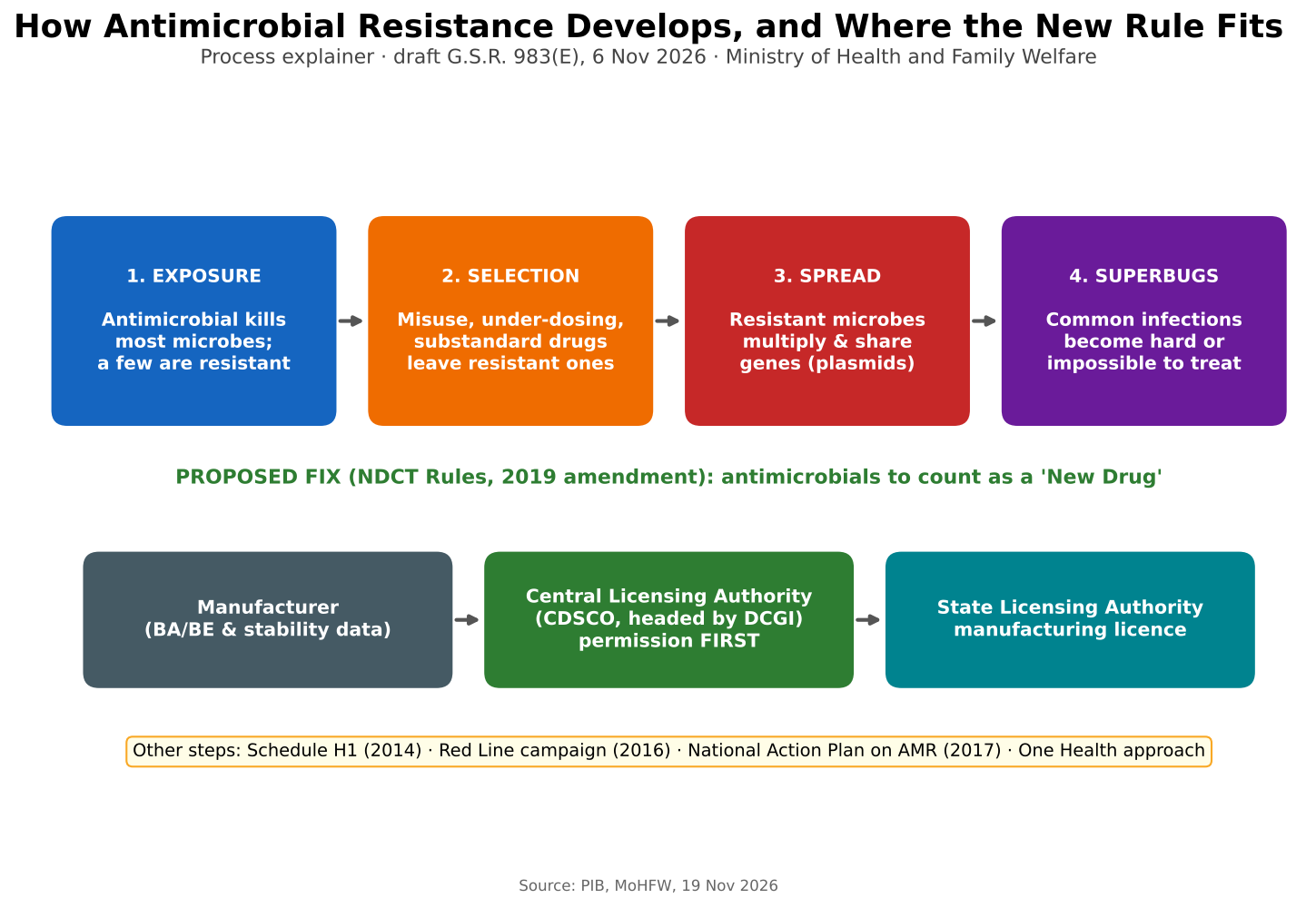
Change: manufacturers must first get permission from the Central Licensing Authority (CLA) before applying for a licence from the State Licensing Authority (SLA).
The public has 30 days to send objections and suggestions.
The release recalled that the G20 New Delhi Leaders' Declaration called for tackling AMR through a One Health approach.
Prelims Facts & Static Linkages
How antimicrobial resistance develops
Exposure: antimicrobials kill most microbes, but a few carry resistance genes.
Selection: misuse, under-dosing or incomplete courses kill susceptible microbes and leave resistant ones.
Spread: resistant microbes multiply and pass resistance genes to others, including through plasmids.
Amplification: use in livestock and poultry, hospital infections and poor sanitation spread resistant strains.
Prevention gap: weak infection control, unsafe water and low vaccination raise the need for antibiotics in the first place.
Outcome: common infections become hard or impossible to treat ("superbugs").
Types of antimicrobials
Type
Acts against
Antibiotics
Bacteria
Antivirals
Viruses
Antifungals
Fungi
Antiparasitics
Parasites, such as the malaria parasite
The One Health approach
Human, animal and environmental health are closely linked.
Antibiotic use in poultry, livestock and fish farming, and residues in water bodies near drug factories, add to resistance in humans.
So AMR needs joint action by the health, agriculture, animal husbandry and environment sectors.
India's drug regulation framework
Item
Fact
Parent law
Drugs and Cosmetics Act, 1940
Central Licensing Authority
CDSCO, headed by the Drugs Controller General of India (DCGI)
State Licensing Authorities
Issue manufacturing licences for most drugs
NDCT Rules, 2019
Govern new drugs and clinical trials
India's steps against AMR
Schedule H1 (2014): certain antibiotics can be sold only on prescription, with records kept.
Red Line campaign (2016): a red vertical line on the packs of prescription-only antibiotics.
National Action Plan on AMR (2017): a One Health plan across sectors.
Kerala was the first State to adopt its own AMR action plan.
WHO AWaRe classification groups antibiotics into Access, Watch and Reserve.
World AMR Awareness Week is observed from 18 to 24 November.
Likely Prelims angles
Causes of multi-drug resistance
The Red Line campaign and Schedule H1
CDSCO and the DCGI
The One Health approach
Quick Revision
The proposed amendment adds antimicrobials to the definition of "New Drug" under the NDCT Rules.
Manufacturers would need CLA permission before applying to the SLA.
Substandard antimicrobials can drive AMR.
CDSCO, headed by the DCGI, is the Central Licensing Authority.
India's National Action Plan on AMR dates from 2017.
Antibiotics act on bacteria, not viruses.
The Red Line campaign began in 2016, and Schedule H1 took effect in 2014.
Practice MCQ
Q. Consider the following statements:
1. The Red Line campaign marks prescription-only antibiotics with a red vertical line.
2. The Drugs Controller General of India heads the Central Drugs Standard Control Organisation.
3. Under WHO's AWaRe classification, "Reserve" antibiotics are meant for routine first-line use.
Which of the statements given above are correct?
(a) 1 and 2 only
(b) 2 and 3 only
(c) 1 and 3 only
(d) 1, 2 and 3
Answer: (a). "Reserve" antibiotics are last-resort drugs.
Related PYQs
PYQ 1 (UPSC CSE Prelims 2020)
What is the importance of using Pneumococcal Conjugate Vaccines in India?
1. These vaccines are effective against pneumonia as well as meningitis and sepsis.
2. Dependence on antibiotics that are not effective against drug-resistant bacteria can be reduced.
3. These vaccines have no side effects and cause no allergic reactions.



 24
Nov 2026
 24
Nov 2026
 24
Nov 2026














0 comments
Discussion
No comments yet. Be the first.