Birbal Sahni Institute of Palaeosciences (BSIP), Lucknow, studied pollen, fungal spores and ...
DDecode Civils
· 3 min read
Himalayan Marmot Droppings Reveal Climate Clues
Why in News
Scientists at the Birbal Sahni Institute of Palaeosciences (BSIP), Lucknow, studied pollen, fungal spores and elements in the droppings of the Himalayan marmot (Marmota himalayana). They found that the droppings work as a record of alpine vegetation and climate in the high Himalaya.
News Summary
Traditional records of past environments come from lake sediments, peat and soil, which are rare in remote, arid high mountains.
The marmot, a high-altitude herbivore, eats local plants, so pollen in its droppings shows the surrounding alpine-steppe vegetation.
Its diet was dominated by Artemisia, Asteroideae, Caryophyllaceae and Chenopodiaceae.
Ratios of pollen types, such as Artemisia/Chenopodiaceae and Artemisia/Ephedra, were used to interpret vegetation and climate.
Samples came from Pensila Pass and Rimkhim, two Himalayan marmot habitats.
Methods included palynology and FESEM–EDS (electron microscopy with X-ray spectroscopy) to find the elemental make-up.
The marmot could be a strong indicator species for vegetation and climate change in the higher Himalaya.
The study, published in PLOS ONE, also helps conserve the snow leopard, for which marmots are important prey.
Prelims Facts & Static Linkages
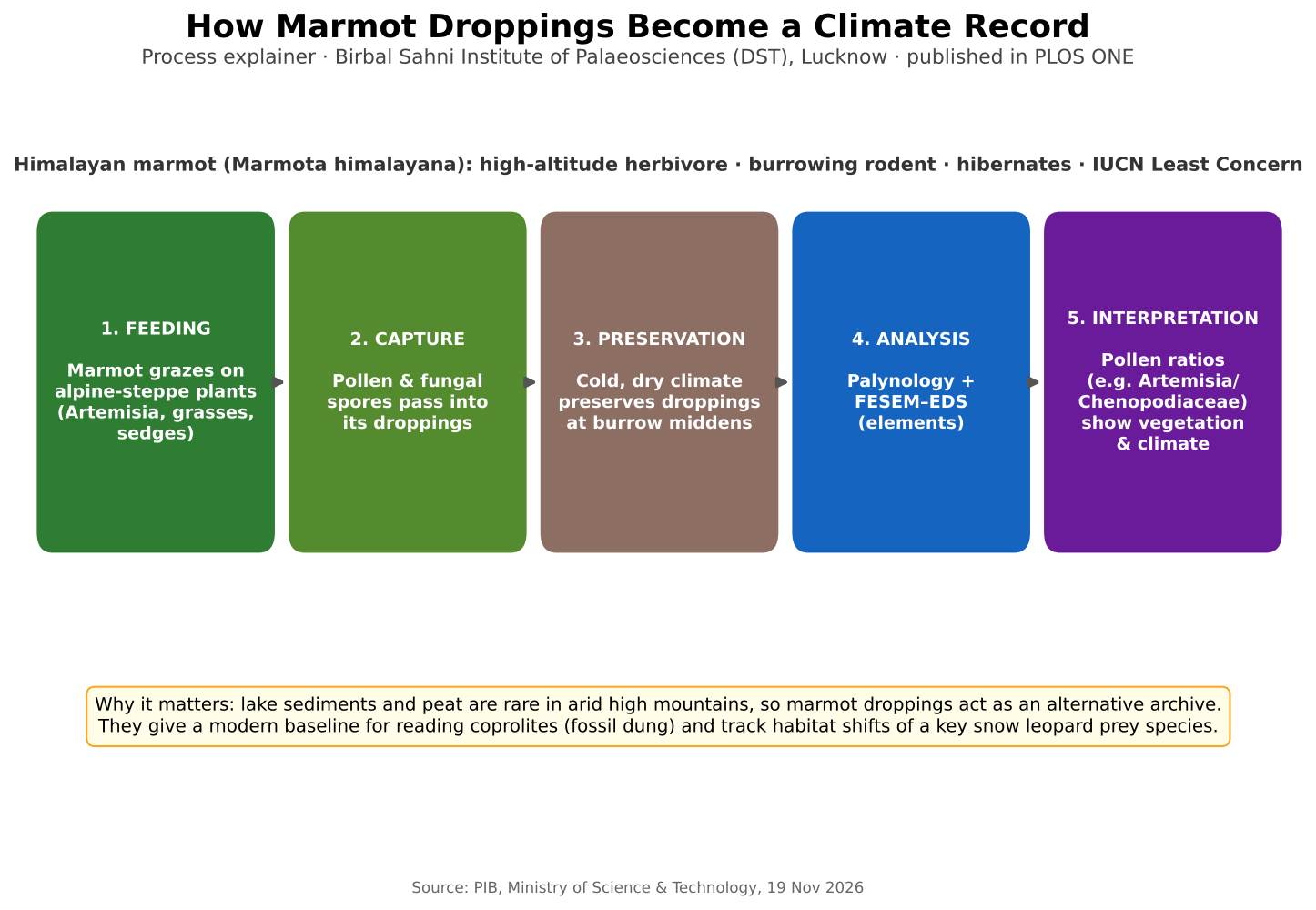
How droppings become a climate record
Feeding: the marmot grazes on alpine plants around its burrow.
Capture: pollen and fungal spores from those plants pass into its droppings.
Preservation: the cold, dry climate preserves droppings at burrow sites (middens).
Analysis: scientists identify the pollen and spores and measure elements.
Interpretation: the pollen mix shows the vegetation type, which reflects temperature and moisture.
Reference: today's samples become a baseline for reading fossil dung (coprolites) and tracking future change.
Key terms
Term
Meaning
Palynology
The study of pollen grains and spores
Palaeoclimate
The climate of the geological past
Coprolite
Fossilised dung
Proxy record
Natural evidence used to infer past climate, such as tree rings, ice cores, corals and lake sediments
Indicator species
A species whose presence or condition reflects the health of its environment
Climate proxies compared
Proxy
What it records
Tree rings
Yearly growth bands reflect temperature and rainfall (dendrochronology)
Ice cores
Trapped air bubbles preserve past atmospheric gases
Lake sediments and peat
Layers of pollen and minerals show past vegetation
Corals
Growth bands and isotopes record past sea temperatures
Marmot droppings
Modern alpine vegetation, useful where other archives are rare
The Himalayan marmot
A large burrowing rodent of the squirrel family that hibernates in winter.
Lives in alpine meadows and steppe of the Himalaya and Tibetan Plateau, including Ladakh, Sikkim and Uttarakhand.
Listed as Least Concern by the IUCN.
An important prey species for the snow leopard, whose population assessment (SPAI) estimated about 718 in India.
About BSIP
An autonomous institute of the Department of Science and Technology, in Lucknow.
Named after Birbal Sahni, the pioneer of Indian palaeobotany.
Likely Prelims angles
What palynology studies
Climate proxy records
Himalayan fauna and the snow leopard's prey
DST's autonomous institutes
Quick Revision
BSIP studied pollen, spores and elements in Himalayan marmot droppings.
The marmot is a high-altitude herbivore and a key snow leopard prey species.
Artemisia-dominated alpine-steppe vegetation formed most of its diet.
Palynology is the study of pollen and spores.
Coprolites are fossilised dung.
BSIP is an autonomous DST institute in Lucknow.
Tree rings, ice cores, corals and lake sediments are other climate proxies.
Practice MCQ
Q. Consider the following statements:
1. Palynology is the study of pollen grains and spores.
2. The Himalayan marmot is a carnivorous mammal.
3. Coprolites are fossilised animal dung.
Which of the statements given above are correct?
(a) 1 and 2 only
(b) 2 and 3 only
(c) 1 and 3 only
(d) 1, 2 and 3
Answer: (c). The Himalayan marmot is a herbivore.
Related PYQs
PYQ 1 (UPSC CSE Prelims 2026)
With respect to the Western Hoolock Gibbons, which of the following statements is/are correct?
1. A Sanctuary in North-east India is home to this ape species listed as Endangered in the International Union for Conservation of Nature (IUCN) Red List.
2. They have specialized brachiation and can easily swing between trees.
3. They possess a strong and heavy build like gorillas, yet are remarkably agile tree climbers.
Select the answer using the code given below:
(a) 1 only
(b) 1 and 2
(c) 2 and 3
(d) 3 only
Answer: (b). Hoolock gibbons are small and light, not heavily built.



 24
Nov 2026
 24
Nov 2026
 24
Nov 2026














0 comments
Discussion
No comments yet. Be the first.