The Union Health Minister chaired the 32nd meeting of the Central Supervisory Board (CSB) under the PC&PNDT Act
DDecode Civils
· 3 min read
PC&PNDT Act: Sex Ratio at Birth Rises to 918
Why in News
The Union Health Minister chaired the 32nd meeting of the Central Supervisory Board (CSB) under the PC&PNDT Act, 1994. The SRS 2024 report puts India's Sex Ratio at Birth (SRB) at 918, with improvement in many States and UTs.
News Summary
The CSB reviewed how States and UTs are implementing the Act and discussed steps against gender-biased sex selection.
The Minister called for regular inspections of registered facilities and quick action on violations.
The Board discussed recommendations of the High-Level Committee on Non-Financial Regulatory Reforms.
Proposals included digital processes, capacity building of Appropriate Authorities, engaging medical professionals and sharing good practices between States.
The Minister of State for Women and Child Development stressed the role of Beti Bachao Beti Padhao.
The Minister said technology must advance healthcare and must not be allowed to enable sex selection.
Prelims Facts & Static Linkages
Key features of the PC&PNDT Act
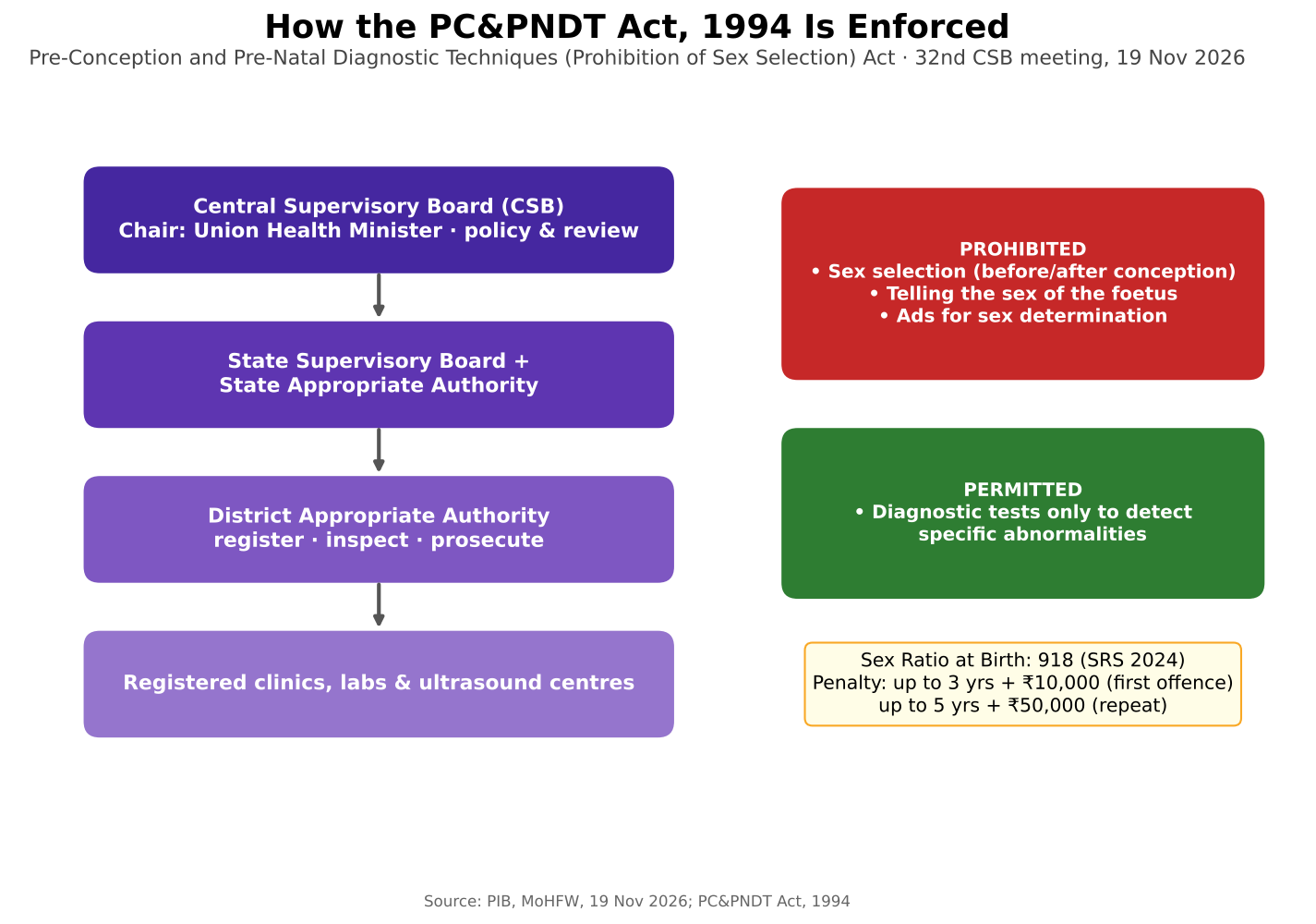
Ban: prohibits sex selection before or after conception, and telling anyone the sex of a foetus.
Regulation: diagnostic techniques such as ultrasound may be used only to detect specific abnormalities, not sex.
Registration: every genetic counselling centre, lab and clinic with an ultrasound machine must register.
Advertising: any advertisement for sex determination is banned.
Penalties: up to 3 years in prison and a fine of up to ₹10,000 for a first offence, rising to 5 years and ₹50,000 for repeat offences.
History: enacted as the PNDT Act, 1994, and renamed in 2003 to cover pre-conception techniques.
Why the sex ratio at birth matters
Without interference, about 950 girls are born for every 1,000 boys (about 105 boys for every 100 girls).
A lower ratio points to sex-selective abortion driven by son preference, dowry and a small-family norm combined with easy access to ultrasound.
A skewed ratio leads to "missing women", shortages of brides and a higher risk of trafficking.
Enforcement structure
Level
Body
Role
National
Central Supervisory Board, chaired by the Union Health Minister
Policy, review and advice to the Centre
State
State Supervisory Board and State Appropriate Authority
Monitoring and enforcement in the State
District
District Appropriate Authority
Registering, inspecting and prosecuting clinics
Sex ratio measures
Measure
Definition
Sex Ratio at Birth (SRB)
Girls born per 1,000 boys born
Child Sex Ratio
Girls per 1,000 boys aged 0–6 (Census 2011: 918)
Overall sex ratio
Females per 1,000 males (Census 2011: 943)
The Sample Registration System (SRS) is run by the Registrar General of India.
Beti Bachao Beti Padhao
Launched on 22 January 2015 at Panipat, Haryana.
A joint initiative of the Ministries of Women and Child Development, Health and Family Welfare, and Education.
Likely Prelims angles
Who chairs the Central Supervisory Board
SRB versus child sex ratio
Which agency publishes SRS data
Where and when Beti Bachao Beti Padhao was launched
Quick Revision
The 32nd CSB meeting reviewed the PC&PNDT Act.
The SRS 2024 report puts the Sex Ratio at Birth at 918.
The Union Health Minister chairs the Central Supervisory Board.
The Act was renamed in 2003 to include pre-conception techniques.
Beti Bachao Beti Padhao began at Panipat in 2015.
Practice MCQ
Q. With reference to the PC&PNDT Act, 1994, consider the following statements:
1. The Central Supervisory Board under the Act is chaired by the Union Minister of Health and Family Welfare.
2. Clinics with ultrasound machines must be registered under the Act.
3. The Act was amended in 2003 to cover pre-conception sex selection.
Which of the statements given above are correct?
(a) 1 and 2 only
(b) 2 and 3 only
(c) 1 and 3 only
(d) 1, 2 and 3
Answer: (d).
Related PYQs
PYQ 1 (UPSC CSE Prelims 2024)
With reference to the 'Pradhan Mantri Surakshit Matritva Abhiyan', consider the following statements:
1. This scheme guarantees a minimum package of antenatal care services to women in their second and third trimesters of pregnancy and six months post-delivery health care service in any government health facility.
2. Under this scheme, private sector health care providers of certain specialities can volunteer to provide services at nearby government health facilities.
Which of the statements given above is/are correct?
(a) 1 only
(b) 2 only
(c) Both 1 and 2
(d) Neither 1 nor 2
Answer: (b). The scheme covers antenatal care in the second and third trimesters, not six months of post-delivery care.



 24
Nov 2026
 24
Nov 2026
 24
Nov 2026














0 comments
Discussion
No comments yet. Be the first.