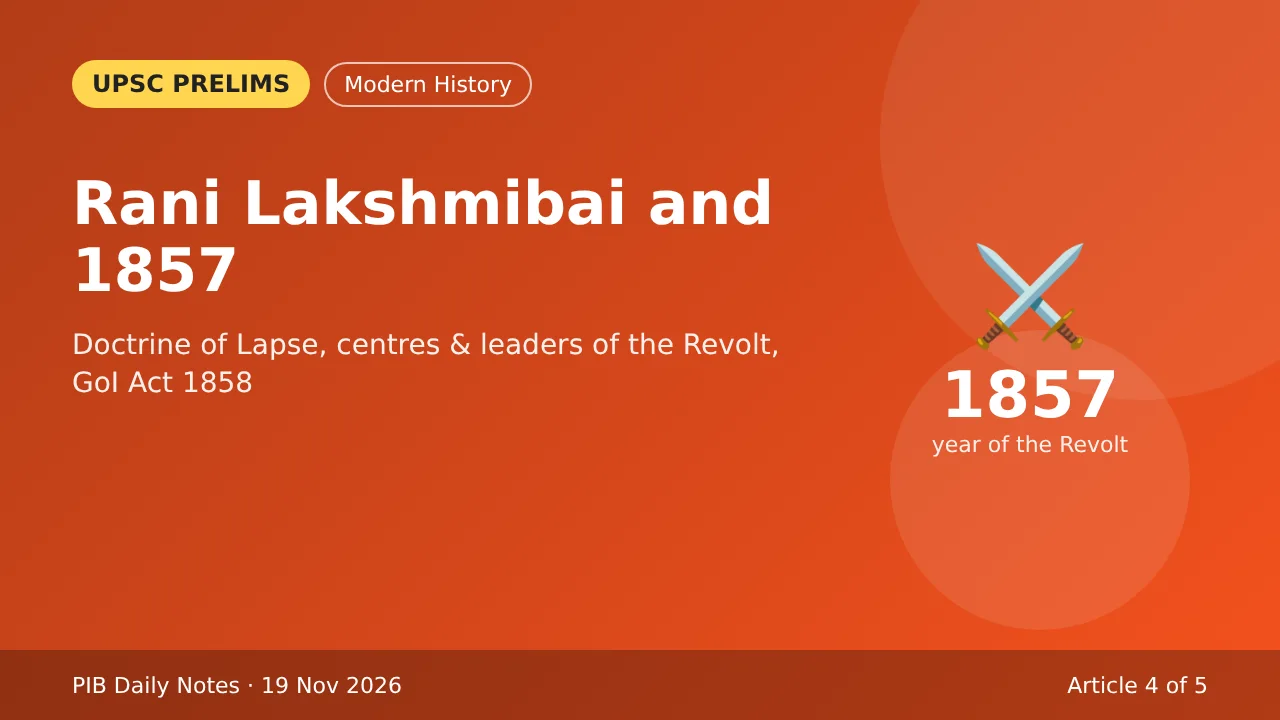
The Prime Minister paid tribute to Rani Lakshmibai of Jhansi on her birth anniversary (19 November)
DDecode Civils
· 3 min read
Rani Lakshmibai and the Revolt of 1857
Why in News
The Prime Minister paid tribute to Rani Lakshmibai of Jhansi on her birth anniversary (19 November), recalling her courage against foreign rule.
News Summary
The Prime Minister called her a valiant daughter of Mother India who never compromised on duty or self-respect, even in the hardest circumstances.
He said her courage against foreign rule will keep inspiring every generation.
Her birth anniversary is a good occasion to revise the Revolt of 1857, a core modern history topic.
Prelims Facts & Static Linkages
Life of Rani Lakshmibai
Born Manikarnika ("Manu") on 19 November 1828 in Varanasi.
Married Gangadhar Rao, the Maratha ruler of Jhansi.
After her husband's death in 1853, the British refused to accept their adopted son, Damodar Rao, as heir.
Lord Dalhousie annexed Jhansi under the Doctrine of Lapse in 1854.
She led the defence of Jhansi in 1858 against Sir Hugh Rose, then joined Tantia Tope to capture Gwalior.
She died fighting near Gwalior in June 1858.
Causes of the Revolt of 1857
Political: annexations under the Doctrine of Lapse, and the annexation of Awadh (1856) on grounds of misgovernment.
Economic: heavy land revenue, ruin of artisans and loss of jobs for nobles and soldiers.
Military: low pay for Indian sepoys, service overseas, and the greased cartridges of the Enfield rifle.
Social and religious: fears that British reforms and missionaries threatened Indian customs.
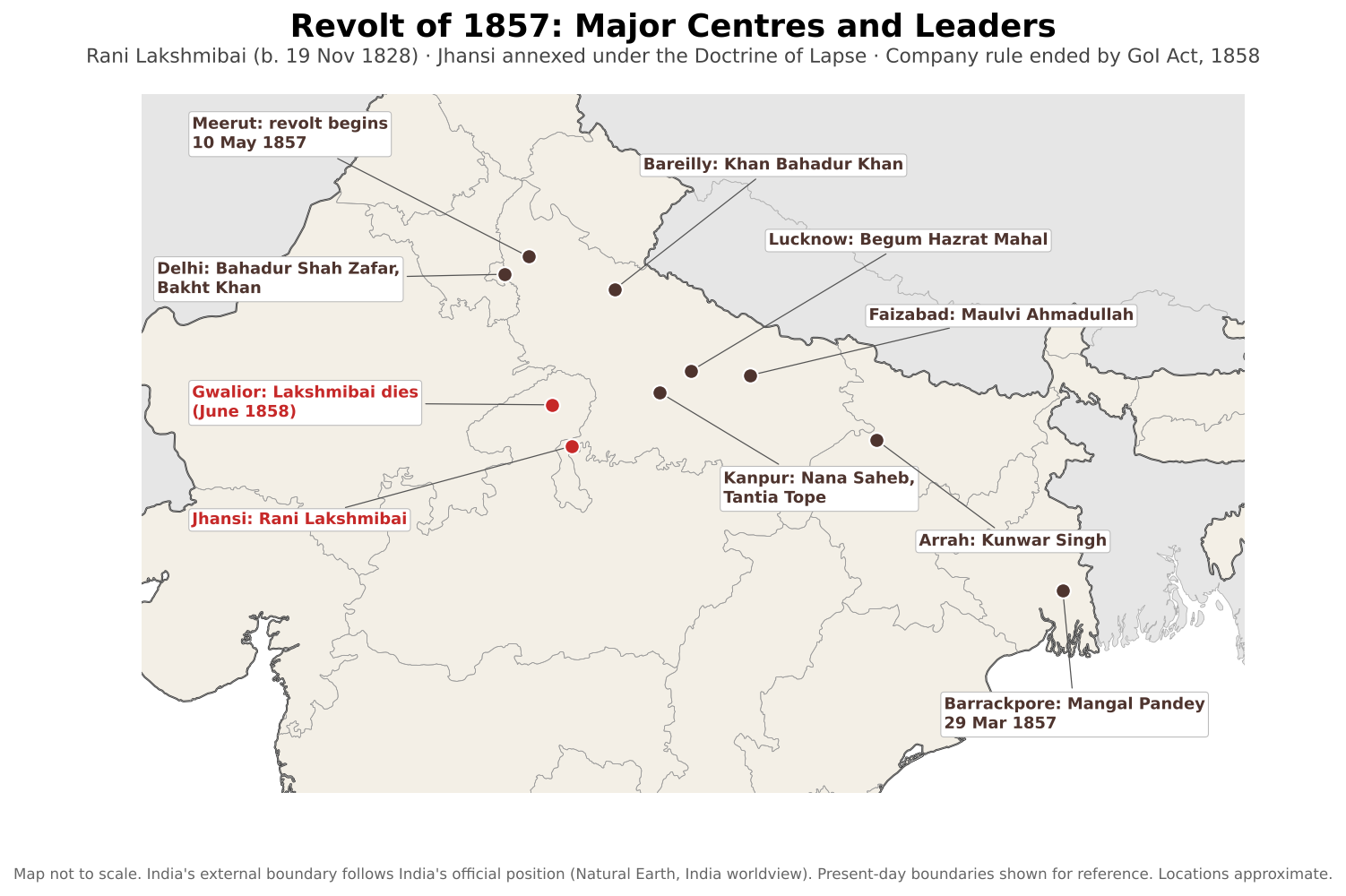
Centres, leaders and British commanders
Centre
Indian leader
British commander
Delhi
Bahadur Shah Zafar, Bakht Khan
John Nicholson, William Hodson
Kanpur
Nana Saheb, Tantia Tope
Colin Campbell
Lucknow
Begum Hazrat Mahal
Colin Campbell
Jhansi and Gwalior
Rani Lakshmibai
Hugh Rose
Arrah (Bihar)
Kunwar Singh
William Taylor, Vincent Eyre
Bareilly
Khan Bahadur Khan
Colin Campbell
Faizabad
Maulvi Ahmadullah
—
Timeline
Date
Event
29 March 1857
Mangal Pandey's revolt at Barrackpore
10 May 1857
Sepoys rise at Meerut and march to Delhi
1858
Government of India Act ends Company rule
1 November 1858
Queen Victoria's Proclamation read at Allahabad
Other figures to remember
Mangal Pandey of the 34th Bengal Native Infantry attacked officers at Barrackpore and was hanged in April 1857.
Tantia Tope carried on guerrilla resistance after Gwalior and was executed in 1859.
Bahadur Shah Zafar was exiled to Rangoon, where he died in 1862.
Lord Canning was Governor-General during the revolt and became the first Viceroy.
Doctrine of Lapse annexations
State
Year
Satara
1848
Jaitpur and Sambalpur
1849
Baghat
1850
Udaipur
1852
Jhansi
1853–54
Nagpur
1854
Consequences and interpretations
The Government of India Act, 1858 ended Company rule. A Secretary of State for India was created, and the Governor-General also became the Viceroy.
The Queen's Proclamation promised to respect the rights of princes and ended further annexations.
The army was reorganised with a higher share of European troops.
V. D. Savarkar called it the "First War of Indian Independence" (1909), while R. C. Majumdar argued it was neither the first, nor national, nor a war of independence.
Likely Prelims angles
Matching leaders with centres
States annexed under the Doctrine of Lapse
Outcomes of the Government of India Act, 1858
Where the revolt began
Quick Revision
Rani Lakshmibai was born on 19 November 1828 in Varanasi.
Jhansi was annexed under the Doctrine of Lapse.
She fought Hugh Rose and died near Gwalior in 1858.
The revolt began at Meerut on 10 May 1857.
Begum Hazrat Mahal led at Lucknow, and Kunwar Singh at Arrah.
The Government of India Act, 1858 transferred power to the Crown.
Practice MCQ
Q. Consider the following pairs:
1. Kunwar Singh : Arrah
2. Begum Hazrat Mahal : Lucknow
3. Nana Saheb : Kanpur
How many of the above pairs are correctly matched?
(a) Only one
(b) Only two
(c) All three
(d) None
Answer: (c).
Related PYQs
PYQ 1 (UPSC CSE Prelims 2020)
With reference to the history of India, "Ulgulan" or the Great Tumult is the description of which of the following events?



 24
Nov 2026
 24
Nov 2026
 24
Nov 2026














0 comments
Discussion
No comments yet. Be the first.