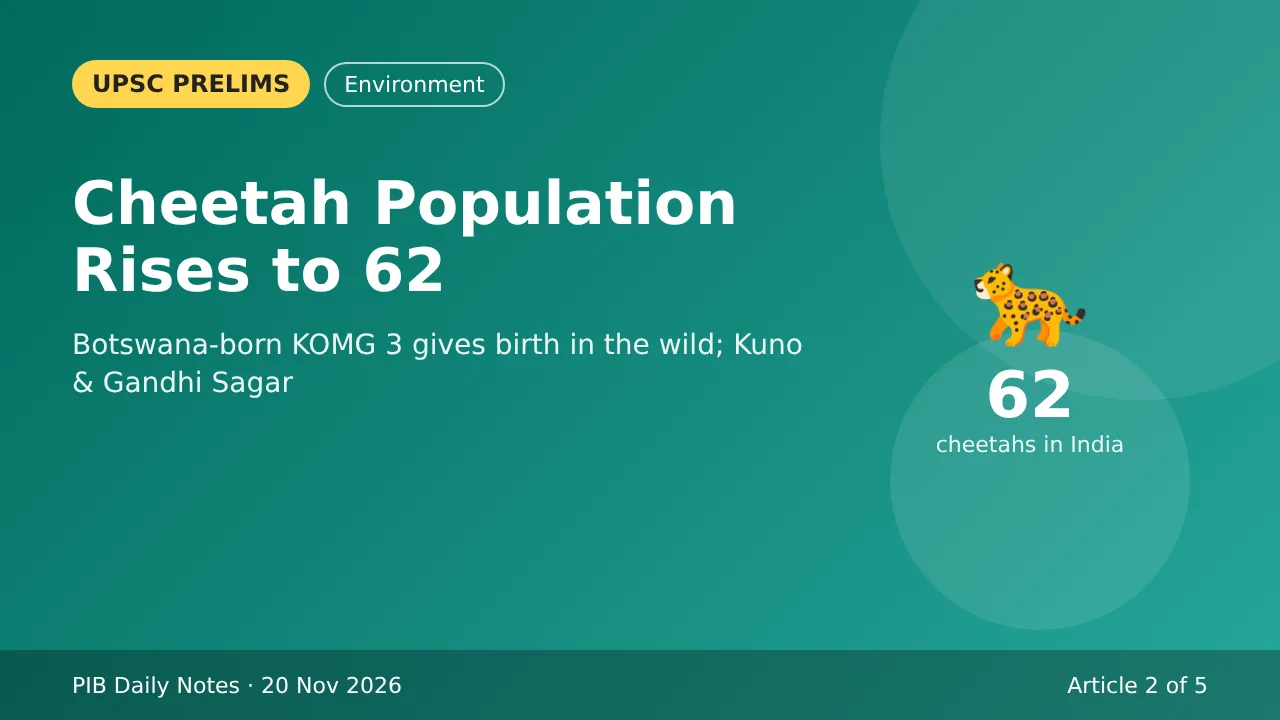
India's cheetah population has risen to 62, of which 43 were born in India.
DDecode Civils
· 3 min read
Cheetah Population Rises to 62
Why in News
KOMG 3, a two-and-a-half-year-old female cheetah brought from Botswana, gave birth to four cubs in the wild. With this, India's cheetah population has risen to 62, of which 43 were born in India.
News Summary
KOMG 3 is the first female cheetah from Botswana to give birth in India.
She had spent more than four months in the wild before giving birth under natural conditions.
This is only the second recorded birth in the wild since the reintroduction programme began in 2022.
The Environment Minister called it a landmark for Project Cheetah and credited the managers, veterinarians and frontline forest staff.
More than two-thirds of the population is now India-born, which matters because a reintroduced species must breed on its own to become self-sustaining.
Prelims Facts & Static Linkages
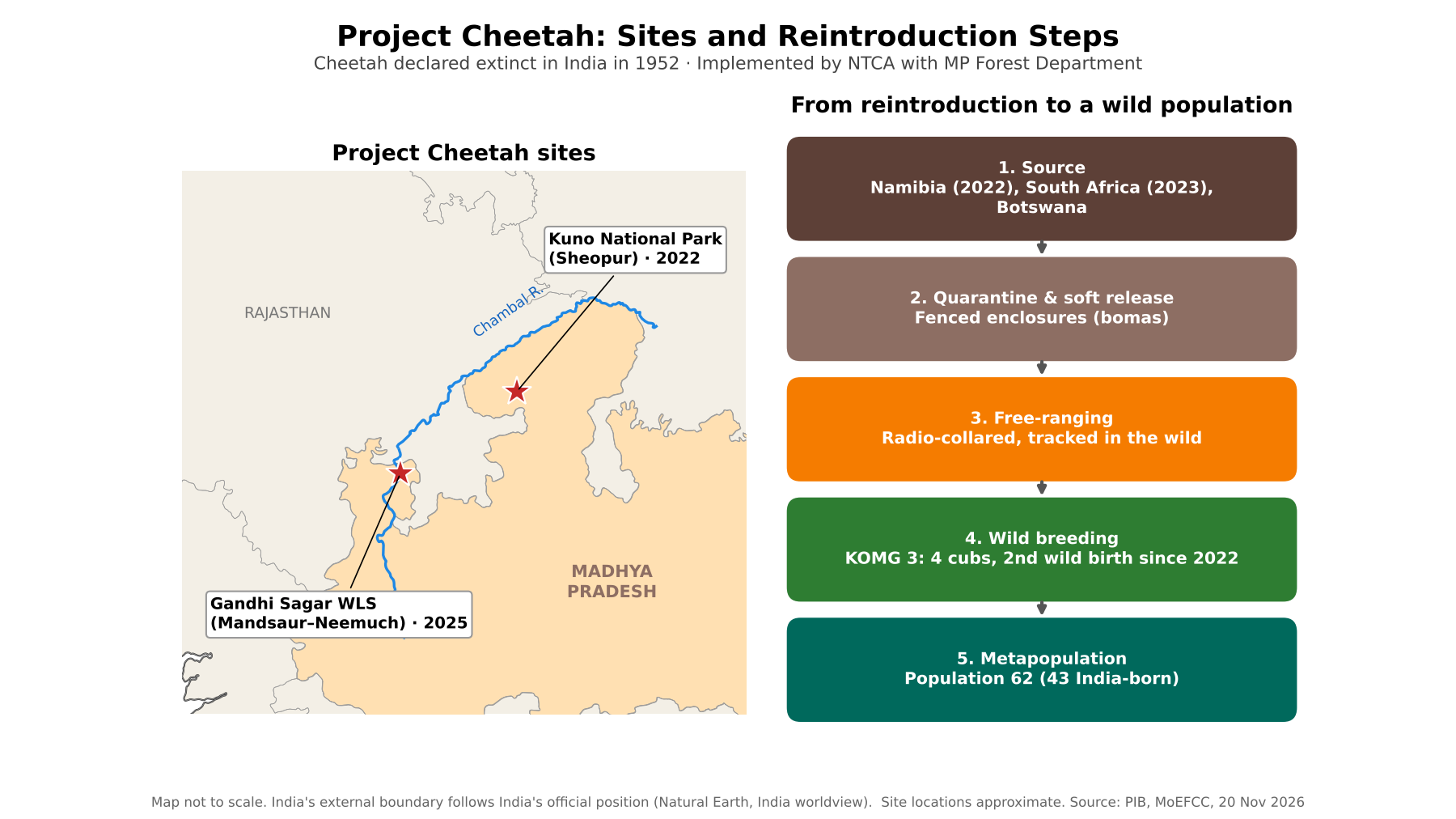
Project Cheetah: timeline
Year
Milestone
1952
The cheetah was declared extinct in India, the only large mammal to go extinct in India since Independence
2022
8 cheetahs from Namibia released in Kuno National Park, Madhya Pradesh, on 17 September
2023
12 cheetahs from South Africa arrive at Kuno; first cubs born in India
2025
Gandhi Sagar Wildlife Sanctuary (Madhya Pradesh) becomes the second cheetah site
2026
Botswana-origin female gives birth in the wild; population reaches 62
How a reintroduction becomes self-sustaining
Source: healthy animals are brought from African range countries (Namibia, South Africa and Botswana).
Quarantine and soft release: animals spend time in fenced enclosures (bomas) to adapt.
Free-ranging: animals are released into the wild and tracked with radio collars.
Wild breeding: births in natural conditions show that the habitat can support them.
Metapopulation: linked sites across Kuno, Gandhi Sagar and future landscapes help maintain genetic diversity.
Cheetah versus other big cats
Feature
Cheetah
Species in India
African cheetah (Acinonyx jubatus jubatus); the Asiatic subspecies survives only in Iran
IUCN status
Vulnerable (the Asiatic cheetah is Critically Endangered)
Roar
Cannot roar; it purrs and chirps
Claws
Semi-retractable, which gives grip while sprinting
Habitat
Open grasslands and savannas, not dense forest
Hunting
Hunts by day, relying on speed (about 100–110 km/h) rather than strength
Key concepts to revise
Kuno National Park lies in the Sheopur district of Madhya Pradesh, along the Kuno river, a tributary of the Chambal.
Gandhi Sagar Wildlife Sanctuary lies along the Chambal, on the Madhya Pradesh–Rajasthan border.
The project is implemented by the National Tiger Conservation Authority (NTCA) with the state forest department.
Likely Prelims angles
The year the cheetah was declared extinct in India
The source countries of reintroduced cheetahs
Locating Kuno and Gandhi Sagar
Traits that set cheetahs apart from other big cats
Quick Revision
KOMG 3, from Botswana, gave birth to four cubs in the wild.
India's cheetah population is now 62, including 43 born in India.
This is the second recorded birth in the wild since 2022.
The cheetah was declared extinct in India in 1952.
Kuno and Gandhi Sagar, both in Madhya Pradesh, are the cheetah sites.
Gandhi Sagar lies along the Chambal on the Madhya Pradesh–Rajasthan border.
Cheetahs cannot roar and have semi-retractable claws.
The NTCA implements Project Cheetah.
Practice MCQ
Q. With reference to Project Cheetah, consider the following statements:
The first batch of cheetahs reintroduced in India came from Namibia.
Gandhi Sagar Wildlife Sanctuary lies along the Chambal river.
The cheetahs brought to India belong to the Asiatic subspecies.
Which of the statements given above are correct?
(a) 1 and 2 only
(b) 2 and 3 only
(c) 1 and 3 only
(d) 1, 2 and 3
Answer: (a). The reintroduced cheetahs are African cheetahs.
Related PYQs
PYQ 1 (UPSC CSE Prelims 2024)
Consider the following statements:
Lions do not have a particular breeding season.
Unlike most other big cats, cheetahs do not roar.
Unlike male lions, male leopards do not proclaim their territory by scent marking.
Which of the statements given above are correct?
(a) 1 and 2 only
(b) 2 and 3 only
(c) 1 and 3 only
(d) 1, 2 and 3
Answer: (a). Male leopards do mark their territory by scent.



 24
Nov 2026
 24
Nov 2026
 24
Nov 2026














0 comments
Discussion
No comments yet. Be the first.