Drone surveys are complete in 3.28 lakh villages and 3.47 crore property cards have been generated
DDecode Civils
· 4 min read
SVAMITVA Scheme: Push for Saturation by 2027
Why in News
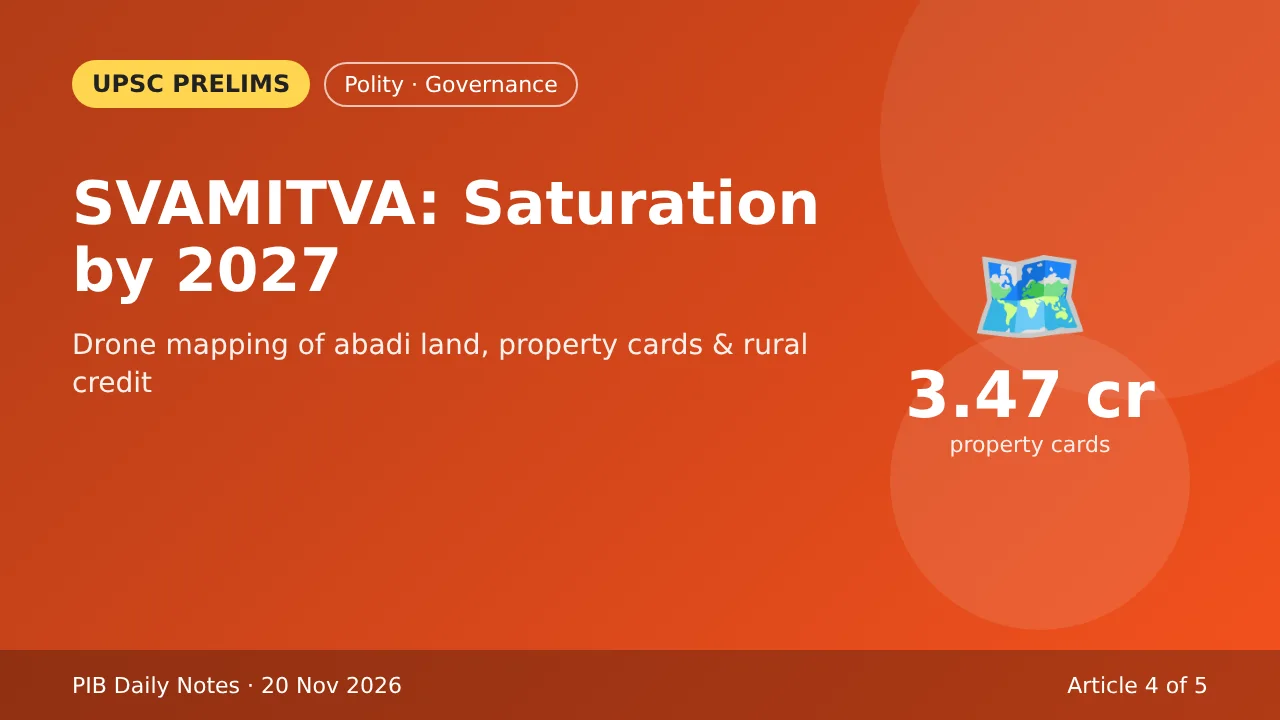
At a national review meeting, the Union Panchayati Raj Minister asked states to implement the SVAMITVA scheme in mission mode and reach saturation by 31 March 2027. Drone surveys are complete in 3.28 lakh villages and 3.47 crore property cards have been generated.
News Summary
States were asked to prepare time-bound action plans for the remaining surveys and card distribution.
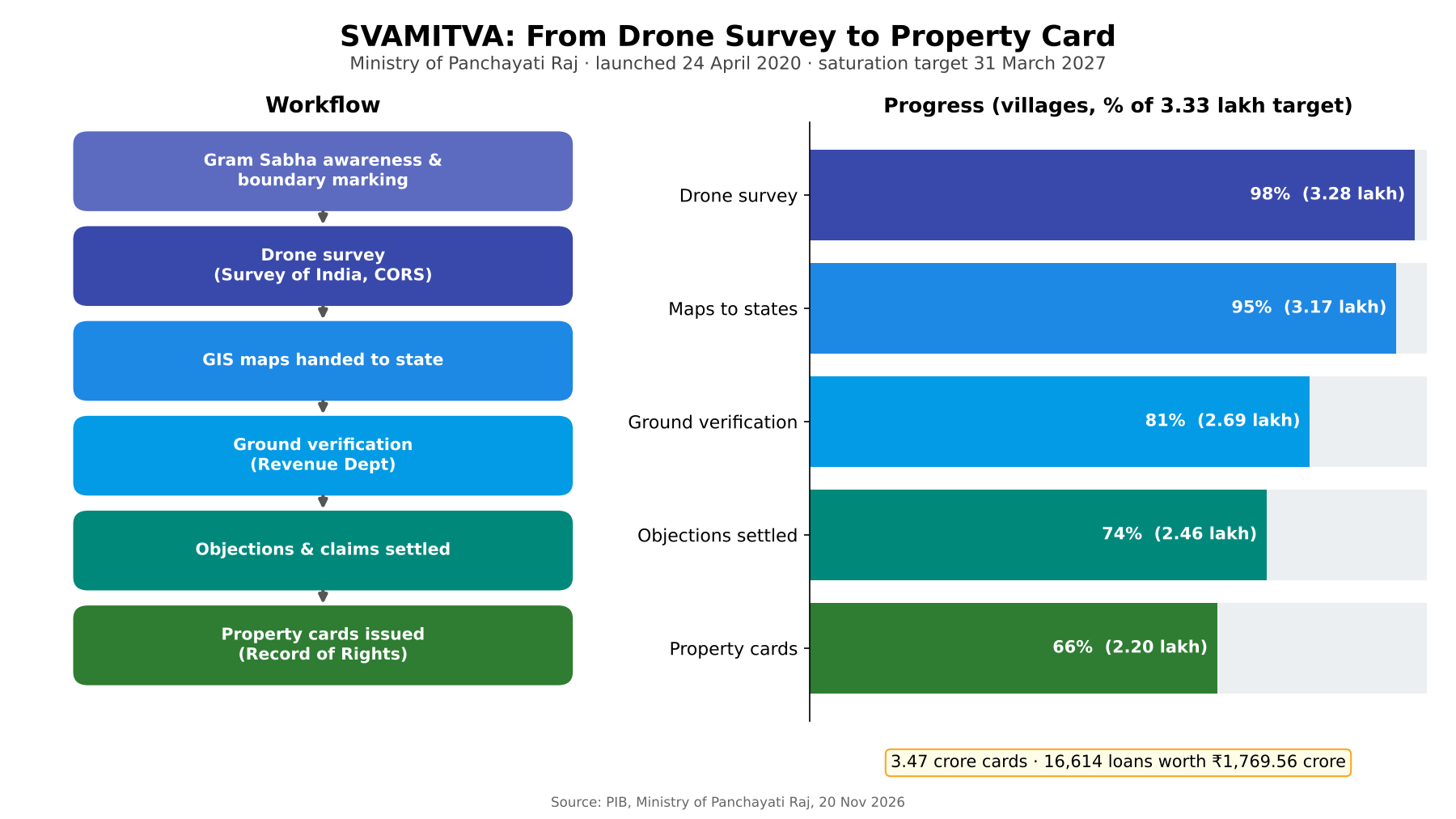
Banks now accept SVAMITVA property cards as collateral. So far, 16,614 loans worth ₹1,769.56 crore have been taken in Madhya Pradesh, Rajasthan, Maharashtra, Gujarat, Mizoram, Jammu & Kashmir and Ladakh.
States were urged to use the high-resolution spatial data for estimating solar potential, planning drainage and preparing Gram Panchayat Development Plans (GPDPs).
The scheme is implemented with the Survey of India and state Revenue Departments.
Progress so far
Stage
Villages
Share of target
Target
3.33 lakh
100%
Drone survey done
3.28 lakh
98%
Maps handed to states
3.17 lakh
95%
Ground verification
2.69 lakh
81%
Objections and claims settled
2.46 lakh
74%
Property cards (3.47 crore)
2.20 lakh
66%
Prelims Facts & Static Linkages
SVAMITVA at a glance
Item
Fact
Full form
Survey of Villages And Mapping with Improvised Technology in Village Areas
Launched
24 April 2020, National Panchayati Raj Day
Nodal ministry
Ministry of Panchayati Raj
Type
Central Sector Scheme
Technical partner
Survey of India, using drones and a CORS (Continuously Operating Reference Stations) network
Coverage
Inhabited rural (abadi) areas, which old revenue surveys usually left out
How a village gets its property cards
Awareness: the Gram Sabha is informed and owners mark their property boundaries (chunna marking).
Drone survey: Survey of India flies drones to capture high-resolution images.
Map generation: large-scale GIS maps are prepared and handed to the state.
Ground verification: revenue officials check each parcel with the owners.
Objections and claims: disputes are heard and settled.
Record of Rights:property cards (title deeds) are issued, digitally or on paper.
Why it matters
Credit: property becomes a financial asset that can be mortgaged.
Fewer disputes: clear boundaries reduce land litigation.
Local revenue: Gram Panchayats can assess property tax more accurately.
Planning: GIS maps support GPDPs and disaster planning.
Women's empowerment: joint or women's names on property cards strengthen their asset ownership.
Constitutional linkages
Land is a State List subject (Entry 18), so states run the records while the Centre funds and provides technology.
Panchayats were given constitutional status by the 73rd Amendment Act, 1992 (Part IX, Articles 243–243O).
The Eleventh Schedule lists 29 subjects for panchayats, including land improvement and land consolidation.
Likely Prelims angles
The full form and launch date of SVAMITVA
Agencies involved and the technology used
Abadi land and Record of Rights
Land as a State subject
Quick Revision
SVAMITVA was launched on 24 April 2020 under the Ministry of Panchayati Raj.
The saturation deadline is 31 March 2027.
Drone surveys cover 3.28 lakh of 3.33 lakh target villages.
3.47 crore property cards have been generated.
16,614 loans worth ₹1,769.56 crore have been taken against property cards.
Survey of India is the technology partner.
Banks now accept property cards as collateral for loans.
Land is a State List subject, and panchayats got constitutional status through the 73rd Amendment.
Practice MCQ
Q. Consider the following statements about the SVAMITVA scheme:
It is implemented by the Ministry of Rural Development.
It maps inhabited (abadi) land in rural areas using drones.
Survey of India is its technology partner.
Which of the statements given above are correct?
(a) 1 and 2 only
(b) 2 and 3 only
(c) 1 and 3 only
(d) 1, 2 and 3
Answer: (b). The nodal ministry is the Ministry of Panchayati Raj.
Related PYQs
PYQ 1 (UPSC CSE Prelims 2025)
Consider the following statements:
I. Panchayats at the intermediate level exist in all States.
II. To be eligible to be a Member of a Panchayat at the intermediate level, a person should attain the age of thirty years.
III. The Chief Minister of a State constitutes a commission to review the financial position of Panchayats at the intermediate levels and to make recommendations regarding the distribution of net proceeds of taxes and duties, leviable by the State, between the State and Panchayats at the intermediate level.
Which of the statements given above are not correct?
(a) I and II only
(b) II and III only
(c) I and III only
(d) I, II and III
Answer: (d) States with a population under 20 lakh need not have the intermediate level, the minimum age is 21, and the Governor constitutes the State Finance Commission.



 24
Nov 2026
 24
Nov 2026
 24
Nov 2026














0 comments
Discussion
No comments yet. Be the first.