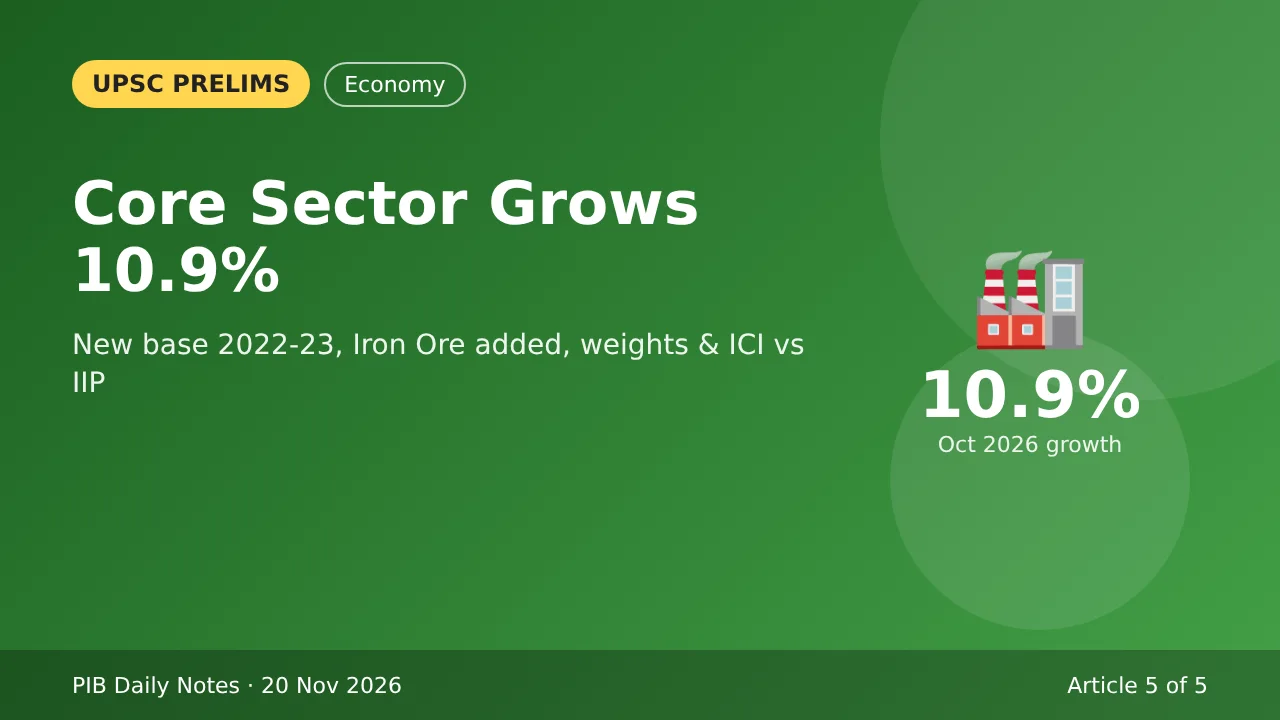
Index of Core Industries (ICI) grew 10.9% (provisional) in October 2026 over October 2025
DDecode Civils
· 3 min read
Core Sector Grows 10.9% in October 2026
Why in News
The Index of Core Industries (ICI) grew 10.9% (provisional) in October 2026 over October 2025. The index now uses the new base year 2022-23 and covers nine industries, with Iron Ore added to the earlier eight.
News Summary
Growth in September 2026 was revised up to 8.2% from 7.9%.
Cumulative growth for April–October 2026-27 was 6.0%, against 2.3% a year earlier.
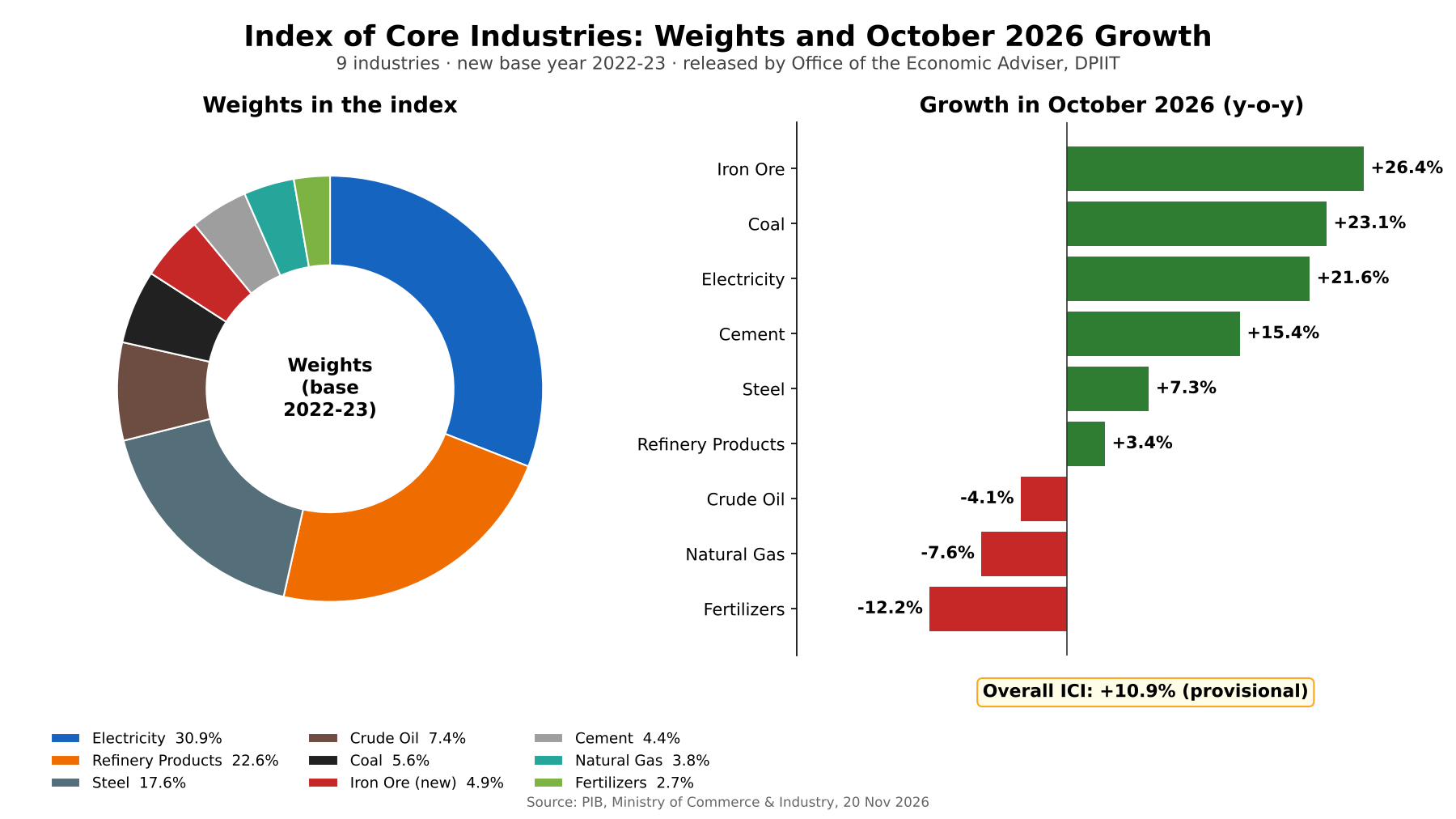
Iron Ore (26.4%), Coal (23.1%), Electricity (21.6%) and Cement (15.4%) grew fastest in October.
Steel grew 7.3% and Refinery Products 3.4%.
Output fell in Fertilizers (−12.2%), Natural Gas (−7.6%) and Crude Oil (−4.1%).
The index is released by the Office of the Economic Adviser, DPIIT, Ministry of Commerce & Industry.
Prelims Facts & Static Linkages
Weights in the new ICI (base 2022-23)
Industry
Weight (%)
Electricity
30.932
Refinery Products
22.572
Steel
17.584
Crude Oil
7.430
Coal
5.596
Iron Ore (new)
4.905
Cement
4.410
Natural Gas
3.841
Fertilizers
2.731
What to remember about the ICI
Electricity has the highest weight, followed by Refinery Products and Steel.
Fertilizers have the lowest weight.
The core industries make up a large part of the Index of Industrial Production (IIP), so the ICI is an early signal of IIP.
The ICI is released on the 20th of the following month, about a week before the IIP.
The base year moved from 2011-12 to 2022-23, in line with the revision of other macro data.
ICI versus IIP
Feature
ICI
IIP
Compiled by
Office of the Economic Adviser, DPIIT
NSO, MoSPI
Coverage
9 basic industries
Mining, manufacturing and electricity
Release
20th of the following month
About the 28th of the following month
Use
Early indicator of industrial activity
Main measure of industrial output
Reading the October numbers
Double-digit growth signals a broad pickup in basic industries, though monthly figures are provisional and are revised later.
Strong coal and electricity growth usually points to higher power demand.
Cement and steel growth tracks construction and infrastructure spending.
Falling crude oil and natural gas output reflects ageing fields, which keeps import dependence high.
Linkages with the wider economy
Electricity, coal and cement are inputs for almost every other industry, so their output reflects demand across the economy.
Steel and iron ore link to the National Steel Policy 2017, which targets 300 million tonnes of capacity by 2030-31.
Fertilizers link to food security. India still imports urea, DAP and potash, and the nano urea push aims to cut those imports.
Crude oil and natural gas link to energy security. India imports more than 85% of its crude oil.
Likely Prelims angles
The industry with the highest weight
The new industry added and the new base year
Which body releases the ICI and which releases the IIP
Matching industries with their weights
Quick Revision
Core sector growth was 10.9% in October 2026.
The new base year is 2022-23, and Iron Ore is the ninth industry.
Electricity has the highest weight (30.932%).
Fertilizers have the lowest weight (2.731%).
DPIIT's Office of the Economic Adviser releases the ICI.
MoSPI's NSO releases the IIP.
Iron Ore grew fastest in October (26.4%), while Fertilizers fell the most (−12.2%).
Cumulative growth for April–October was 6.0%.
Practice MCQ
Q. With reference to the Index of Core Industries with base year 2022-23, consider the following statements:
It covers nine industries, including Iron Ore.
Steel has the highest weight in the index.
It is released by the National Statistics Office.
Which of the statements given above is/are correct?
(a) 1 only
(b) 1 and 2 only
(c) 2 and 3 only
(d) 1, 2 and 3
Answer: (a). Electricity has the highest weight, and DPIIT releases the index.
Related PYQs
PYQ 1 (UPSC CSE Prelims 2025)
Consider the following statements:
Statement I: Studies indicate that carbon dioxide emissions from cement industry account for more than 5% of global carbon emissions.
Statement II: Silica-bearing clay is mixed with limestone while manufacturing cement.
Statement III: Limestone is converted into lime during clinker production for cement manufacturing.
Which one of the following is correct in respect of the above statements?
(a) Both Statement II and Statement III are correct and both of them explain Statement I
(b) Both Statement II and Statement III are correct but only one of them explains Statement I
(c) Only one of the Statements II and III is correct and that explains Statement I
(d) Neither Statement II nor Statement III is correct
Answer: (b) Turning limestone into lime releases CO₂, which explains the emissions. Mixing clay with limestone does not.



 24
Nov 2026
 24
Nov 2026
 24
Nov 2026














0 comments
Discussion
No comments yet. Be the first.