Mines Secretary said India is securing critical mineral supplies from both domestic and overseas sources
DDecode Civils
· 4 min read
India's Critical Minerals Push at Home and Abroad
Why in News
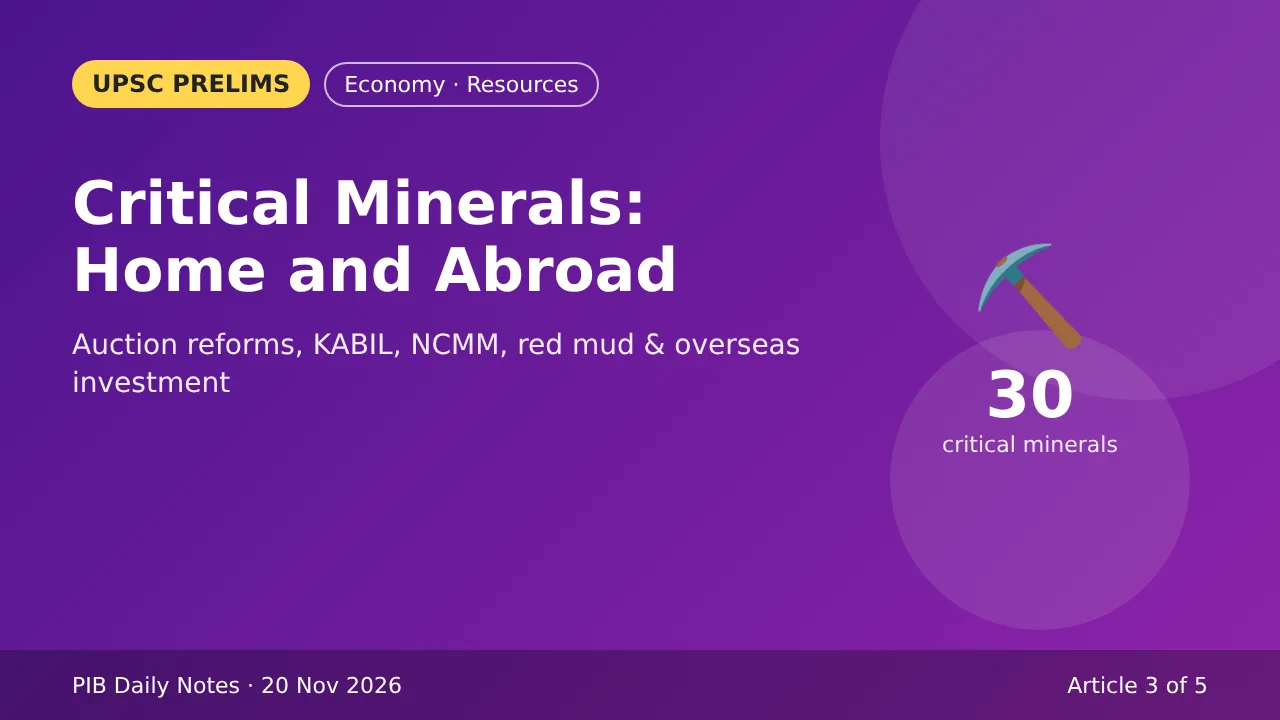
At a Ministry of Mines–FICCI industry interaction, the Mines Secretary said India is securing critical mineral supplies from both domestic and overseas sources. A concept paper, "Enabling Overseas Investment in Critical Minerals", was launched.
News Summary
The Secretary outlined auction reforms, including relaxed minimum bidder requirements for certain minerals and automatic issue of Letters of Intent.
He urged industry to extract critical minerals from waste such as red mud, the residue of alumina refining.
The FICCI paper, prepared at the Ministry's request, proposes a Country-Priority Mineral Matrix to guide overseas investment.
It suggests a tiered framework to decide which overseas projects get government facilitation, and calls for moving "from MoUs to project delivery".
The Secretary linked this to the overseas work of KABIL.
The paper was prepared under the guidance of the head of the National Critical Mineral Mission (NCMM).
Industry flagged risks from export controls, local value-addition rules and processing technology restrictions in supplier countries.
Prelims Facts & Static Linkages
Why critical minerals matter
Energy transition: lithium, cobalt, nickel and graphite go into batteries for electric vehicles and grid storage.
Electronics and defence: rare earth elements are used in permanent magnets, missiles and semiconductors.
Import dependence: India imports most of its lithium, cobalt and nickel.
Concentration risk: mining and especially processing are concentrated in a few countries, mainly China.
Strategic autonomy: secure supply supports Make in India and the net-zero target for 2070.
Weaponisation of supply: export curbs on graphite, gallium and rare earth processing technology show how supply can be used as leverage.
India's critical minerals framework
Initiative
Key fact
Critical minerals list (2023)
The Ministry of Mines identified 30 critical minerals
MMDR Amendment Act, 2023
Lets the Centre auction mining leases and composite licences for listed critical minerals; introduced exploration licences
KABIL (Khanij Bidesh India Ltd)
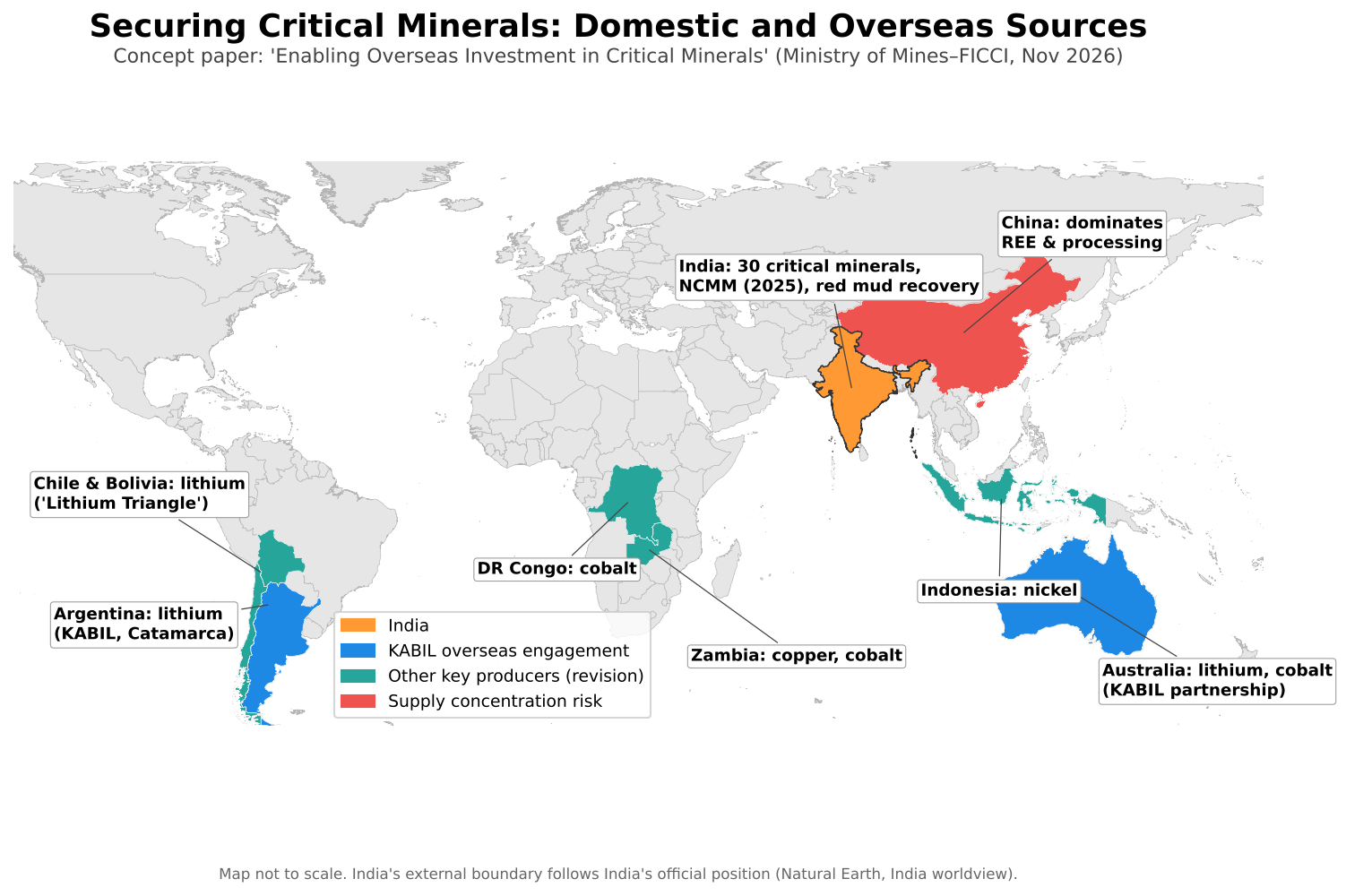
A joint venture of NALCO, HCL and MECL to acquire mineral assets abroad; it signed a lithium exploration deal in Argentina's Catamarca province
NCMM (2025)
National Critical Mineral Mission, for self-reliance across exploration, mining, processing and recycling
Minerals Security Partnership
A US-led grouping that India joined in 2023
Key source countries to know
Country
Mineral
Argentina, Chile, Bolivia
Lithium (the "Lithium Triangle")
Australia
Lithium, cobalt
DR Congo
Cobalt
Indonesia
Nickel
Zambia
Copper, cobalt
Red mud: a waste and a resource
Red mud is the alkaline residue left when bauxite is refined into alumina by the Bayer process.
It contains iron, titanium, scandium and some rare earths, so recovering them cuts both waste and imports.
India produces millions of tonnes of red mud a year, mostly near alumina refineries in Odisha, so recovery also eases a storage and pollution problem.
Likely Prelims angles
Members of KABIL and its overseas projects
What the 2023 MMDR amendment changed
Matching countries with minerals
Where red mud comes from
Quick Revision
India is pursuing critical minerals both at home and overseas.
The FICCI concept paper proposes a Country-Priority Mineral Matrix.
Auction reforms include relaxed bidder rules and automatic Letters of Intent.
KABIL is a joint venture of NALCO, HCL and MECL.
India has 30 notified critical minerals.
Red mud is a by-product of alumina refining.
Practice MCQ
Q. Consider the following statements about Khanij Bidesh India Ltd (KABIL):
It is a joint venture of NALCO, Hindustan Copper Ltd and MECL.
It has signed an agreement for lithium exploration in Argentina.
It works under the Ministry of External Affairs.
Which of the statements given above are correct?
(a) 1 and 2 only
(b) 2 and 3 only
(c) 1 and 3 only
(d) 1, 2 and 3
Answer: (a). KABIL works under the Ministry of Mines.
Related PYQs
PYQ 1 (UPSC CSE Prelims 2025)
Consider the following statements:
I. India has joined the Minerals Security Partnership as a member.
II. India is a resource-rich country in all the 30 critical minerals that it has identified.
III. The Parliament in 2023 has amended the Mines and Minerals (Development and Regulation) Act, 1957 empowering the Central Government to exclusively auction mining lease and composite license for certain critical minerals.
Which of the statements given above are correct?
(a) I and II only
(b) II and III only
(c) I and III only
(d) I, II and III
Answer: (c)
PYQ 2 (UPSC CSE Prelims 2026)
Which of the following statements about Rare Earth Elements (REEs) and Critical Minerals is/are correct?
Modern technological innovations including Artificial Intelligence, robotics and space exploration extensively utilise Rare Earth Elements (REEs).
China has the highest share in mining of REEs followed by India.
The Government of India launched the National Critical Mineral Mission (NCMM) in 2025 to establish a robust framework for self-reliance in the critical mineral sector.
Rare Earth Elements are a set of 13 metallic elements.
Select the answer using the code given below:
(a) 1 and 3 only
(b) 3 only
(c) 1, 3 and 4
(d) 1, 2 and 4
Answer: (a) India is not second in REE mining, and REEs are a set of 17 elements.
PYQ 3 (UPSC CSE Prelims 2025)
Consider the following pairs:
Country
Resource-rich in
I. Botswana
Diamond
II. Chile
Lithium
III. Indonesia
Nickel
In how many of the above rows is the given information correctly matched?



 24
Nov 2026
 24
Nov 2026
 24
Nov 2026














0 comments
Discussion
No comments yet. Be the first.