A survey by DIVERSIFARM-India found that India has at least 1,000 community seed banks (CSBs)
DDecode Civils
· 3 min read
Community Seed Banks: DIVERSIFARM-India
Why in News
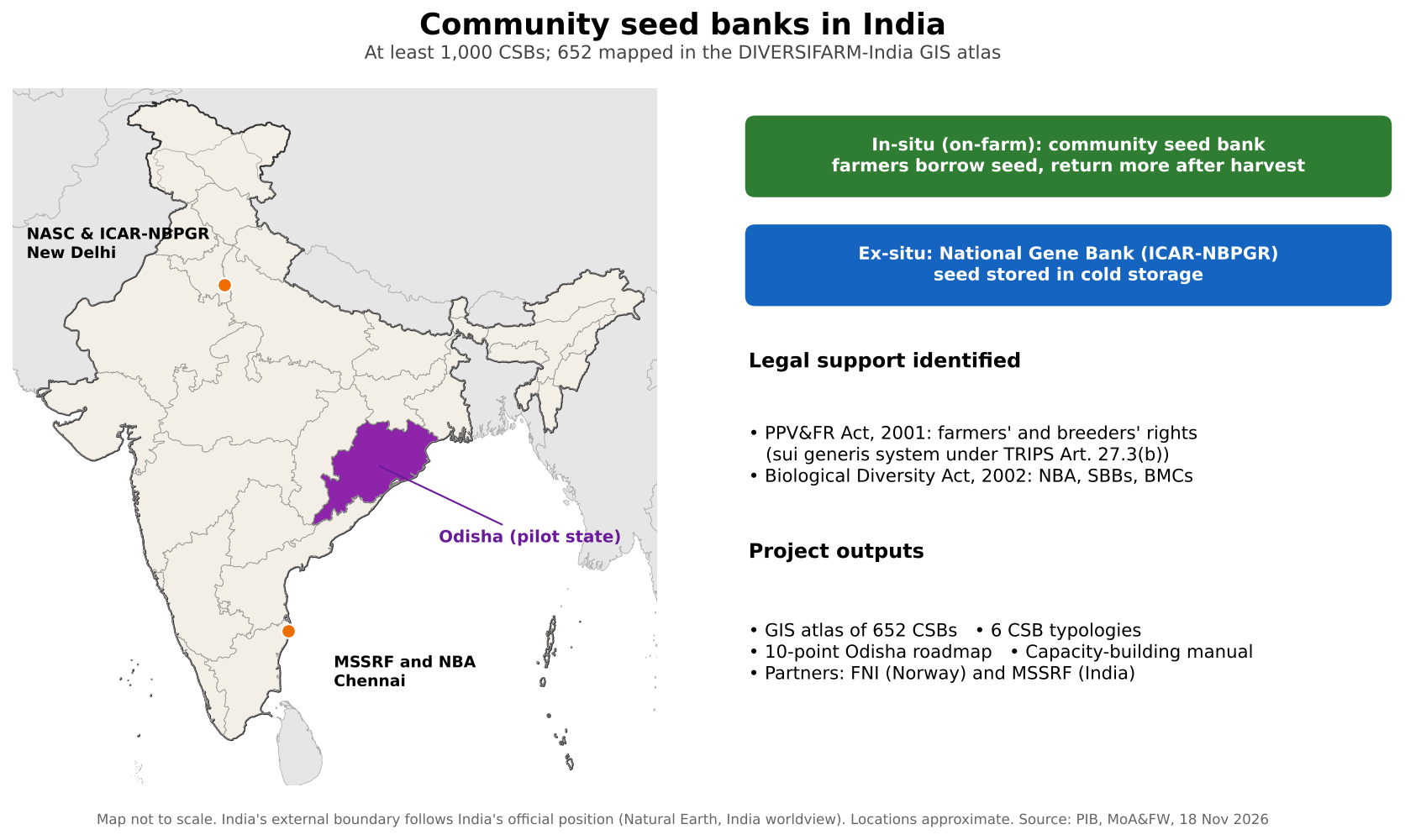
A survey by DIVERSIFARM-India found that India has at least 1,000 community seed banks (CSBs). The project's digital atlas has mapped 652 of them. Its findings were shared at a National Seminar for the Advancement of CSBs at the National Agricultural Science Complex (NASC), New Delhi, on 17–18 November 2026.
News Summary
DIVERSIFARM-India is led by Norway's Fridtjof Nansen Institute (FNI) and the M S Swaminathan Research Foundation (MSSRF). It aims to improve food, nutrition and livelihoods for small farmers by strengthening seed systems.
The project is part of the India–Norway partnership.
The seminar released four outputs:
A GIS-based atlas with profiles of CSBs
A policy brief on six CSB typologies, based on how the banks are managed
A 10-point roadmap for CSBs in Odisha, which recommends a secretariat under the state's Department of Agriculture and Farmers' Empowerment
A capacity-building manual, based on case studies in Odisha, the pilot state
The manual was released by Dr Trilochan Mohapatra, Chairperson of the Protection of Plant Varieties and Farmers' Rights Authority (PPVFRA).
MSSRF described CSBs as living institutions for in-situ conservation that build farmers' resilience.
The project found two laws useful for strengthening CSBs:
The PPV&FR Act, 2001
The Biological Diversity Act, 2002
Speakers called for synergy between these two laws.
The Director of ICAR-NBPGR said community gene banks and national gene banks can be strengthened together.
Prelims Facts & Static Linkages
What a community seed bank does
A CSB is a local, farmer-run store of seeds, mostly of traditional varieties and landraces.
Farmers borrow seed and return a larger quantity after harvest.
It keeps crop diversity in farmers' fields (on-farm, in-situ conservation), unlike a gene bank, which stores seed in cold storage (ex-situ).
It helps after floods or droughts, when farmers lose their seed.
PPV&FR Act, 2001
India enacted it as a sui generis system to meet Article 27.3(b) of the TRIPS Agreement.
It protects the rights of both breeders and farmers.
The PPVFR Authority was set up in 2005, under the Ministry of Agriculture.
Farmers may save, use, sow, re-sow, exchange, share or sell their farm produce, including seed. They may not sell it as branded seed of a protected variety.
The Plant Genome Saviour Community Award honours communities that conserve genetic resources.
Plant varieties cannot be patented in India. Section 3(j) of the Patents Act excludes them.
Biological Diversity Act, 2002
Gives effect to the Convention on Biological Diversity (CBD).
Sets up a three-tier structure:
The National Biodiversity Authority (NBA), in Chennai
State Biodiversity Boards
Biodiversity Management Committees at the local level, which maintain People's Biodiversity Registers
It was amended in 2023.
Related institutions
Institution
Fact
ICAR-NBPGR
National Bureau of Plant Genetic Resources, New Delhi; runs the National Gene Bank
MSSRF
Chennai-based research foundation started by M S Swaminathan
ITPGRFA
The FAO "Seed Treaty" (2001); India is a party
Svalbard Global Seed Vault
A back-up seed vault in Norway, in the Arctic
Quick Revision
India has at least 1,000 community seed banks, and 652 are mapped.
DIVERSIFARM-India is an India–Norway project led by FNI and MSSRF.
Odisha is the pilot state.
The PPV&FR Act was passed in 2001, and its Authority was set up in 2005.
The NBA is in Chennai, and NBPGR is in New Delhi.
CSBs conserve seeds in-situ, on farms.
Practice MCQ
Q. With reference to the Protection of Plant Varieties and Farmers' Rights Act, 2001, consider the following statements:
1. It was enacted to meet India's obligations under the TRIPS Agreement.
2. Farmers are allowed to sell branded seed of a protected variety.
3. It recognises the rights of both plant breeders and farmers.
Which of the statements given above are correct?
(a) 1 and 2 only
(b) 1 and 3 only
(c) 2 and 3 only
(d) 1, 2 and 3
Answer: (b).
Related PYQs
PYQ 1 (UPSC CSE Prelims 2019)
Consider the following statements:
1. According to the Indian Patents Act, a biological process to create a seed can be patented in India.
2. In India, there is no Intellectual Property Appellate Board.
3. Plant varieties are not eligible to be patented in India.
Which of the statements given above is/are correct?



 24
Nov 2026
 24
Nov 2026
 24
Nov 2026














0 comments
Discussion
No comments yet. Be the first.