PIB Backgrounder released on 18 November 2026 set out India's path to 100 GW of wind capacity by 2030
DDecode Civils
· 3 min read
India's Wind Energy Transition
Why in News
A PIB Backgrounder released on 18 November 2026 set out India's path to 100 GW of wind capacity by 2030 and 156 GW by 2036. It also covered offshore wind, domestic manufacturing and India's international partnerships.
News Summary
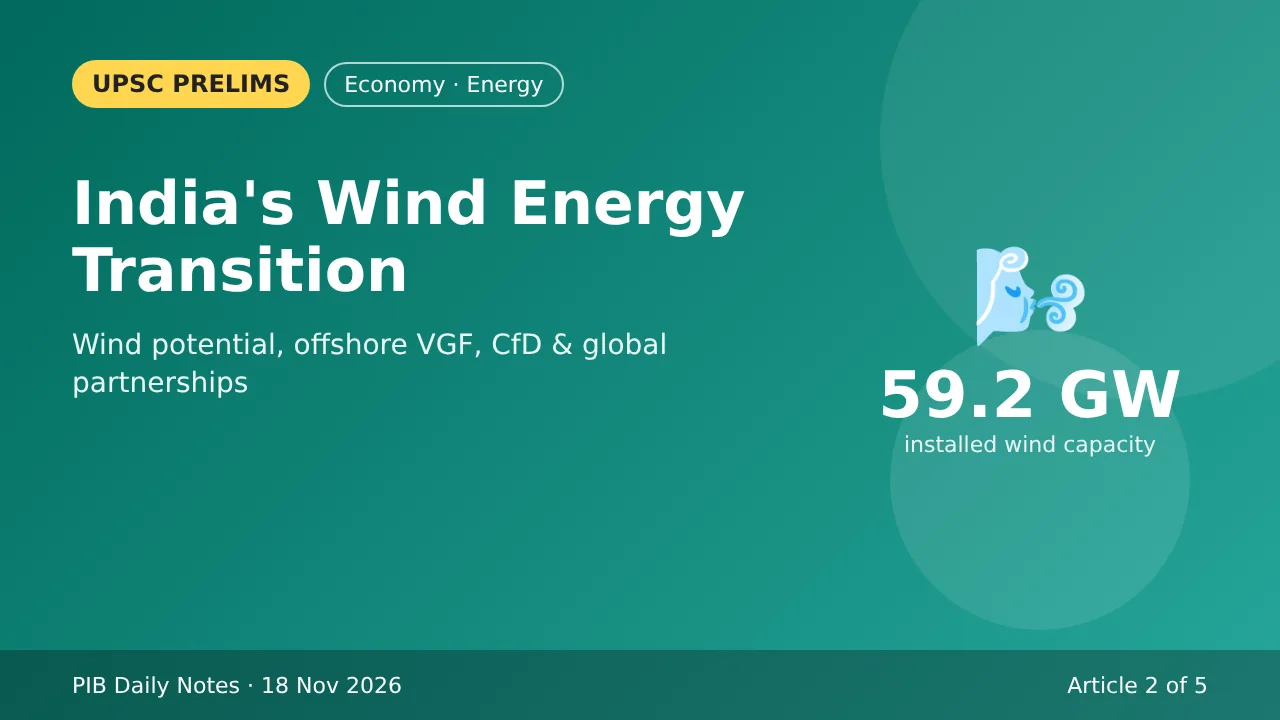
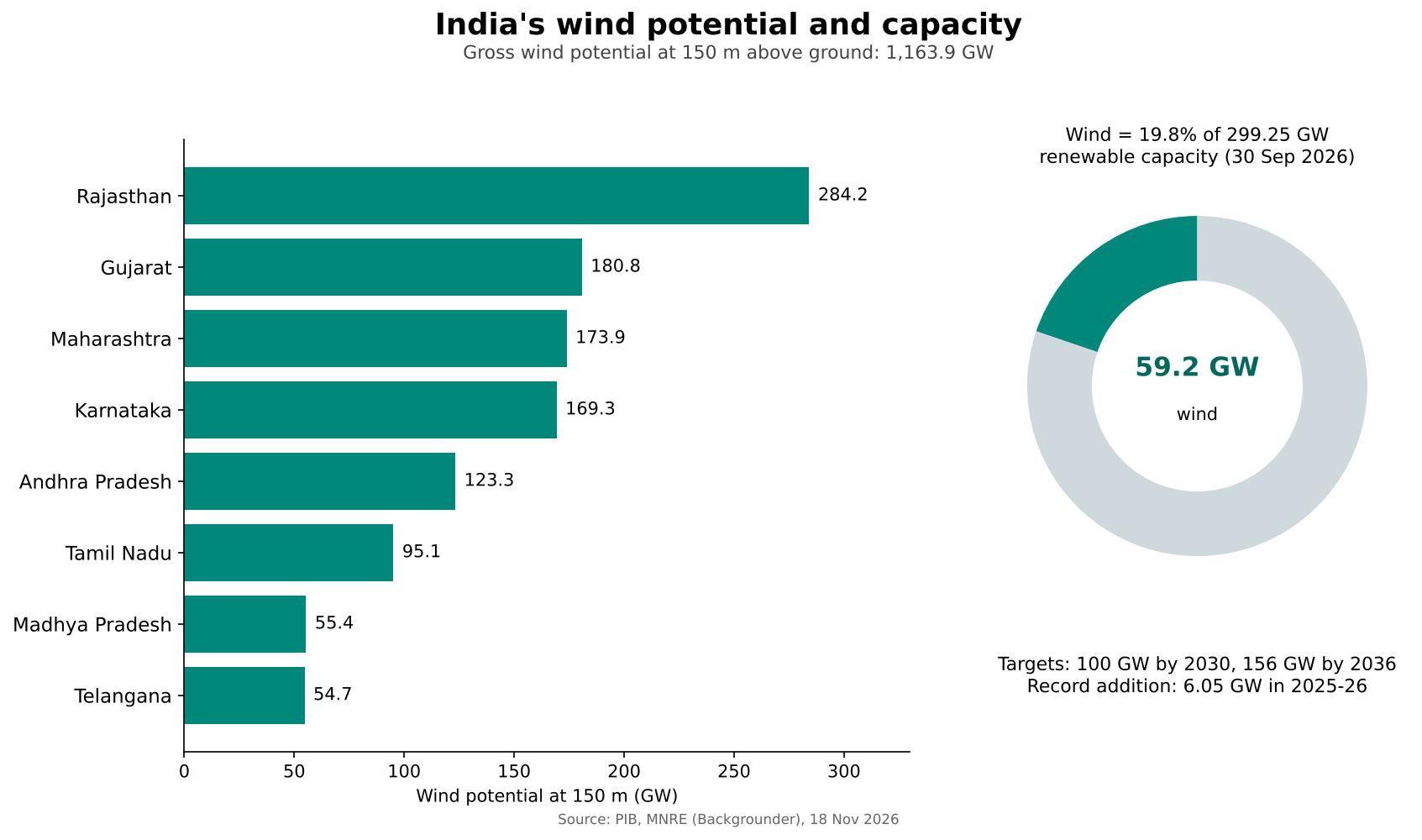
On 30 September 2026, India's renewable energy capacity was 299.25 GW. Wind made up 59.20 GW, about 19.8% of it.
Installed wind capacity grew from 21 GW in March 2014 to 59.20 GW, nearly a 2.8-fold rise.
India ranks 4th in the world in installed wind power capacity.
India added a record 6.05 GW of wind capacity in 2025–26, beating the previous record of 5.4 GW in 2016–17.
Wind generated 106.7 billion units in FY 2025–26.
About 45% of wind generation happens during peak demand hours, which complements solar power.
Turbine manufacturing capacity rose from 10 GW (2014) to about 24 GW (March 2026), with 70–80% indigenisation of key components.
Another 28 GW of wind capacity is under implementation.
Prelims Facts & Static Linkages
Wind resource potential
India's gross wind potential is 695.5 GW at 120 m and 1,163.9 GW at 150 m above ground level.
Most of the potential at 150 m lies in eight states. Rajasthan leads, followed by Gujarat, Maharashtra and Karnataka.
NIWE (the National Institute of Wind Energy, Chennai, under MNRE) has set up more than 900 wind-monitoring stations.
Wind potential maps exist for hub heights of 50, 80, 100, 120 and 150 m. Wind speed, and so potential, rises with height.
Government interventions
Measure
What it does
Viability Gap Funding (VGF)
₹6,853 crore for 1,000 MW offshore wind, 500 MW each off Gujarat and Tamil Nadu
Contracts for Difference (CfD)
A 500 MW pilot; pays developers the gap between a fixed strike price and the market price, reducing price risk
Generation Based Incentive (GBI)
Was available for projects commissioned before March 2017
Renewable Purchase Obligation (RPO)
Now has a dedicated wind component
Green Energy Open Access Rules
Let industries buy renewable power directly
ALMM
The Approved List of Models and Manufacturers, which ensures quality of equipment
Other key points
Round-the-Clock (RTC) and hybrid projects pair wind with solar and storage to give steady supply.
AI-based forecasting and grid modernisation are priorities.
Emerging wind states: Madhya Pradesh, Telangana and Odisha.
International partnerships
United Kingdom: India–UK Offshore Wind Taskforce, launched in February 2026.
Denmark: a cooperation agreement on offshore wind (2019), with the MoU renewed in May 2025.
Belgium: cooperation on offshore wind, R&D and green taxonomy, reaffirmed at WEF 2026.
Cooperation also extends to Germany and the EU.
Static linkages
The National Offshore Wind Energy Policy was notified in 2015. MNRE is the nodal ministry, and NIWE is the nodal agency for offshore wind.
India's west and south coasts get strong winds from the south-west monsoon (June to September). This is why Gujarat and Tamil Nadu lead.
Quick Revision
Wind capacity was 59.20 GW on 30 September 2026, about 19.8% of renewable capacity.
India ranks 4th in the world in installed wind capacity.
India's targets are 100 GW by 2030 and 156 GW by 2036.
NIWE is in Chennai.
Offshore wind VGF covers 1,000 MW off Gujarat and Tamil Nadu.
Rajasthan has the highest wind potential at 150 m.
Practice MCQ
Q. With reference to wind energy in India, consider the following statements:
1. India's gross wind potential is higher at 150 m hub height than at 120 m.
2. Viability Gap Funding for offshore wind covers projects off the coasts of Gujarat and Tamil Nadu.
3. Tamil Nadu has the highest assessed wind potential at 150 m.
Which of the statements given above are correct?
(a) 1 and 2 only
(b) 2 and 3 only
(c) 1 and 3 only
(d) 1, 2 and 3
Answer: (a). Rajasthan has the highest assessed potential at 150 m.
Related PYQs
PYQ 1 (UPSC CSE Prelims 2024)
Consider the following:
1. Battery storage
2. Biomass generators
3. Fuel cells
4. Rooftop solar photovoltaic units
How many of the above are considered "Distributed Energy Resources"?



 24
Nov 2026
 24
Nov 2026
 24
Nov 2026














0 comments
Discussion
No comments yet. Be the first.