Navy Marks 50 Years of Long-Range Maritime Reconnaissance
Indian Navy marked the Golden Jubilee of its Long-Range Maritime Reconnaissance (LRMR) operations on 18 November
DDecode Civils
· 3 min read
Navy Marks 50 Years of Long-Range Maritime Reconnaissance
Why in News
The Indian Navy marked the Golden Jubilee of its Long-Range Maritime Reconnaissance (LRMR) operations on 18 November 2026. The date is the 50th anniversary of the commissioning of Indian Naval Air Squadron (INAS) 312, the "Albatross".
News Summary
After the 1971 war, the Navy needed shore-based patrol aircraft that could work with ships and helicopters, so it took charge of LRMR.
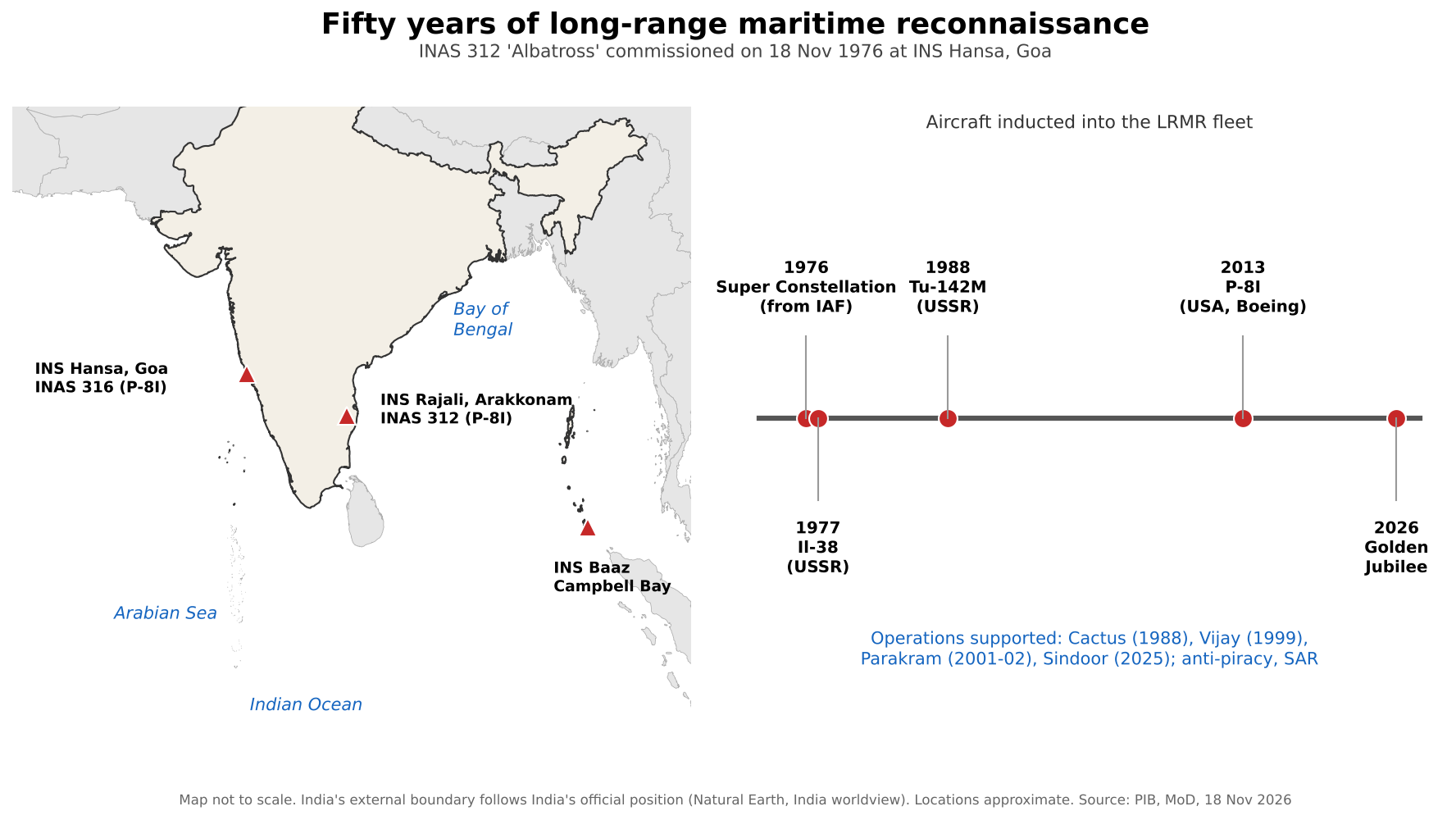
INAS 312 was commissioned on 18 November 1976 at INS Hansa, Goa. It began with five Lockheed Super Constellation aircraft transferred from the Indian Air Force.
Later aircraft:
Ilyushin Il-38 (1977), for maritime reconnaissance and anti-submarine warfare (ASW)
Tupolev Tu-142M (1988), which extended patrols across the Indian Ocean Region
Boeing P-8I (2013), based at INS Rajali, Arakkonam (Tamil Nadu)
The P-8I brought wide-area ISR (intelligence, surveillance and reconnaissance), ASW and maritime strike capabilities.
LRMR aircraft supported Operations Cactus, Vijay, Parakram and Sindoor, as well as anti-piracy and search and rescue missions.
Today the P-8Is fly with INAS 312 at INS Rajali and INAS 316 at INS Hansa.
Prelims Facts & Static Linkages
Aircraft of the LRMR fleet
Aircraft
Origin
Inducted
Super Constellation
USA (Lockheed)
1976, from the IAF
Il-38
USSR (Ilyushin)
1977
Tu-142M
USSR (Tupolev)
1988
P-8I Neptune
USA (Boeing)
2013
Operations named in the release
Operation Cactus (1988): India stopped a coup attempt in the Maldives.
Operation Vijay (1999): the Kargil conflict.
Operation Parakram (2001–02): troop mobilisation after the attack on Parliament.
Operation Sindoor (2025): strikes on terror infrastructure after the Pahalgam attack.
Naval air stations
INS Hansa (Dabolim, Goa): one of the Navy's largest air stations, on the west coast.
INS Rajali (Arakkonam, Tamil Nadu): home of the P-8I fleet, on the east coast.
INS Baaz (Campbell Bay, Great Nicobar): India's southernmost naval air station.
Maritime surveillance links
The Information Fusion Centre – Indian Ocean Region (IFC-IOR), at Gurugram, was set up in 2018 to share maritime information with partner countries.
The P-8I is a military version of the Boeing 737 airliner.
The Navy also leases and is buying MQ-9B drones for long-endurance surveillance.
Maritime patrol aircraft use radar, sonobuoys and magnetic anomaly detectors to find ships and submarines.
Key terms
Term
Meaning
LRMR
Long-Range Maritime Reconnaissance: patrolling far out at sea to find and track ships and submarines
ASW
Anti-submarine warfare: detecting, tracking and attacking enemy submarines
Sonobuoy
A small sonar buoy dropped from an aircraft; it listens for submarines and radios the data back
MAD
Magnetic Anomaly Detector: senses the disturbance a submarine's steel hull causes in Earth's magnetic field
ISR
Intelligence, Surveillance and Reconnaissance
Naval aviation milestones
The Navy's first air station, INS Garuda at Kochi, was commissioned in 1953.
INS Vikrant, India's first indigenous aircraft carrier, was commissioned in 2022.
INAS 312 is called the "Albatross", after the long-ranging seabird.
Why LRMR matters
India has a coastline of about 7,500 km and an Exclusive Economic Zone of about 2 million sq km.
About 95% of India's trade by volume moves by sea.
Long-range aircraft can search huge ocean areas far faster than ships.
Quick Revision
INAS 312 "Albatross" was commissioned on 18 November 1976 at INS Hansa, Goa.
The first aircraft were Super Constellations from the IAF.
The P-8I was inducted in 2013 at INS Rajali, Arakkonam.
Operation Cactus took place in the Maldives in 1988.
IFC-IOR is at Gurugram.
Practice MCQ
Q. Consider the following pairs:
1. INS Rajali : Arakkonam
2. INS Hansa : Goa
3. Operation Cactus : Sri Lanka
How many of the pairs given above are correctly matched?
(a) Only one
(b) Only two
(c) All three
(d) None
Answer: (b). Operation Cactus was in the Maldives.
Related PYQs
PYQ 1 (UPSC CSE Prelims 2024)
Consider the following aircraft:
1. Rafael
2. MiG-29
3. Tejas MK-1
How many of the above are considered fifth generation fighter aircraft?
(a) Only one
(b) Only two
(c) All three
(d) None
Answer: (d).
PYQ 2 (UPSC CSE Prelims 2024)
Consider the following activities:
1. Identification of narcotics on passengers at airports or in aircraft
2. Monitoring of precipitation
3. Tracking the migration of animals
In how many of the above activities can the radars be used?



 24
Nov 2026
 24
Nov 2026
 24
Nov 2026














0 comments
Discussion
No comments yet. Be the first.