Ministry of Rural Development issued Guidelines for Ombudsperson and Appellate Authority under...
DDecode Civils
· 4 min read
Ombudsperson Guidelines under VB-G RAM G
Why in News
The Ministry of Rural Development issued Guidelines for Ombudsperson and Appellate Authority under the Viksit Bharat – Guarantee for Rozgar and Ajeevika Mission (Gramin) (VB-G RAM G) Act, 2025. They aim to strengthen grievance redressal, transparency and accountability.
News Summary
A dedicated Ombudsperson at the district level will hear grievances on:
Job cards and employment
Wage payments and delay compensation
Worksite facilities and muster rolls
Denial of statutory entitlements
The guidelines also cover discrimination, harassment and violations of workers' rights, including those of women and vulnerable groups.
The pool of eligible candidates has been widened to include people with experience in:
Rural development
Public administration
Law
Academics
Social work
Management
Tenure and remuneration rules have been revised to support continuity.
A dedicated digital platform will allow:
Online registration and tracking of complaints
Recording of proceedings
Uploading of awards
Monitoring of action taken
Geo-tagged and time-stamped photographs of field visits will improve traceability.
Ombudspersons must attend at least three Social Audit public hearings or Gram Sabhas every month.
The framework works alongside digital monitoring, public disclosure and social audit.
An Appellate Authority hears appeals against the Ombudsperson's decisions.
Prelims Facts & Static Linkages
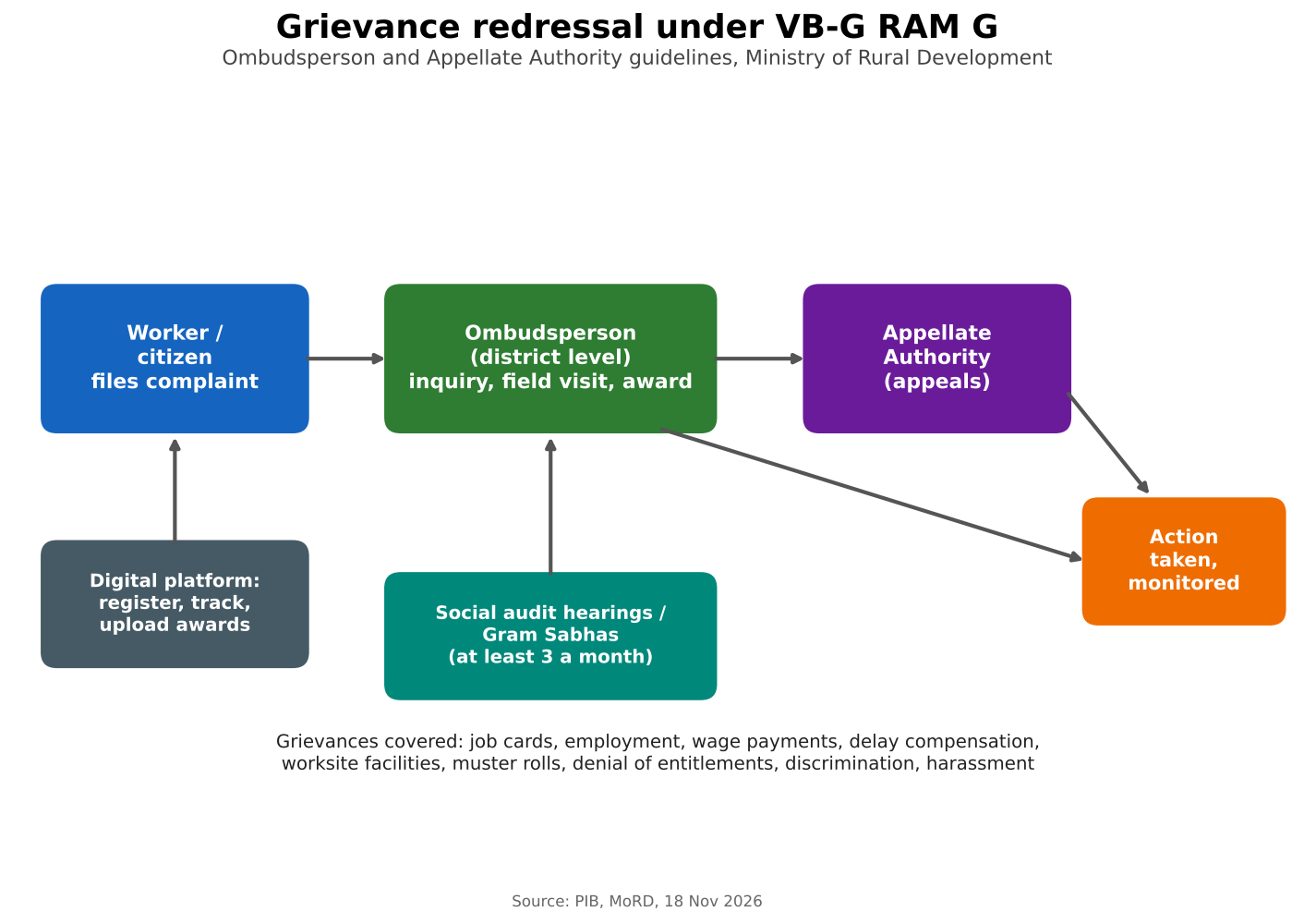
The grievance redressal chain
Worker or citizen: files a complaint in person or on the digital platform.
Ombudsperson (district): registers and inquires into the complaint, visits the field and passes an award.
Appellate Authority: hears appeals against the award.
Action taken: monitored online. Social audit findings feed back into corrective action.
About the VB-G RAM G Act, 2025
It replaced the Mahatma Gandhi National Rural Employment Guarantee Act (MGNREGA), 2005.
It provides a statutory guarantee of 125 days of wage employment a year to rural households whose adult members volunteer for unskilled manual work.
It keeps the core accountability tools of the earlier law: job cards, social audit and grievance redressal.
Key terms
Term
Meaning
Ombudsperson
An independent officer who hears complaints against an administration; the idea comes from Sweden (1809)
Social audit
Review of a scheme's records and works by the community itself, usually in a Gram Sabha
Muster roll
Attendance and wage record for workers at a worksite
Delay compensation
Payment due to workers when wages are paid late
Gram Sabha
All registered voters of a village panchayat area (Article 243(b))
Static linkages
Lokpal and Lokayuktas Act, 2013: the Lokpal is India's anti-corruption ombudsman at the Union level.
The first Administrative Reforms Commission (1966) recommended the Lokpal and Lokayukta.
Meghalaya was the first state to make social audit a law, through the Meghalaya Community Participation and Public Services Social Audit Act, 2017.
Article 243G lets states give panchayats powers to plan and implement schemes for economic development and social justice.
Quick Revision
The Ombudsperson works at the district level.
Ombudspersons attend at least three social audit hearings or Gram Sabhas a month.
The VB-G RAM G Act, 2025 replaced MGNREGA, 2005.
The Act guarantees 125 days of wage employment a year.
The ombudsman idea comes from Sweden.
Meghalaya passed the first state social audit law, in 2017.
Practice MCQ
Q. With reference to the Ombudsperson guidelines under the VB-G RAM G Act, 2025, consider the following statements:
1. The Ombudsperson is appointed at the district level.
2. The Ombudsperson must attend at least three Social Audit public hearings or Gram Sabhas every month.
3. There is no provision for appeal against the Ombudsperson's award.
Which of the statements given above are correct?
(a) 1 and 2 only
(b) 2 and 3 only
(c) 1 and 3 only
(d) 1, 2 and 3
Answer: (a). An Appellate Authority hears appeals.
Related PYQs
PYQ 1 (UPSC CSE Prelims 2025)
Consider the following statements about Lokpal:
I. The power of Lokpal applies to public servants of India, but not to the Indian public servants posted outside India.
II. The Chairperson or a Member shall not be a Member of the Parliament or a Member of the Legislature of any State or Union Territory, and only the Chief Justice of India, whether incumbent or retired, has to be its Chairperson.
III. The Chairperson or a Member shall not be a person of less than forty-five years of age on the date of assuming office as the Chairperson or Member, as the case may be.
IV. Lokpal cannot inquire into the allegations of corruption against a sitting Prime Minister of India.
Which of the statements given above is/are correct?



 24
Nov 2026
 24
Nov 2026
 24
Nov 2026














0 comments
Discussion
No comments yet. Be the first.