DRI Seizes 12.87 Tonnes of Red Sanders at Chennai Port
Red Sanders (Pterocarpus santalinus) is listed in CITES Appendix II and Schedule IV of the Wildlife
DDecode Civils
· 3 min read
DRI Seizes 12.87 Tonnes of Red Sanders at Chennai Port
Why in News
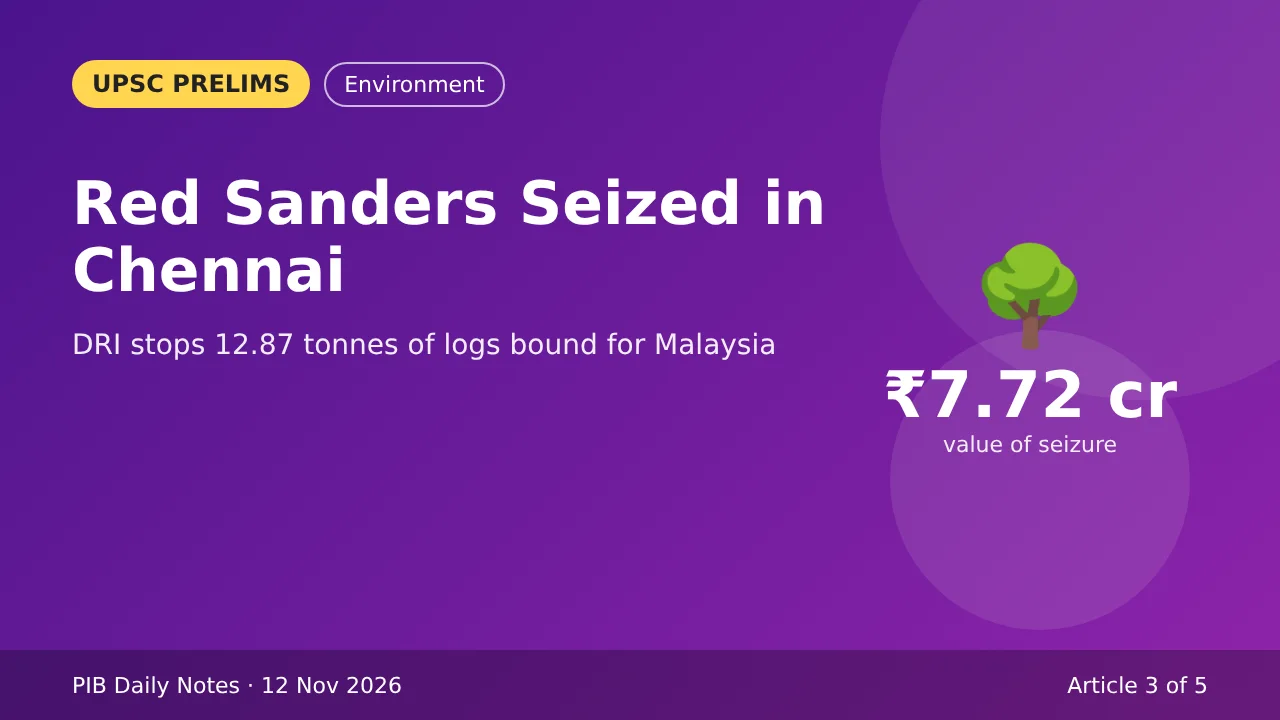
The Directorate of Revenue Intelligence (DRI) stopped an export container at Chennai Port during 9–11 November 2026 and seized 12.87 metric tonnes of Red Sanders logs worth about ₹7.72 crore. The logs were bound for Malaysia. Three members of a Chennai-based syndicate were arrested.
News Summary
The container was declared as "Paper Laminate Rolls". The logs were hidden with a small amount of the declared cargo and gravel stones.
The syndicate misused the self-sealing facility given to a manufacturer-exporter. It diverted the container to a private godown and swapped the cargo before export.
A search of the godown found the original cargo, an industrial weighing scale and traces of Red Sanders.
The logs and cover cargo were seized, and the arrests made, under the Customs Act, 1962.
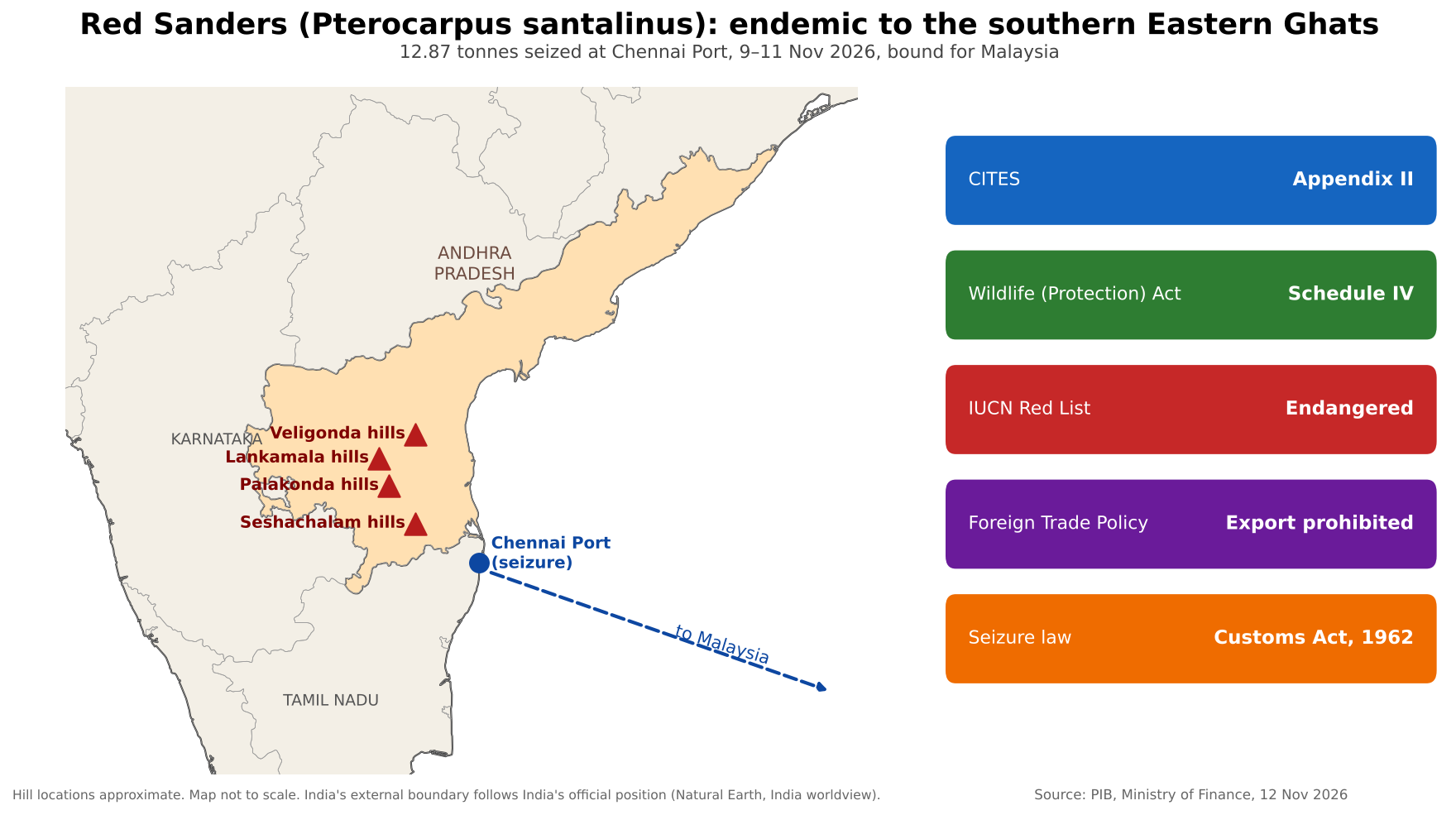
Red Sanders (Pterocarpus santalinus) is listed in CITES Appendix II and Schedule IV of the Wildlife (Protection) Act, 1972. Its export is prohibited under the Foreign Trade Policy.
Prelims Facts & Static Linkages
About Red Sanders
Scientific name:Pterocarpus santalinus, a tree of the legume (pea) family. It is different from white sandalwood (Santalum album).
Endemic to the southern Eastern Ghats, mainly in Andhra Pradesh: the Seshachalam, Palakonda, Lankamala and Veligonda hills, with small areas in adjoining Tamil Nadu and Karnataka.
Habitat: dry deciduous forests on rocky, well-drained hill slopes, in a hot, dry climate.
Uses: the dark red heartwood is prized for furniture, carving and musical instruments. It also gives a red dye, santalin, and is used in traditional medicine.
Status: listed as Endangered on the IUCN Red List. Slow growth and heavy smuggling are the main threats.
Demand: most smuggled wood goes to East and Southeast Asian markets, often through ports in Chennai and Mumbai.
Legal protection
Law or treaty
What it does for Red Sanders
CITES Appendix II
International trade only with permits that show it is legal and not harmful
Wildlife (Protection) Act, 1972, Schedule IV
Since the 2022 amendment, Schedule IV lists species in CITES appendices
Foreign Trade Policy
Export of the wood is prohibited
Customs Act, 1962
Seizure, arrest and penalties for smuggling
About CITES
Signed in 1973 at Washington, D.C.; came into force in 1975. India joined in 1976.
It is legally binding on parties but does not replace national laws.
Appendix I: species threatened with extinction (trade only in exceptional cases).
Appendix II: species not necessarily threatened, but trade must be controlled.
Appendix III: species protected by one country that asks others for help.
The secretariat is administered by UNEP and sits in Geneva.
Enforcement agencies
DRI: the main anti-smuggling intelligence agency, under the Central Board of Indirect Taxes and Customs (CBIC), Department of Revenue, Ministry of Finance.
Wildlife Crime Control Bureau (WCCB): a statutory body under the Wildlife (Protection) Act, under MoEFCC.
TRAFFIC: a non-governmental network that monitors wildlife trade.
Quick Revision
DRI seized 12.87 tonnes of Red Sanders worth ₹7.72 crore at Chennai Port, bound for Malaysia.
The syndicate misused the exporter's self-sealing facility.
Red Sanders is endemic to the southern Eastern Ghats of Andhra Pradesh.
It is in CITES Appendix II and Schedule IV of the Wildlife (Protection) Act.
Its export is banned under the Foreign Trade Policy.
DRI works under CBIC, Ministry of Finance.
Practice MCQ
Q. With reference to Red Sanders (Pterocarpus santalinus), consider the following statements:
1. It is endemic to the southern Eastern Ghats.
2. It is listed in Appendix I of CITES.
3. Its export from India is prohibited under the Foreign Trade Policy.
Which of the statements given above is/are correct?
(a) 1 and 2 only
(b) 1 and 3 only
(c) 2 and 3 only
(d) 1, 2 and 3
Answer: (b). Red Sanders is in Appendix II, not Appendix I.
Related PYQs
PYQ 1 (UPSC CSE Prelims 2024)
Consider the following:
1. Cashew
2. Papaya
3. Red Sanders
How many of the above trees are actually native to India?



 28
Nov 2026
 28
Nov 2026
 28
Nov 2026














0 comments
Discussion
No comments yet. Be the first.