Government approved Nutrient-Based Subsidy (NBS) rates for Phosphatic and Potassic
DDecode Civils
· 3 min read
Nutrient-Based Subsidy Rates for Rabi 2026-27
Why in News
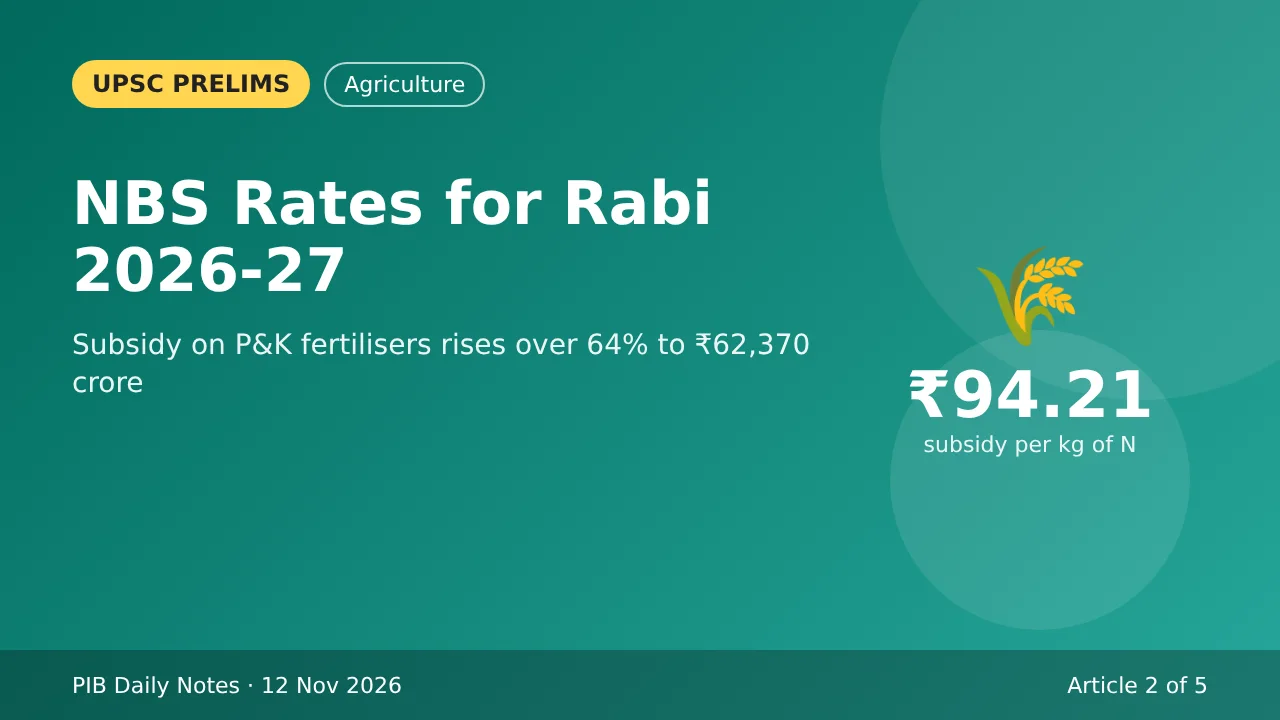
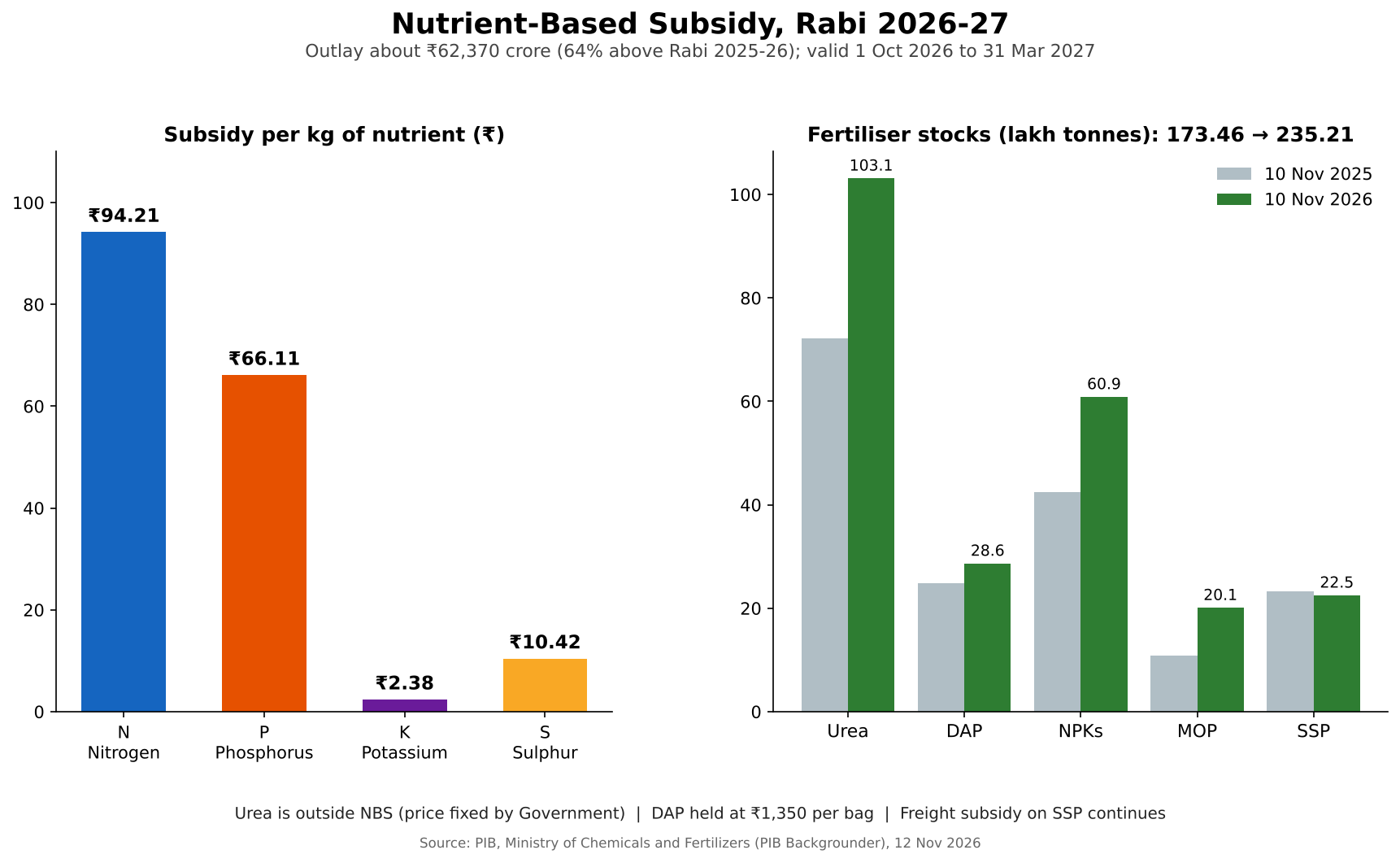
The Government approved Nutrient-Based Subsidy (NBS) rates for Phosphatic and Potassic (P&K) fertilisers for Rabi 2026-27 on 11 November 2026. The rates apply from 1 October 2026 to 31 March 2027, with a tentative outlay of about ₹62,370 crore, over 64% higher than the ₹37,952 crore for Rabi 2025-26.
News Summary
Rates per kg of nutrient: Nitrogen (N) ₹94.21, Phosphorus (P) ₹66.11, Potassium (K) ₹2.38 and Sulphur (S) ₹10.42.
The rates were revised because of recent trends in international prices of fertilisers and inputs.
DAP: special provisions continue so that Di-Ammonium Phosphate stays at ₹1,350 per bag. These are extended to Triple Superphosphate (TSP) and imported Monoammonium Phosphate (MAP).
SSP: a freight subsidy on Single Superphosphate continues, to promote it as a cheaper alternative to DAP.
Ammonium sulphate: the subsidy on imported and domestic ammonium sulphate continues, as an alternative to urea.
Sulphur package: domestic makers of sulphur and sulphuric acid get 20% of the procurement cost, with floor prices of USD 800 and USD 266.67 per tonne.
Over ₹2.79 lakh crore was disbursed for P&K fertilisers between 2022-23 and 2025-26.
Stocks of major fertilisers rose about 35.6%, from 173.46 lakh tonnes (10 November 2025) to 235.21 lakh tonnes (10 November 2026).
Prelims Facts & Static Linkages
How the NBS scheme works
Launched on 1 April 2010 by the Department of Fertilizers, Ministry of Chemicals and Fertilizers.
Subsidy is linked to nutrient content (N, P, K and S), not to the product. Rates are fixed twice a year, for Kharif and Rabi.
It covers 28 grades of P&K fertilisers, including DAP, MOP, NPK complexes and SSP.
Decontrolled pricing: companies fix the MRP at reasonable levels under government oversight. The subsidy is paid to companies, and farmers get it through a lower price.
Urea is outside NBS. Its MRP is fixed by the Government, and the subsidy covers the gap between cost and that price.
Fertilisers to know
Fertiliser
Main nutrients
Fact
Urea
N (46%)
Price fixed by Government; made from natural gas-based ammonia
DAP
N 18%, P 46%
Second most used fertiliser; largely imported
MOP
K (60% K₂O)
India imports all its potash
SSP
P (16%) and S
Made domestically; cheaper DAP substitute
Ammonium sulphate
N and S
Alternative to urea
Why balanced fertilisation matters
The commonly cited ideal N:P:K ratio is 4:2:1. Cheap urea tilts use towards nitrogen.
Overuse of urea hurts soil health, lowers nutrient-use efficiency and adds nitrous oxide emissions.
Soil Health Cards advise farmers on crop-wise nutrient doses.
Sulphur deficiency is common in Indian soils, especially for oilseeds and pulses.
Related schemes
PM-PRANAM: rewards States that cut chemical fertiliser use.
One Nation One Fertiliser: a single brand, "Bharat", for subsidised fertilisers.
Nano urea and nano DAP: liquid fertilisers developed by IFFCO.
Quick Revision
NBS began on 1 April 2010 and covers 28 grades of P&K fertilisers.
Rabi 2026-27 outlay: about ₹62,370 crore, valid 1 October 2026 to 31 March 2027.
Rates: N ₹94.21, P ₹66.11, K ₹2.38 and S ₹10.42 per kg.
DAP stays at ₹1,350 per bag through special provisions.
Urea is not under NBS; its price is fixed by the Government.
Fertiliser stocks rose 35.6% year on year to 235.21 lakh tonnes.
Practice MCQ
Q. With reference to the Nutrient-Based Subsidy (NBS) scheme, consider the following statements:
1. The subsidy is fixed per kilogram of nutrient rather than per bag of fertiliser.
2. Urea is covered under the NBS scheme.
3. Manufacturers of P&K fertilisers can fix the MRP at reasonable levels.
Which of the statements given above is/are correct?
(a) 1 only
(b) 1 and 3 only
(c) 2 and 3 only
(d) 1, 2 and 3
Answer: (b). Urea has a government-fixed price and is outside NBS.
Related PYQs
PYQ 1 (UPSC CSE Prelims 2020)
With reference to chemical fertilizers in India, consider the following statements:
1. At present, the retail price of chemical fertilizers is market-driven and not administered by the Government.
2. Ammonia, which is an input of urea, is produced from natural gas.
3. Sulphur, which is a raw material for phosphoric acid fertilizer, is a by-product of oil refineries.
Select the correct answer using the code given below:



 28
Nov 2026
 28
Nov 2026
 28
Nov 2026














0 comments
Discussion
No comments yet. Be the first.