PLI ACC Scheme: 22 Bids for 10 GWh of Grid-Scale Battery Cells
Grid-scale storage is needed to handle the growth of solar and wind power, which vary through the day
DDecode Civils
· 3 min read
PLI ACC Scheme: 22 Bids for 10 GWh of Grid-Scale Battery Cells
Why in News
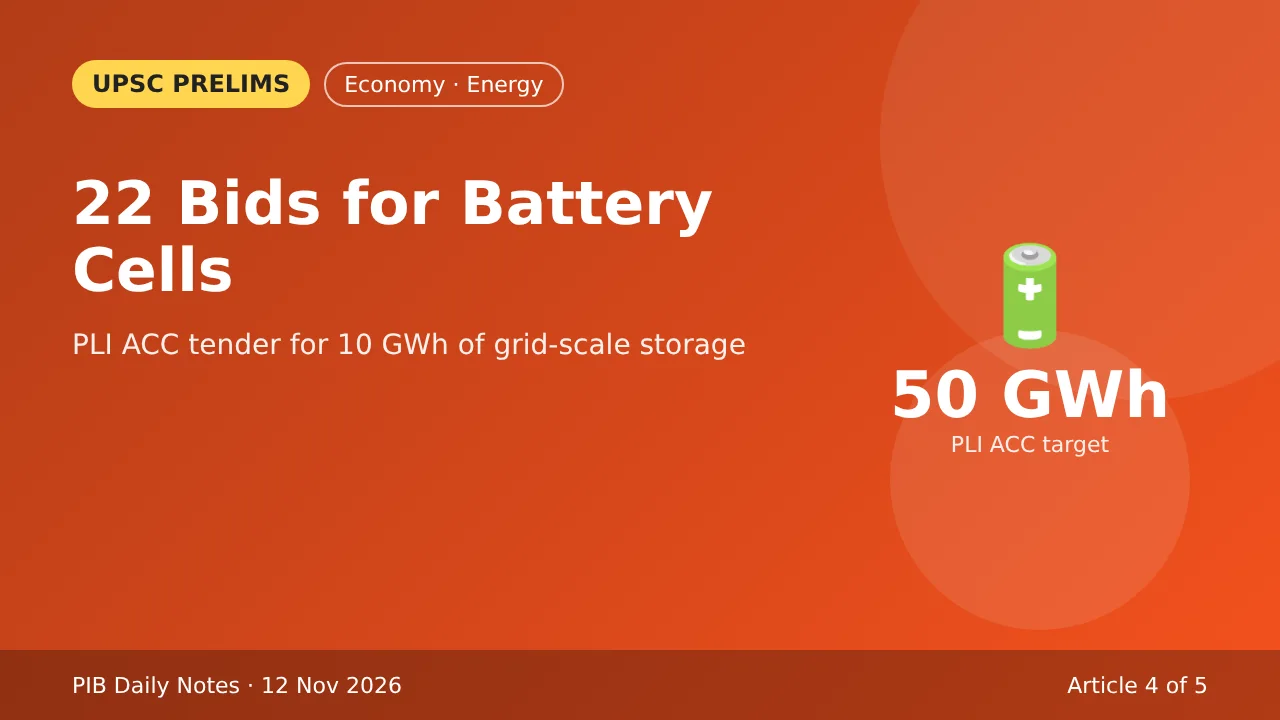
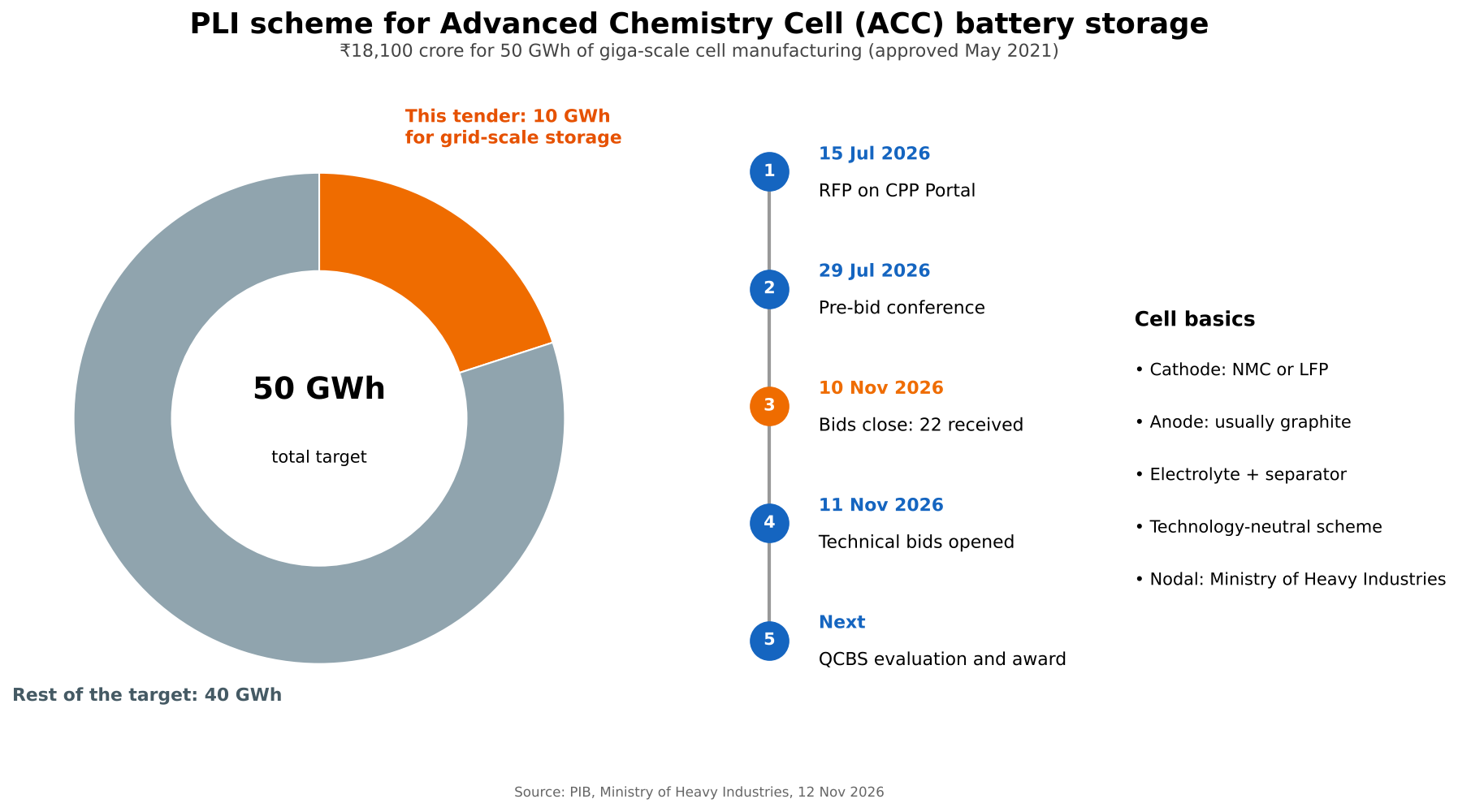
The Ministry of Heavy Industries (MHI) received 22 bids for 10 GWh of Advanced Chemistry Cell (ACC) manufacturing capacity under the PLI Scheme for the National Programme on ACC Battery Storage. The technical bids were opened on 11 November 2026. This capacity is earmarked for Grid-Scale Stationary Storage (GSSS).
News Summary
The global tender was floated on the Central Public Procurement (CPP) Portal on 15 July 2026. The pre-bid conference was on 29 July, and bids closed on 10 November 2026.
Selection uses a two-stage Quality and Cost Based Selection (QCBS) method.
Bidders include battery makers (Amara Raja, Exide Energy), renewable energy firms (ACME Solar, Avaada, ReNew, Waaree, Vikram Solar) and conglomerates (Reliance, JSW Neo Energy, Megha Engineering).
The 10 GWh is part of the overall target of 50 GWh of ACC capacity.
Grid-scale storage is needed to handle the growth of solar and wind power, which vary through the day and the seasons.
Prelims Facts & Static Linkages
About the PLI ACC scheme
Approved: by the Union Cabinet in May 2021.
Outlay:₹18,100 crore for 50 GWh of giga-scale ACC manufacturing capacity.
Nodal ministry: Ministry of Heavy Industries.
Technology-neutral: firms may choose any advanced chemistry, such as lithium-ion or sodium-ion.
Incentive: paid on cells actually made and sold, linked to domestic value addition that must rise over time.
Goal: cut import dependence for batteries used in electric vehicles, grid storage and electronics.
What is an Advanced Chemistry Cell?
An ACC is a new-generation cell that stores electricity as chemical energy and converts it back when needed.
A lithium-ion cell has four main parts: a cathode, an anode, an electrolyte and a separator.
Cathode materials: lithium with nickel, manganese and cobalt (NMC), or lithium iron phosphate (LFP).
Anode material: usually graphite.
LFP cells are cheaper and safer, so they are widely used for stationary storage.
Sodium-ion cells avoid lithium and cobalt and suit grid storage.
Energy storage options
Option
Type
Typical use
Battery Energy Storage System (BESS)
Electrochemical
Short-duration grid balancing
Pumped storage hydropower
Mechanical
Long-duration storage
Green hydrogen
Chemical
Seasonal storage, industry
Distributed resources (rooftop solar, small batteries)
Mixed
Local supply close to consumers
Why domestic cell manufacturing matters
Import dependence: most lithium-ion cells used in India are imported, largely from China.
Energy transition: storage lets solar power generated at noon be used in the evening peak.
Value chain: cell plants create demand for local cathode, anode and electrolyte makers.
Related schemes and missions
National Critical Mineral Mission (2025): secures lithium, cobalt and nickel.
KABIL: a joint venture that acquires critical mineral assets abroad.
Viability Gap Funding for BESS: supports grid battery projects.
PM E-DRIVE: supports electric vehicle adoption.
Quick Revision
MHI received 22 bids for 10 GWh of ACC capacity for grid-scale stationary storage.
The PLI ACC scheme (May 2021) has an outlay of ₹18,100 crore for 50 GWh.
Bidding uses Quality and Cost Based Selection on the CPP Portal.
The scheme is technology-neutral.
Graphite is the usual anode; NMC and LFP are common cathodes.
Grid storage helps integrate variable solar and wind power.
Practice MCQ
Q. With reference to the PLI Scheme for Advanced Chemistry Cell (ACC) Battery Storage, consider the following statements:
1. It targets 50 GWh of ACC manufacturing capacity.
2. It is implemented by the Ministry of New and Renewable Energy.
3. It allows only lithium-ion chemistry.
Which of the statements given above is/are correct?
(a) 1 only
(b) 1 and 2 only
(c) 2 and 3 only
(d) 1, 2 and 3
Answer: (a). The scheme is run by the Ministry of Heavy Industries and is technology-neutral.
Related PYQs
PYQ 1 (UPSC CSE Prelims 2025)
In the context of electric vehicle batteries, consider the following elements:
1. Cobalt
2. Graphite
3. Lithium
4. Nickel
How many of the above usually make up battery cathodes?
(a) Only one
(b) Only two
(c) Only three
(d) All the four
Answer: (c).
PYQ 2 (UPSC CSE Prelims 2024)
Consider the following:
1. Battery storage
2. Biomass generators
3. Fuel cells
4. Rooftop solar photovoltaic units
How many of the above are considered "Distributed Energy Resources"?



 28
Nov 2026
 28
Nov 2026
 28
Nov 2026














0 comments
Discussion
No comments yet. Be the first.