Medicinal Plant Conservation in 16 Tribal Hotspots
three-year project to conserve medicinal plants and build livelihoods in 16 tribal hotspots
DDecode Civils
· 3 min read
Medicinal Plant Conservation in 16 Tribal Hotspots
Why in News
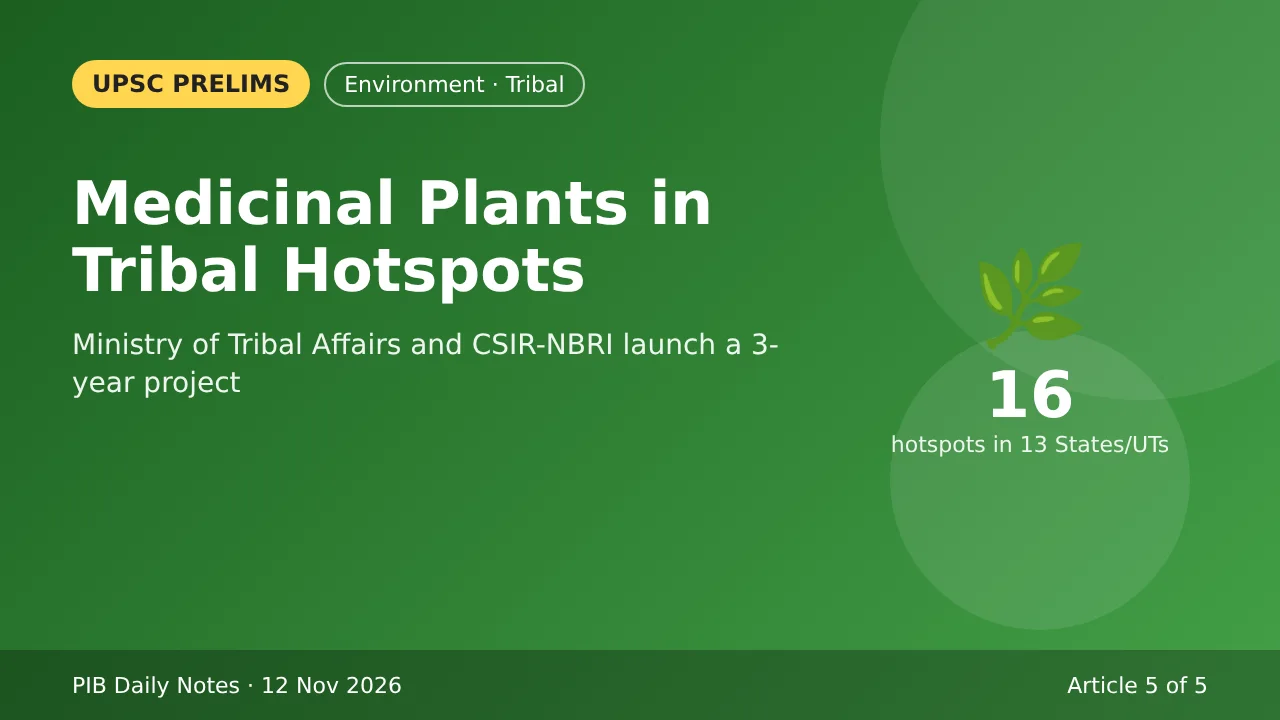
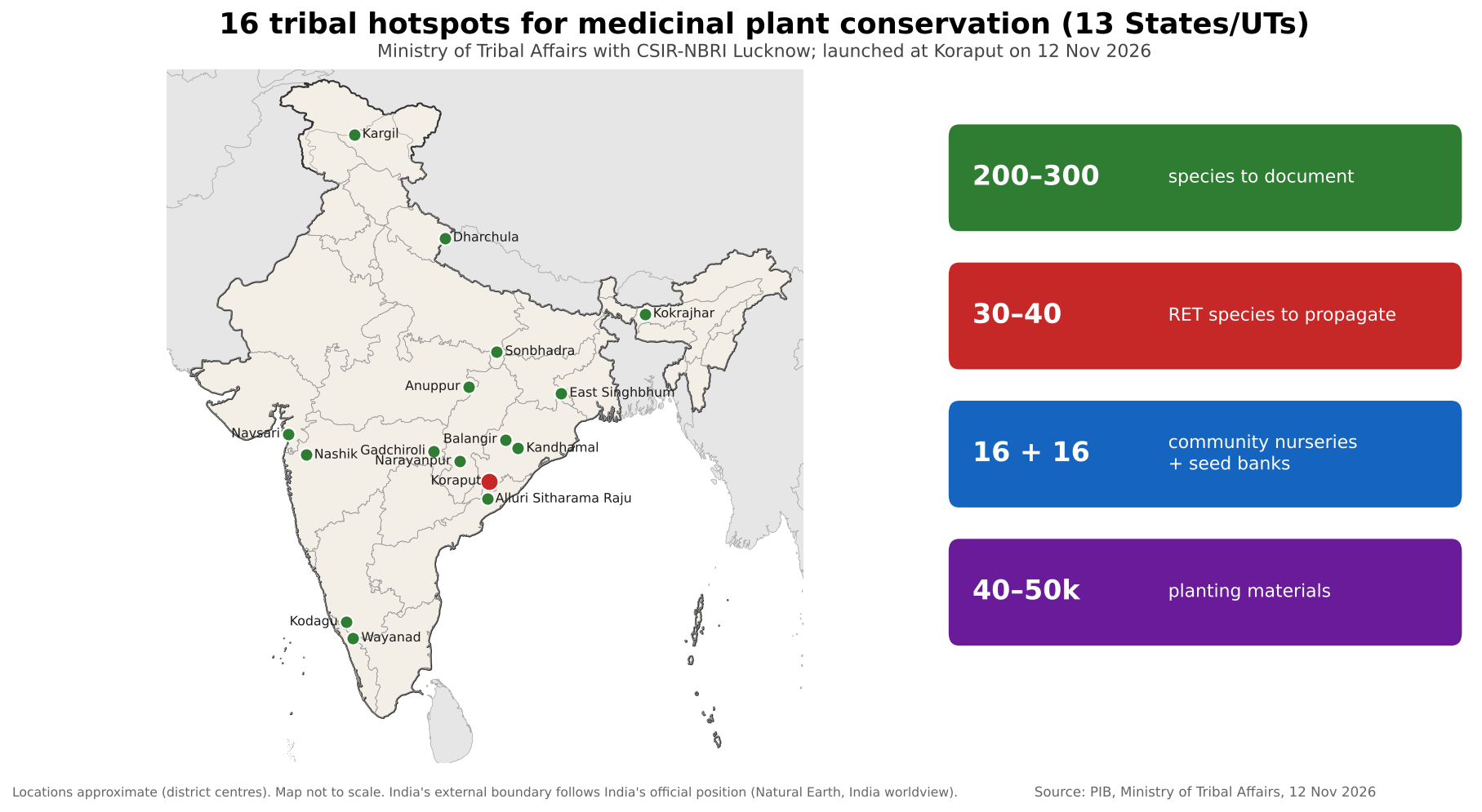
The Ministry of Tribal Affairs and CSIR–National Botanical Research Institute (CSIR-NBRI), Lucknow launched a three-year project to conserve medicinal plants and build livelihoods in 16 tribal hotspots across 13 States/UTs. It was launched at the Central University of Odisha, Koraput, on 12 November 2026.
News Summary
Full name: "Integrated Conservation, Agro-Technology and Bioresource Enterprise Development for Sustainable Tribal Livelihoods in Tribal Hotspots of India".
Targets: document about 200–300 medicinal plant species, propagate 30–40 rare, endangered and threatened (RET) species, and set up 16 community nurseries and 16 seed banks.
About 40,000–50,000 quality planting materials will be distributed.
First fieldwork: in Sonbhadra (Uttar Pradesh) in October 2026, with 146 tribal knowledge holders across 12 villages. About 200 plant samples and 25 live orchids were collected for the CSIR-NBRI Botanical Garden.
The project links scientific institutions with Krishi Vigyan Kendras (KVKs), Van Dhan Vikas Kendras (VDVKs), State Tribal Welfare and Forest Departments, and local communities.
Tribal farmers, traditional healers, women and youth will be involved in cultivation and value chains.
Prelims Facts & Static Linkages
The 16 hotspots
State/UT
District(s)
Andhra Pradesh
Alluri Sitharama Raju
Assam
Kokrajhar
Chhattisgarh
Narayanpur
Gujarat
Navsari
Jharkhand
East Singhbhum
Karnataka
Kodagu
Kerala
Wayanad
Ladakh
Kargil
Madhya Pradesh
Anuppur
Maharashtra
Gadchiroli, Nashik
Odisha
Kandhamal, Balangir, Koraput
Uttar Pradesh
Sonbhadra
Uttarakhand
Dharchula (Pithoragarh)
What the project will do
Conserve: document species and the traditional knowledge about their use.
Propagate: raise RET species in nurseries and keep seeds in community seed banks.
Cultivate: give farmers quality planting material and agro-techniques.
Earn: build enterprises that process and sell medicinal plant products through VDVKs.
Institutions and schemes to link
CSIR-NBRI, Lucknow: a CSIR lab for plant research, which began as the National Botanic Gardens.
National Medicinal Plants Board (NMPB): under the Ministry of Ayush, supports conservation and cultivation of medicinal plants.
PM Van Dhan Yojana (2018): sets up Van Dhan Vikas Kendras for value addition to minor forest produce, implemented through TRIFED.
Forest Rights Act, 2006: gives forest dwellers ownership of minor forest produce.
Biological Diversity Act, 2002: protects traditional knowledge and requires access and benefit sharing when it is used commercially.
Key terms
RET species: plants classed as rare, endangered or threatened, often using IUCN Red List categories.
In-situ conservation: protecting species in their natural habitat, as in sacred groves and biosphere reserves.
Ex-situ conservation: protecting species outside their habitat, as in nurseries, botanical gardens and seed banks. This project uses both.
Bioprospecting: searching for useful compounds in plants, which must respect benefit sharing under the Nagoya Protocol (2010).
Likely Prelims angles
Locating hotspot districts on the map of India.
The roles of NMPB, TRIFED and Van Dhan Vikas Kendras.
In-situ versus ex-situ conservation.
Why Koraput matters
Koraput, in the Eastern Ghats of southern Odisha, is known for its traditional rice diversity.
Its traditional agriculture was recognised by the FAO as a Globally Important Agricultural Heritage System (GIAHS) in 2012.
Quick Revision
The project covers 16 tribal hotspots in 13 States/UTs over three years.
Partners: Ministry of Tribal Affairs and CSIR-NBRI, Lucknow.
It was launched at the Central University of Odisha, Koraput.
Targets: 200–300 species documented, 30–40 RET species propagated, 16 nurseries and 16 seed banks.
Odisha has three hotspots; Maharashtra has two.
Van Dhan Vikas Kendras add value to minor forest produce.
Practice MCQ
Q. Which of the following districts is/are among the tribal hotspots of the medicinal plant conservation project launched by the Ministry of Tribal Affairs in November 2026?
1. Kargil
2. Wayanad
3. Sonbhadra
Select the correct answer using the code given below:
(a) 1 and 2 only
(b) 2 and 3 only
(c) 1 and 3 only
(d) 1, 2 and 3
Answer: (d).
Related PYQs
PYQ 1 (UPSC CSE Prelims 2026)
Consider the following statements about Rhynchostylis retusa (Foxtail orchid):
1. It is an epiphytic orchid.
2. The species is endemic to North-east India.
3. It is the State flower of Arunachal Pradesh.
Which of the statements given above is/are correct?



 28
Nov 2026
 28
Nov 2026
 28
Nov 2026














0 comments
Discussion
No comments yet. Be the first.